
Dual Nature of Radiation and Matter
Get insights from 66 questions on Dual Nature of Radiation and Matter, answered by students, alumni, and experts. You may also ask and answer any question you like about Dual Nature of Radiation and Matter
- 66
Questions
- 0
Discussions
- 0
Active Users
- 0
Followers
Have a question about Dual Nature of Radiation and Matter? Ask our experts
Keep it short & simple. Type complete word. Avoid abusive language.
A proton and an a-particle are accelerated, using the same potential difference. How are the de-Broglie wavelengths λp and λαrelated to each other?
A proton and an a-particle are accelerated, using the same potential difference. How are the de-Broglie wavelengths λp and λαrelated to each other?
This is a Short Answer Type Questions as classified in NCERT Exemplar
Explanation-
=
So wavelength of proton is times of alpha particle
 Upvote

Two particles A and B of de-Broglie wavelengths A, and combine to form a particle C. The process conserves momentum. Find the de-Broglie wavelength of the particle C. (The motion is one-dimensional)
Two particles A and B of de-Broglie wavelengths A, and combine to form a particle C. The process conserves momentum. Find the de-Broglie wavelength of the particle C. (The motion is one-dimensional)
This is a Short Answer Type Questions as classified in NCERT Exemplar
Explanation- from conservation of momentum
Pc=PA+PB
=
=
Case 1 when both momentum are positive
=
Case 2 when both momentum are negative
=
Case 3 when 1 is negative and 2 is positive
=
Case4 when 1 is positive and 2 is
Upvote Two monochromatic beams A and B of equal intensity I, hit a screen. The number of photons hitting the screen by beam A is twice that by beam B. Then, what inference can you make about their frequencies?
Two monochromatic beams A and B of equal intensity I, hit a screen. The number of photons hitting the screen by beam A is twice that by beam B. Then, what inference can you make about their frequencies?
This is a Short Answer Type Questions as classified in NCERT Exemplar
Explanation- Suppose nA is the number of photons falling per second of beam A and nB is the number of photons falling per second of beam B.
NA=2nB
energy of falling photon A=hvA
B=hvB
as we know intensities are same
nAhvA=nBhvB
va/v
Upvote Assuming an electron is confined to a 1 nm wide region, find the uncertainty in momentum using Heisenberg uncertainty principle (∆x x∆p=h). You can assume the uncertainty in position ∆x as 1 nm. Assuming p = ∆p, find the energy of the electron in electron volts.
Assuming an electron is confined to a 1 nm wide region, find the uncertainty in momentum using Heisenberg uncertainty principle (∆x x∆p=h). You can assume the uncertainty in position ∆x as 1 nm. Assuming p = ∆p, find the energy of the electron in electron volts.
This is a Short Answer Type Questions as classified in NCERT Exemplar
Explanation-
= kgm/s
E= p2/2m= J= 3.8 eV
Upvote Consider a metal exposed to light the wavelength of 600 nm. The maximum energy of electron doubles when light of wavelength 400 nm is used.Find the work function in eV?
Consider a metal exposed to light the wavelength of 600 nm. The maximum energy of electron doubles when light of wavelength 400 nm is used.Find the work function in eV?
This is a Short Answer Type Questions as classified in NCERT Exemplar
Explanation- k’max= 2kmax
K’max= hc/
2Kmax= hc/
2 (1230/600- )= (1230/400- )
So =1.02eV
Upvote Consider a metal exposed to light of wavelength 600 nm. The maximum energy of the electron doubles when light of wavelength 400 nm is used. Find the work function in eV.
Consider a metal exposed to light of wavelength 600 nm. The maximum energy of the electron doubles when light of wavelength 400 nm is used. Find the work function in eV.
This is a Short Answer Type Questions as classified in NCERT Exemplar
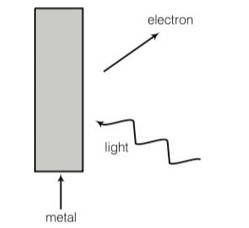
Explanation- During photoelectric emission, the momentum of incident photon is transferred to the metal. At microscopic level, atoms of a metal absorb the photon and its momentum is transferred mainly to the nucleus and electrons.
T
Upvote Consider figure for photoemission. How would you reconcile with momentum conservation ? note light have momentum in a different direction than the emitted electrons.
Consider figure for photoemission. How would you reconcile with momentum conservation ? note light have momentum in a different direction than the emitted electrons.
This is a Short Answer Type Questions as classified in NCERT Exemplar
Explanation- during photoelectric emission the momentum is transferred to metal. metal absorbs absorb the photon and its momentum is transferred, and excited electron emitted.
Upvote A particle moves in a closed orbit around the origin, due to a force which is directed towards the origin. The de-BrOglie wavelength of the particle varies cyclically between two values λ1, λ2 with λ1> λ2 Which of the following statements are true?
(a) The particle could be moving in a circular orbit with origin as centre
(b) The particle could be moving in an elliptic orbit with origin as its focus
(c) When the de-Broglie wavetength is λ1the particle is nearer the origin than when its value is λ2
(d) When the de-Broglie wavelength is λ2 the particle is nearer the origin than when its value is λ1
Answer-(b,d)
A particle moves in a closed orbit around the origin, due to a force which is directed towards the origin. The de-BrOglie wavelength of the particle varies cyclically between two values λ1, λ2 with λ1> λ2 Which of the following statements are true?
(a) The particle could be moving in a circular orbit with origin as centre
(b) The particle could be moving in an elliptic orbit with origin as its focus
(c) When the de-Broglie wavetength is λ1the particle is nearer the origin than when its value is λ2
(d) When the de-Broglie wavelength is λ2 the particle is nearer the origin than when its value is λ1
Answer-(b,d)
This is a Multiple Choice Questions as classified in NCERT Exemplar
Explanation- the debroglie wavelength of the particle can be varying cyclically between two values and , if particle is moving in an elliptical orbit with origin as its focus.

Let v1, v2, be the speed of particle at A and B respec
Upvote Photons absorbed in a matter are converted to heat. A source emitting v photon/sec of frequency v is used to convert 1 kg of ice at 0°C to water at 0°C. Then, the time T taken for the conversion
(a) Decreases with increasing n. with v fixed
(b) Decreases with n fixed, v increasing
(c) Remains constant with n and v changing such that nv = constant
(d) Increases when the product nv increases
Answer-(a,b,c)
Photons absorbed in a matter are converted to heat. A source emitting v photon/sec of frequency v is used to convert 1 kg of ice at 0°C to water at 0°C. Then, the time T taken for the conversion
(a) Decreases with increasing n. with v fixed
(b) Decreases with n fixed, v increasing
(c) Remains constant with n and v changing such that nv = constant
(d) Increases when the product nv increases
Answer-(a,b,c)
This is a Multiple Choice Questions as classified in NCERT Exemplar
Explanation- energy spent to convert into water = mass latent heat
= mL= 1000g 80cal/g
= 80000cal
Energy of phtons used= nT E=nT
So nTh =mL
T= mL/nhv
T 1/n where v is constant
T when n is fixed
T 1/nv
Upvote . De-Broglie wavelength associated with uncharged particles: For Neutron efe-Broglie wavelength is given as ve=c/100.Then
(a) = 10-4 (b) = 10-2 (c) (d)
Answer- (b,c)
. De-Broglie wavelength associated with uncharged particles: For Neutron efe-Broglie wavelength is given as ve=c/100.Then
(a) = 10-4 (b) = 10-2 (c) (d)
Answer- (b,c)
This is a Multiple Choice Questions as classified in NCERT Exemplar
Explanation- =
Ee=1/2meve2
Meve=
Ee= h2/2 e2me
For photon
Ep= hc/ = hc/2
= 100
Pe=meve= me
Upvote