
Exemplar Solution
Get insights from 1.3k questions on Exemplar Solution, answered by students, alumni, and experts. You may also ask and answer any question you like about Exemplar Solution
- 1.3k
Questions
- 0
Discussions
- 0
Active Users
- 0
Followers
Have a question about Exemplar Solution? Ask our experts
Keep it short & simple. Type complete word. Avoid abusive language.
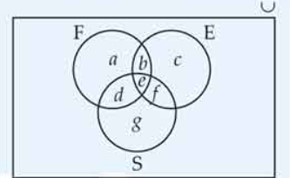
In a group of 50 students, the number of students studying French, English, Sanskrit were found to be as follows:
French = 17, English = 13, Sanskrit = 15
French and English = 09, English and Sanskrit = 4
French and Sanskrit = 5, English, French and Sanskrit = 3. Find the number of students who study
(i) French only
(ii) English only
(iii) Sanskrit only
(iv) French and English but not Sanskrit
(v) At least one of the three languages
(vi) English and Sanskrit
(vii) None of the three languages but not French
 Upvote

In a town of 10,000 families it was found that 40% families buy newspaper A, 20% families buy newspaper B, 10% families buy newspaper C, 5% families buy A and B, 3% buy B and C and 4% buy A and C. If 2% families buy all the three newspapers. Find
(i) The number of families which buy newspaper A only.
(ii) The number of families which buy none of A, B and C
In a survey of 200 students of a school, it was found that 120 study Mathematics, 90 study Physics and 70 study Chemistry, 40 study Mathematics and Physics, 30 study Physics and Chemistry, 50 study Chemistry and Mathematics and 20 none of these subjects. Find the number of students who study all the three subjects.
In a survey of 200 students of a school, it was found that 120 study Mathematics, 90 study Physics and 70 study Chemistry, 40 study Mathematics and Physics, 30 study Physics and Chemistry, 50 study Chemistry and Mathematics and 20 none of these subjects. Find the number of students who study all the three subjects.
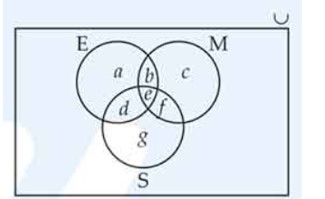
Out of 100 students; 15 passed in English, 12 passed in Mathematics, 8 in science, 6 in English and Mathematics, 7 in Mathematics and Science; 4 in English and Science; 4 in all the three. Find how many passed
(a) In English and Mathematics but not in Science
(b) In Mathematics and Science but not in English
(c) In Mathematics only
(d) In more than one subject only
Let A, B and C be sets. Then show that
A ∩ (B ∪ C) = (A ∩ B) ∪ (A ∩ C)
Let A, B and C be sets. Then show that
A ∩ (B ∪ C) = (A ∩ B) ∪ (A ∩ C)
Let T = xx + 5/x – 7 –5 = 4x – 40/13 – x. Is T an empty set? Justify your answer.
Let T = xx + 5/x – 7 –5 = 4x – 40/13 – x. Is T an empty set? Justify your answer.