
Ncert Solutions Chemistry Class 12th
Get insights from 2.6k questions on Ncert Solutions Chemistry Class 12th, answered by students, alumni, and experts. You may also ask and answer any question you like about Ncert Solutions Chemistry Class 12th
- 2.6k
Questions
- 0
Discussions
- 0
Active Users
- 79
Followers
Have a question about Ncert Solutions Chemistry Class 12th? Ask our experts
Keep it short & simple. Type complete word. Avoid abusive language.
Given below are two statements.
Statement I: Stannane is an example of a molecular hydride.
Statement II: Stannane is a planar molecule.
In the light of the above statement, choose the most appropriate answer from the options given below.
Given below are two statements.
Statement I: Stannane is an example of a molecular hydride.
Statement II: Stannane is a planar molecule.
In the light of the above statement, choose the most appropriate answer from the options given below.
Stannane is the tetrahedral shape of molecule.
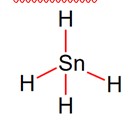
Hybridisation is- sp3, shape and structure are tetrahedral
 Upvote

Liquation refining process is applicable for the metal having low m.p, but containing impurities have higher m.p
Upvote Given below are the critical temperature of some of the gases:
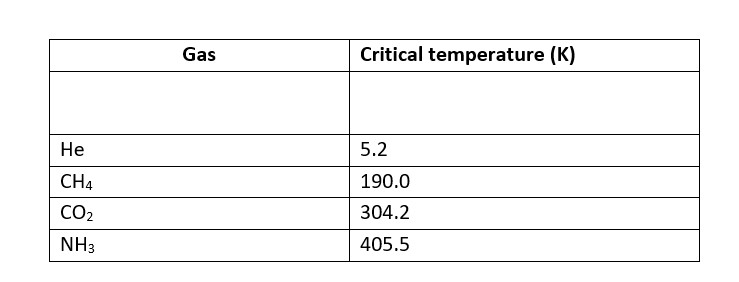
Given below are the critical temperature of some of the gases:
Higher adsorbtion of gas is corresponds to higher liquefaction and higher liquefaction is directly proportional to the higher critical temperature.
Upvote <p><strong>Given below are the critical temperature of some of the gases:</strong></p>
<div class="photo-widget-full">
<div class="figure"><strong><picture><source srcset="" media="(max-width: 500px)"><img src="https://images.shiksha.com/mediadata/images/1753713029php2yn3J5.jpeg" alt="" width="608" height="209" loading="lazy"></picture></strong></div>
<div class="figure">
<p><strong>The gas showing least adsorption on a definite amount of charcoal is</strong></p>
</div>
</div>
<p> </p>
Match List-I with List-II
List – I
List – II
(A)
4NH3(g) + 5O2(g) -> 4NO(g) + 6H2O(g)
(I)
NO(g)
(B)
N2(g) + 3H2(g) -> 2NH3(g)
(II)
H2SO4(I)
(C)
C12H22O11(aq) + H2O(I) -> C6H12O6 + C6H12O6
Glucose Fructose
(III)
Pt(s)
(D)
2SO2(g) + O2(g) -> 2SO3(g)
(IV)
Fe(s)
Choose the correct answer from the options given below
Match List-I with List-II
|
List – I |
List – II |
||
|
(A) |
4NH3(g) + 5O2(g) -> 4NO(g) + 6H2O(g) |
(I) |
NO(g) |
|
(B) |
N2(g) + 3H2(g) -> 2NH3(g) |
(II) |
H2SO4(I) |
|
(C) |
C12H22O11(aq) + H2O(I) -> C6H12O6 + C6H12O6 Glucose Fructose |
(III) |
Pt(s) |
|
(D) |
2SO2(g) + O2(g) -> 2SO3(g) |
(IV) |
Fe(s) |
Choose the correct answer from the options given below
(a) Nitric oxide formation -> Pt is used as catalyst
(b) Haber’s process -> Fe is used as catalyst
(c) Hydrolysis of ester -> Acid (H2SO4) is used as catalyst
(d) SO3 formation -> NO is used as catalyst
Upvote The number of stereoisomers formed in a reaction of
<!-- [if gte mso 9]><xml>
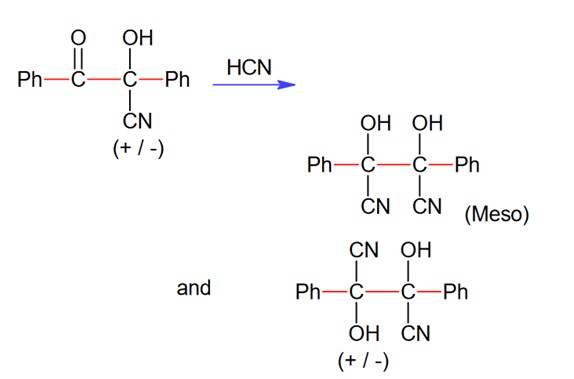
The number of stereoisomers formed in a reaction of
<!-- [if gte mso 9]><xml>
A 1.84 mg sample of polyhydric alcoholic compound ‘X’ of molar mass 92.0 g/mol gave 1.344mL of H2 gas at STP. The number of alcoholic hydrogens present in compound ‘X’ is_________.
A 1.84 mg sample of polyhydric alcoholic compound ‘X’ of molar mass 92.0 g/mol gave 1.344mL of H2 gas at STP. The number of alcoholic hydrogens present in compound ‘X’ is_________.
Mole of polyhydric alcohol =
Mole of H2 gas produced =
No of -OH gp present =
Upvote 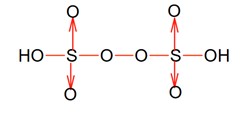
Assuming 1 of trace radioactive element X with a half life of 30 years is absorbed by a growing tree. The amount of X remaining in the tree after 100 years is __________× 10-1 <!-- [if gte mso 9]><xml>
[Given: In 10 = 2.303; log 2 = 0.30]
Assuming 1 of trace radioactive element X with a half life of 30 years is absorbed by a growing tree. The amount of X remaining in the tree after 100 years is __________× 10-1 <!-- [if gte mso 9]><xml>
[Given: In 10 = 2.303; log 2 = 0.30]
Or
Or Nt = 1 × 10⁻¹
Upvote In the below reaction, 5g of toluene is converted into benzaldehyde with 92% yield. The amount of benzaldehyde produced is____________× 10-2 g. (Nearest integer)
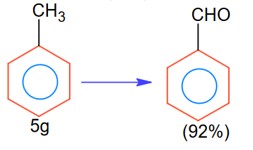
In the below reaction, 5g of toluene is converted into benzaldehyde with 92% yield. The amount of benzaldehyde produced is____________× 10-2 g. (Nearest integer)
No. of moles =
Moles of benzaldehyde =
Mass of benzaldehyde = 5 × 10-2 ×106 = 5.3 gm
= 530 × 10-2 gm
Upvote