
Ncert Solutions Chemistry Class 12th
Get insights from 2.6k questions on Ncert Solutions Chemistry Class 12th, answered by students, alumni, and experts. You may also ask and answer any question you like about Ncert Solutions Chemistry Class 12th
- 2.6k
Questions
- 0
Discussions
- 0
Active Users
- 79
Followers
Have a question about Ncert Solutions Chemistry Class 12th? Ask our experts
Keep it short & simple. Type complete word. Avoid abusive language.
KH value for Ar(g), CO2 (g), HCHO (g) and CH4 (g) are 40.39, 1.67, 1.83×10⁻⁵ and 0.413 respectively. Arrange these gases in the order of their increasing solubility.
(i) HCHO4
(ii) HCHO2< CH4
(iii) Ar2
(iv) Ar4
KH value for Ar(g), CO2 (g), HCHO (g) and CH4 (g) are 40.39, 1.67, 1.83×10⁻⁵ and 0.413 respectively. Arrange these gases in the order of their increasing solubility.
(i) HCHO4
(ii) HCHO2< CH4
(iii) Ar2
(iv) Ar4
This is a multiple choice answer as classified in NCERT Exemplar
(iii) Ar< CO2< CH4< HCHO
Explanation: The higher the KH value, the better. The solubility of a gas at a given pressure will be lower, hence the solubility of given gases will increase as KH values rise.
 Upvote

<p><strong>KH value for Ar(g), CO<sub>2</sub> (g), HCHO (g) and CH<sub>4</sub> (g) are 40.39, 1.67, 1.83×10<sup>-5</sup> and 0.413 respectively. Arrange these gases in the order of their increasing solubility.</strong></p>
<p><strong>(i)</strong> HCHO<ch<sub>4<co2<ar< p=""> </ar<></co</ch</sub></p>
<p><strong>(ii)</strong> HCHO<co<sub>2< CH4<ar< p=""> </ar<></co</sub></p>
<p><strong>(iii)</strong> Ar<co<sub>2<ch4<hcho< p=""> </hcho<></ch</co</sub></p>
<p><strong>(iv)</strong> Ar<ch<sub>4<co2<hcho< p=""> </hcho<></co</ch</sub></p>
On the basis of information given below mark the correct option.
Information: On adding acetone to methanol some of the hydrogen bonds between methanol molecules break.
(i) At specific composition methanol-acetone mixture will form minimum boiling azeotrope and will show positive deviation from Raoult’s law.
(ii) At specific composition methanol-acetone mixture forms maximum boiling azeotrope and will show positive deviation from Raoult’s law.
(iii) At specific composition methanol-acetone mixture will form minimum boiling azeotrope and will show negative deviation from Raoult’s law.
(iv) At specific composition methanol-acetone mixture will form maximum boiling azeotrope and will show negative deviation from Raoult’s law.
This is a multiple choice answer as classified in NCERT Exemplar
(i) At specific composition methanol-acetone mixture will form minimum boiling azeotrope and will show positive deviation from Raoult's law.
Explanation: (i) (A-A) or (B-B) interactions are more powerful than (A-B) interactio
Upvote 4L of 0.02 M aqueous solution of NaCl was diluted by adding one litre of water. The molality of the resultant solution is _____________.
(i) 0.004
(ii) 0.008
(iii) 0.012
(iv) 0.016
4L of 0.02 M aqueous solution of NaCl was diluted by adding one litre of water. The molality of the resultant solution is _____________.
(i) 0.004
(ii) 0.008
(iii) 0.012
(iv) 0.016
This is a multiple choice answer as classified in NCERT Exemplar
(iv) 0.016
Explanation: Apply the relation : M1V1= M2V2
Given: M1=0.02M, V1=4L, M2=? V2=5L
Therefore, 0.02×4L=M2×5L
M2=0.08/5
=0.016 M
Upvote If two liquids A and B form minimum boiling azeotrope at some specific composition then_______________.
(i) A–B interactions are stronger than those between A–A or B–B.
(ii) Vapour pressure of solution increases because more number of molecules of liquids A and B can escape from the solution.
(iii) Vapour pressure of solution decreases because less number of molecules of only one of the liquids escapes from the solution.
(iv) A–B interactions are weaker than those between A–A or B–B.
If two liquids A and B form minimum boiling azeotrope at some specific composition then_______________.
(i) A–B interactions are stronger than those between A–A or B–B.
(ii) Vapour pressure of solution increases because more number of molecules of liquids A and B can escape from the solution.
(iii) Vapour pressure of solution decreases because less number of molecules of only one of the liquids escapes from the solution.
(iv) A–B interactions are weaker than those between A–A or B–B.
This is a multiple choice answer as classified in NCERT Exemplar
(iv) A–B interactions are weaker than those between A–A or B–B.
Explanation: (i) At a given composition, the solutions that demonstrate a big positive divergence from Rault's law form a minimum boiling azeotrope.
(ii) When Rault's law is
Upvote Two beakers of capacity 500 mL were taken. One of these beakers, labelled as “A”, was filled with 400 mL water whereas the beaker labelled “B” was filled with 400 mL of 2 M solution of NaCl. At the same temperature both the beakers were placed in closed containers of same material and same capacity as shown in Fig.2.2. At a given temperature, which of the following statement is correct about the vapour pressure of pure water and that of NaCl solution.

(i) Vapour pressure in container (A) is more than that in container (B).
(ii) Vapour pressure in container (A) is less than that in container (B).
(iii) Vapour pressure is equal in both the containers.
(iv) Vapour pressure in container (B) is twice the vapour pressure in container (A).
Two beakers of capacity 500 mL were taken. One of these beakers, labelled as “A”, was filled with 400 mL water whereas the beaker labelled “B” was filled with 400 mL of 2 M solution of NaCl. At the same temperature both the beakers were placed in closed containers of same material and same capacity as shown in Fig.2.2. At a given temperature, which of the following statement is correct about the vapour pressure of pure water and that of NaCl solution.

(i) Vapour pressure in container (A) is more than that in container (B).
(ii) Vapour pressure in container (A) is less than that in container (B).
(iii) Vapour pressure is equal in both the containers.
(iv) Vapour pressure in container (B) is twice the vapour pressure in container (A).
This is a multiple choice answer as classified in NCERT Exemplar
(i) Vapour pressure in container (A) is more than that in container (B).
Explanation: Due to the fleeing inclinations of water molecules from the liquid's surface, the vapour pressure rises. The vapour pressure increases as the num
Upvote On the basis of information given below mark the correct option. Information:
(A) In bromoethane and chloroethane mixture intermolecular interactions of A–A and B–B type are nearly same as A–B type interactions.
(B) In ethanol and acetone mixture A–A or B–B type intermolecular interactions are stronger than A–B type interactions.
(C) In chloroform and acetone mixture A–A or B–B type intermolecular interactions are weaker than A–B type interactions.
(i) Solution (B) and (C) will follow Raoult’s law.
(ii) Solution (A) will follow Raoult’s law.
(iii) Solution (B) will show negative deviation from Raoult’s law.
(iv) Solution (C) will show positive deviation from Raoult’s law.
On the basis of information given below mark the correct option. Information:
(A) In bromoethane and chloroethane mixture intermolecular interactions of A–A and B–B type are nearly same as A–B type interactions.
(B) In ethanol and acetone mixture A–A or B–B type intermolecular interactions are stronger than A–B type interactions.
(C) In chloroform and acetone mixture A–A or B–B type intermolecular interactions are weaker than A–B type interactions.
(i) Solution (B) and (C) will follow Raoult’s law.
(ii) Solution (A) will follow Raoult’s law.
(iii) Solution (B) will show negative deviation from Raoult’s law.
(iv) Solution (C) will show positive deviation from Raoult’s law.
This is a multiple choice answer as classified in NCERT Exemplar
(ii) Solution (A) will follow Raoult's law.
Explanation: A-A and B-B intermolecular interactions should be almost identical to A-B type interactions in an ideal solution.
Upvote <p><strong>We have three aqueous solutions of NaCl labelled as ‘A’,‘B’ and ‘C’ with</strong></p>
<p><strong>Concentrations 0.1 M, 0.01 M and 0.001 M, respectively. The value of van’t Hoff factor for these solutions will be in the order______.</strong></p>
<p><strong>(i)</strong> iA<ib<ic</p>
<p><strong>(ii)</strong> iA >iB>iC</p>
<p><strong>(iii)</strong> iA=iB=iC</p>
<p><strong>(iv)</strong> iAiC</p>
<p><strong> We have three aqueous solutions of NaCl labelled as ‘A’,‘B’ and ‘C’ with</strong></p>
<p><strong>Concentrations 0.1 M, 0.01 M and 0.001 M, respectively. The value of van’t Hoff factor for these solutions will be in the order______.</strong></p>
<p><strong>(i)</strong> iA<ib<ic< p=""> </ib<ic<></p>
<p><strong>(ii)</strong> iA >iB>iC</p>
<p><strong>(iii)</strong> iA=iB=iC</p>
<p><strong>(iv)</strong> iAiC</p>
Consider the Fig. 2.1 and mark the correct option.
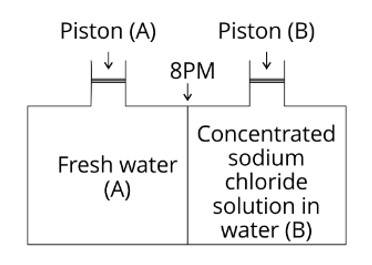
(i) Water will move from side (A) to side(B) if a pressure lower than osmotic pressure is applied on piston (B).
(ii) Water will move from side (B) to side (A) if a pressure greater than osmotic pressure is applied on piston (B).
(iii) Water will move from side (B) to side (A) if a pressure equal to osmotic pressure is applied on piston (B).
(iv) Water will move from side (A) to side (B) if pressure equal to osmotic pressure is applied on piston (A).
Consider the Fig. 2.1 and mark the correct option.
(i) Water will move from side (A) to side(B) if a pressure lower than osmotic pressure is applied on piston (B).
(ii) Water will move from side (B) to side (A) if a pressure greater than osmotic pressure is applied on piston (B).
(iii) Water will move from side (B) to side (A) if a pressure equal to osmotic pressure is applied on piston (B).
(iv) Water will move from side (A) to side (B) if pressure equal to osmotic pressure is applied on piston (A).
This is a multiple choice answer as classified in NCERT Exemplar
(ii) Water will move from side (B) to side (A) if a pressure greater than osmotic pressure is applied on piston (B).
Explanation: Due to reverse osmosis, water will travel from side (B) to side (A) if a pressure greater than
Upvote