
Ncert Solutions Chemistry Class 12th
Get insights from 2.6k questions on Ncert Solutions Chemistry Class 12th, answered by students, alumni, and experts. You may also ask and answer any question you like about Ncert Solutions Chemistry Class 12th
- 2.6k
Questions
- 0
Discussions
- 0
Active Users
- 79
Followers
Have a question about Ncert Solutions Chemistry Class 12th? Ask our experts
Keep it short & simple. Type complete word. Avoid abusive language.
4.37 The decomposition of A into product has value of k as 4.5× 10³ s–1 at 10°C and energy of activation 60 kJ mol–1. At what temperature would k be 1.5 × 10⁴s–1?
4.37 The decomposition of A into product has value of k as 4.5× 10³ s–1 at 10°C and energy of activation 60 kJ mol–1. At what temperature would k be 1.5 × 10⁴s–1?
4.37 From Arrhenius equation, we obtain
Also, k1 = 4.5 × 10³ s -1
T1 = 273 + 10 = 283 K
k2 = 1.5 × 10⁴ s -1
Ea = 60 kJ mol -1 = 6.0 × 10⁴ J mol -1
Then,
→ 0.5229 = 3133.627 × (T2-283)/ (283 × T2)
→ 0.0472T2 = T2-283 T2 = 297K or T2 = 240 C
 Upvote

4.36 The rate constant for the first order decomposition of H2O2 is given by the following equation: log k = 14.34 – 1.25 × 10⁴K/T. Calculate Ea for this reaction and at what temperature will its half-period be 256 minutes?
4.36 The rate constant for the first order decomposition of H2O2 is given by the following equation: log k = 14.34 – 1.25 × 10⁴K/T. Calculate Ea for this reaction and at what temperature will its half-period be 256 minutes?
4.36 We know, The Arrhenius equation is given by k = Ae-Ea/RT Taking natural log on both sides,
Ln k = ln A- (Ea/RT)
Thus, log k = log A - (Ea/2.303RT). eqn 1
The given equation is log k = 14.34 – 1.25 * 104K/T. eqn 2
Comparing 2 equations, Ea/2.303R = 1.25 * 104K
Ea = 1.25 * 104K * 2.303 * 8.314
Ea
Upvote 4.35 The decomposition of hydrocarbon follows the equation k = (4.5 × 10¹¹s–1) e-28000K/T. Calculate Ea
4.35 The decomposition of hydrocarbon follows the equation k = (4.5 × 10¹¹s–1) e-28000K/T. Calculate Ea
4.35 The given equation is
k = (4.5 x 10¹¹ s-1) e-28000K/T (i)
Comparing, Arrhenius equation
k = Ae -E/RT (ii)
We get, Ea / RT = 28000K / T
⇒Ea = R x 28000K
= 8.314 J K-1mol-1 × 28000 K
= 232792 J mol–1 or 232.792 kJ mol–1
Upvote 4.34 Sucrose decomposes in acid solution into glucose and fructose according to the first order rate law, with t 1/2 = 3.00 hours. What fraction of sample of sucrose remains after 8 hours?
4.34 Sucrose decomposes in acid solution into glucose and fructose according to the first order rate law, with t 1/2 = 3.00 hours. What fraction of sample of sucrose remains after 8 hours?
4.34 t1/2 = 3.00 hours
We know, t1/2 = 0.693/k
? k = 0.693/3 k = 0.231 hrs-1
We know, time
Where, k- rate constant
[R]° -Initial concentration
[R]-Concentration at time 't'
Thus, substituting the values,
log ( [R]0/ [R]) = 0.8
log ( [R]/ [R]0) = -0.8
[R]/ [R]0 = 0.158
Hence, 0.158 fraction of
Upvote 4.33 Consider a certain reaction A → Products with k = 2.0 × 10 –2s –1. Calculate the concentration of A remaining after 100 s if the initial concentration of A is 1.0 mol L–1
4.33 Consider a certain reaction A → Products with k = 2.0 × 10 –2s –1. Calculate the concentration of A remaining after 100 s if the initial concentration of A is 1.0 mol L–1
4.33 Given,
k = 2.0 * 10–2s-1
time t = 100s
Concentration [A0] = 1.0 mol L-1
We know,
On substituting the values, Log (1/ [A]) = 2.303/2
Log [A] = -2.303/2 [A] = 0.135 mol L–1
Upvote 4.32 The rate constant for the decomposition of hydrocarbons is 2.418 × 10⁻⁵s – 1 at 546 K. If the energy of activation is 179.9 kJ/mol, what will be the value of pre-exponential factor?
4.32 The rate constant for the decomposition of hydrocarbons is 2.418 × 10⁻⁵s – 1 at 546 K. If the energy of activation is 179.9 kJ/mol, what will be the value of pre-exponential factor?
4.32 Given,
k = 2.418 * 10-5 s-1
T = 546 K
Ea = 179.9 kJ mol-1 = 179.9 * 103J mol-1
The Arrhenius equation is given by k = Ae-Ea/RT Taking natural log on both sides,
Ln k = ln A- (Ea/RT) Substituting the values,
ln (2.418 * 10-5 ) = ln A-179.9/ (8.314 * 546)
ln A = 12.5917
A = 3.9 * 1012 s-1 (approx
Upvote 4.31 The rate constant for the decomposition of N2O5 at various temperatures is given below:
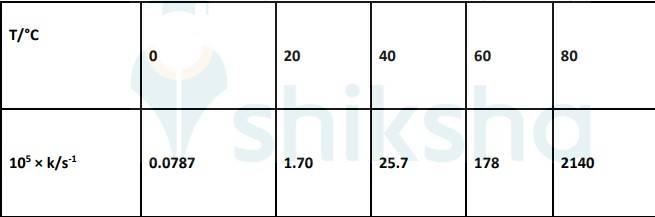
Draw a graph between ln k and 1/T and calculate the values of A and Ea . Predict the rate constant at 30° and 50°C.
4.31 The rate constant for the decomposition of N2O5 at various temperatures is given below:
Draw a graph between ln k and 1/T and calculate the values of A and Ea . Predict the rate constant at 30° and 50°C.
4.31 To convert the temperature in °C to °K we add 273 K.

The graph is given as:
The Arrhenius equation is given by k = Ae-Ea/RT
Where, k- Rate constant
A- Constant
Ea-Activation Energy
R- Gas constant
T-Temperature
Taking natural log on both sides,
ln k = ln A- (Ea/RT). equation 1
By plotting a graph,
Upvote 4.30 The following data were obtained during the first order thermal decomposition of SO2Cl2 at a constant volume. SO2Cl2(g)→ SO2(g) + Cl2(g)
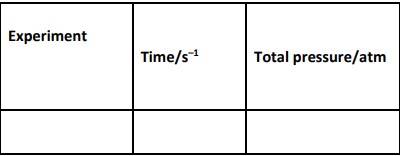
Calculate the rate of the reaction when total pressure is 0.65 atm.
4.30 The following data were obtained during the first order thermal decomposition of SO2Cl2 at a constant volume. SO2Cl2(g)→ SO2(g) + Cl2(g)
Calculate the rate of the reaction when total pressure is 0.65 atm.
4.30 When t = 0, the total partial pressure is P0 = 0.5 atm

When time t = t, the total partial pressure is Pt = P0 + p
P0-p = Pt-2p, but by the above equation, we know p = Pt-P0
Hence, P0-p = Pt-2 (Pt-P0)
Thus, P0-p = 2P0 – Pt
We know that time
t= 2.303/K log R0 / R
Where, k- rate constant
[R]° -Initi
Upvote 4.29 For the decomposition of azoisopropane to hexane and nitrogen at 543 K, the following data are obtained.
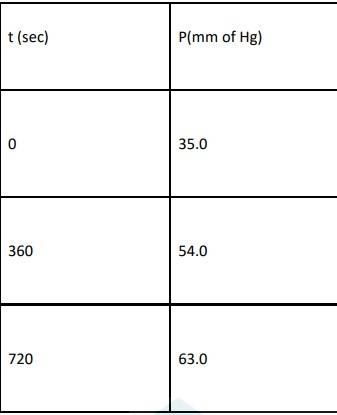
Calculate the rate constant.
4.29 For the decomposition of azoisopropane to hexane and nitrogen at 543 K, the following data are obtained.
Calculate the rate constant.
4.29 When t = 0, the total partial pressure is P0 = 35.0 mm of Hg

When time t = t, the total partial pressure is Pt = P0 + p
P0-p = Pt-2p, but by the above equation, we know p = Pt-P0 Hence, P0-p = Pt-2 ( Pt-P0)
Thus, P0-p = 2P0 – Pt
We know that time
t= 2.303/K log R0 / R
Where, k- rate constant
[R]° -In
Upvote