Ncert Solutions Maths class 12th

Get insights from 2.5k questions on Ncert Solutions Maths class 12th, answered by students, alumni, and experts. You may also ask and answer any question you like about Ncert Solutions Maths class 12th

  • 2.5k

    Questions

  • 0

    Discussions

  • 0

    Active Users

  • 65

    Followers

Have a question about Ncert Solutions Maths class 12th? Ask our experts

Ask Your Question

Keep it short & simple. Type complete word. Avoid abusive language.

New answer posted•a year ago
S
a year ago

This is a Short Answer Type Questions as classified in NCERT Exemplar

Sol:

Thumbs Up IconUpvote Thumbs Down Icon
New answer posted•a year ago
S
a year ago

This is a Short Answer Type Questions as classified in NCERT Exemplar

Sol:

L e t                                   y = s i n x 2 + s i n 2 x + s i n 2 ( x 2 ) D i f f e r e n t i a t i n g     b o t h     s i d e s     w . r . t .     x                         d y d x = d d x s i n ( x 2 ) + 2 s i n x . d d x ( s i n x ) + 2 s i n ( x 2 ) d d x s i n ( x 2 )                                       = c o s x 2 . d d x ( x 2 ) + 2 s i n x . d d x ( s i n x ) + 2 s i n ( x 2 ) d d x s i n ( x 2 )                                       = c o s x 2 . 2 x + 2 s i n x . c o s x + 2 s i n x 2 . c o s x 2 . d d x ( x 2 )                                       = 2 x . c o s x 2 + s i n 2 x + 2 s i n x 2 . c o s x 2 . 2 x                                       = 2 x . c o s x 2 + s i n 2 x + 2 x s i n 2 x 2 H e n c e ,     d y d x = 2 x . c o s x 2 + s i n 2 x + 2 x s i n 2 x 2

Thumbs Up IconUpvote Thumbs Down Icon
New answer posted•a year ago
S
a year ago

This is a Short Answer Type Questions as classified in NCERT Exemplar

Sol:

Thumbs Up IconUpvote Thumbs Down Icon
New answer posted•a year ago
S
a year ago

This is a Short Answer Type Questions as classified in NCERT Exemplar

Sol:

Let                 y=sinn(ax2+bx+c)Differentiating  both  sides  w.r.t.  x⇒      dydx=ddxsinn(ax2+bx+c)⇒              =n.sinn−1(ax2+bx+c).ddxsin(ax2+bx+c)                   =n.sinn−1(ax2+bx+c).cos(ax2+bx+c).ddx(ax2+bx+c)                   =n.sinn−1(ax2+bx+c).cos(ax2+bx+c).(2ax+b)Hence,  dydx=n(2ax+b).sinn−1(ax2+bx+c).cos(ax2+bx+c).

Thumbs Up IconUpvote Thumbs Down Icon
New answer posted•a year ago
S
a year ago

This is a Short Answer Type Questions as classified in NCERT Exemplar

Sol:
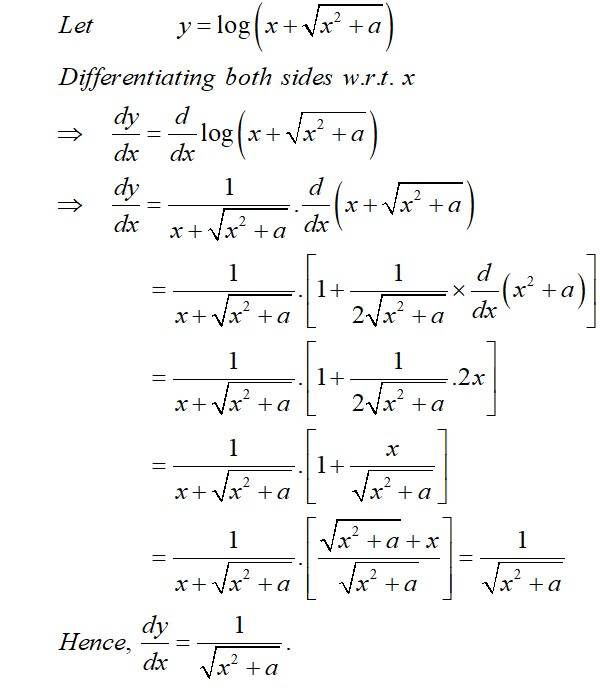
Thumbs Up IconUpvote Thumbs Down Icon
New answer posted•a year ago
S
a year ago

This is a Short Answer Type Questions as classified in NCERT Exemplar

Sol:

L e t                                   y = l o g [ l o g ( l o g x 5 ) ] D i f f e r e n t i a t i n g     b o t h     s i d e s     w . r . t .     x ⇒             d y d x = d d x l o g [ l o g ( l o g x 5 ) ] ⇒              =1log(logx5)×ddxlog(logx5)                                       = 1 log(logx5) × 1 l o g ( x 5 ) × d d x l o g x 5                                       = 1 log(logx5) × 1 l o g ( x 5 ) × 1 x 5 . d d x x 5                                       = 1 log(logx5) × 1 l o g ( x 5 ) × 1 x 5 . 5 x 4                                       = 5 xlog(x5).loglog(x5) H e n c e ,     d y d x = 5 xlog(x5).loglog(x5) .

Thumbs Up IconUpvote Thumbs Down Icon
New answer posted•a year ago
S
a year ago

This is a Short Answer Type Questions as classified in NCERT Exemplar

Sol:

Thumbs Up IconUpvote Thumbs Down Icon
New answer posted•a year ago
S
a year ago

This is a Short Answer Type Questions as classified in NCERT Exemplar

Sol:

Let                 y=8xx8Taking  log  on  both  sides,  we  get,   logy=log8xx8⇒          logy=log8x−logx8     ⇒ logy=xlog8−8logxDifferentiating  both  sides  w.r.t.  x⇒      1y.dydx=log8.1−8x⇒      1y.dydx=y[log8−8x]Hence,  dydx=8xx8[log8−8x]

Thumbs Up IconUpvote Thumbs Down Icon
New answer posted•a year ago
S
a year ago

This is a Short Answer Type Questions as classified in NCERT Exemplar

Sol:

L e t                                   y = 2 c o s 2 x T a k i n g     l o g     o n     b o t h     s i d e s ,     w e     g e t                           l o g y = l o g 2 c o s 2 x D i f f e r e n t i a t i n g     b o t h     s i d e s     w . r . t .     x ⇒             1 y . d y d x = l o g 2 . d d x c o s 2 x ⇒             1 y . d y d x = l o g 2 . [ 2 c o s x . d d x c o s x ] ⇒             1 y . d y d x = l o g 2 . [ 2 c o s x ( − s i n x ) ] ⇒             1 y . d y d x = l o g 2 ( − s i n 2 x ) ⇒             d y d x = − y . l o g 2 s i n 2 x H e n c e ,     d y d x = − 2 c o s 2 x ( l o g 2 s i n 2 x )

Thumbs Up IconUpvote Thumbs Down Icon
New answer posted•a year ago
S
a year ago

This is a Short Answer Type Questions as classified in NCERT Exemplar

Sol:

G i v e n     t h a t     f : R → R     s a t i s f i e s     t h e     e q u a t i o n     f ( x + y ) = f ( x ) . f ( y )     ∀ x , y ∈ R ,     f ( x ) ≠ 0 . Let  us  take  any  point  x=0  at  which  the  function  f(x)  is  differentiable. ∴                         f ' ( 0 ) = l i m h → 0 f ( 0 + h ) − f ( 0 ) h                                                   2 = l i m h → 0 f ( 0 ) . f ( h ) − f ( 0 ) h                   [ ? f ( 0 ) = f ( h ) ]                           … ( 1 )                                                   2 = l i m h → 0 f ( 0 ) . [ f ( h ) − 1 ] h N o w ,         f ' ( x ) = l i m h → 0 f ( x + h ) − f ( x ) h                                                           = l i m h → 0 f ( x ) . f ( h ) − f ( x ) h                   [ ? f ( x + y ) = f ( x ) . f ( y ) ]                                                           = l i m h → 0 f ( x ) . [ f ( h ) − 1 ] h = 2 f ( x )             [ F r o m     e q     ( 1 ) ] H e n c e ,   f ' ( x ) = 2 f ( x )

Thumbs Up IconUpvote Thumbs Down Icon