
Ncert Solutions Maths class 12th
Get insights from 2.5k questions on Ncert Solutions Maths class 12th, answered by students, alumni, and experts. You may also ask and answer any question you like about Ncert Solutions Maths class 12th
- 2.5k
Questions
- 0
Discussions
- 0
Active Users
- 65
Followers
Have a question about Ncert Solutions Maths class 12th? Ask our experts
Keep it short & simple. Type complete word. Avoid abusive language.
Explain why the experiment of tossing a coin three times is said to have binomial distribution.
Explain why the experiment of tossing a coin three times is said to have binomial distribution.
This is a Short Answer Type Questions as classified in NCERT Exemplar
Sol:
 Upvote

Two dice are thrown together and the total score is noted. The events E, F, and G are ‘a total of 4’, ‘a total of 9 or more’, and ‘a total divisible by 5’, respectively.
Calculate , , and and decide which pairs of events, if any, are independent.
Two dice are thrown together and the total score is noted. The events E, F, and G are ‘a total of 4’, ‘a total of 9 or more’, and ‘a total divisible by 5’, respectively.
Calculate , , and and decide which pairs of events, if any, are independent.
This is a Short Answer Type Questions as classified in NCERT Exemplar
Sol:
Upvote A bag contains 5 red marbles and 3 black marbles. Three marbles are drawn one by one without replacement. What is the probability that at least one of the three marbles drawn be black, if the first marble is red?
A bag contains 5 red marbles and 3 black marbles. Three marbles are drawn one by one without replacement. What is the probability that at least one of the three marbles drawn be black, if the first marble is red?
This is a Short Answer Type Questions as classified in NCERT Exemplar
Sol:
Upvote The probability that at least one of the two events A and B occurs is 0.6. If A and B occur simultaneously with probability 0.3, evaluate ) .
The probability that at least one of the two events A and B occurs is 0.6. If A and B occur simultaneously with probability 0.3, evaluate ) .
This is a Short Answer Type Questions as classified in NCERT Exemplar
Sol:
Upvote Refer to Exercise 1 above. If the die were fair, determine whether or not the events A and B are independent.
Refer to Exercise 1 above. If the die were fair, determine whether or not the events A and B are independent.
This is a Short Answer Type Questions as classified in NCERT Exemplar
Sol:
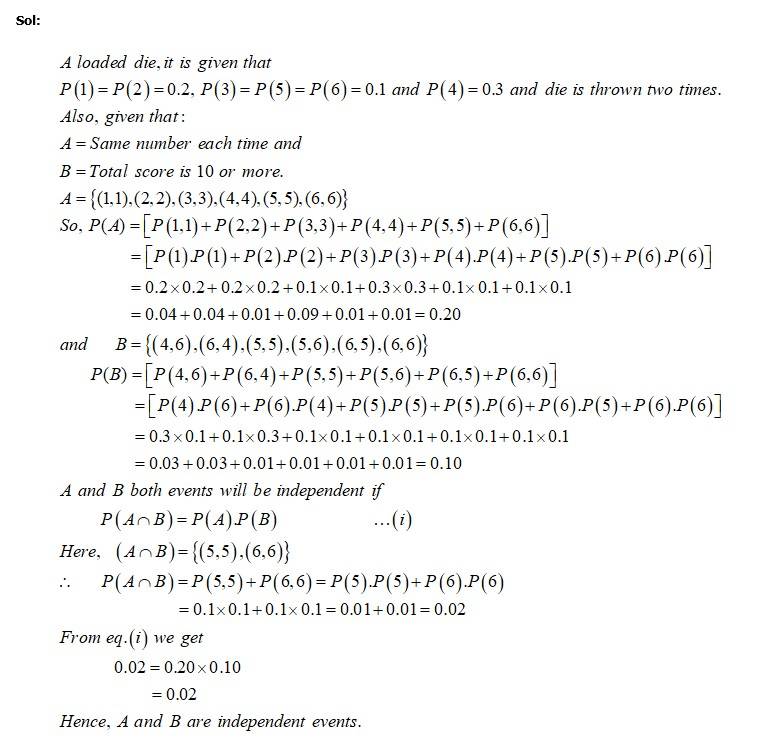
Upvote For a loaded die, the probabilities of outcomes are given as under:
and .
The die is thrown two times. Let A and B be the events, ‘same number each time’, and ‘a total score is 10 or more’, respectively. Determine whether or not A and B are independent.
For a loaded die, the probabilities of outcomes are given as under:
and .
The die is thrown two times. Let A and B be the events, ‘same number each time’, and ‘a total score is 10 or more’, respectively. Determine whether or not A and B are independent.
This is a Short Answer Type Questions as classified in NCERT Exemplar
Upvote There are 5 cards numbered 1 to 5, one number on each card. Two cards are drawn at random without replacement. Let denote the sum of the numbers on the two cards drawn. Find the mean and variance of .
There are 5 cards numbered 1 to 5, one number on each card. Two cards are drawn at random without replacement. Let denote the sum of the numbers on the two cards drawn. Find the mean and variance of .
This is a Long Answer Type Questions as classified in NCERT Exemplar
Sol:
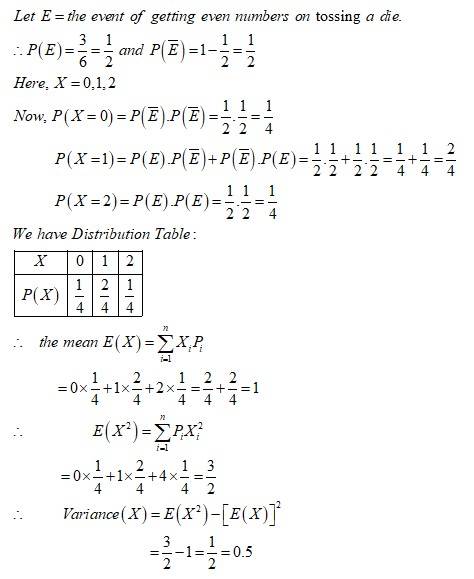
Upvote A die is tossed twice. A ‘success’ is getting an even number on a toss. Find the variance of the number of successes.
A die is tossed twice. A ‘success’ is getting an even number on a toss. Find the variance of the number of successes.
This is a Long Answer Type Questions as classified in NCERT Exemplar
Sol:
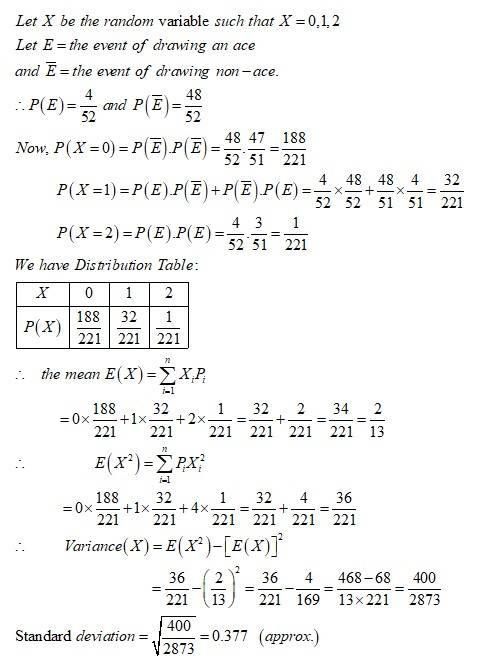
Upvote Two cards are drawn successively without replacement from a well-shuffled deck of cards. Find the mean and standard deviation of the random variable , where is the number of aces
Two cards are drawn successively without replacement from a well-shuffled deck of cards. Find the mean and standard deviation of the random variable , where is the number of aces
This is a Long Answer Type Questions as classified in NCERT Exemplar
Sol:
 Upvote
A bag contains coins. It is known that of these coins have a head on both sides, while the rest of the coins are fair. A coin is picked at random from the bag and tossed. If the probability that the toss results in a head is , determine the value of .
A bag contains coins. It is known that of these coins have a head on both sides, while the rest of the coins are fair. A coin is picked at random from the bag and tossed. If the probability that the toss results in a head is , determine the value of .
This is a Long Answer Type Questions as classified in NCERT Exemplar
Sol:
Upvote