
Ncert Solutions Maths class 12th
Get insights from 2.5k questions on Ncert Solutions Maths class 12th, answered by students, alumni, and experts. You may also ask and answer any question you like about Ncert Solutions Maths class 12th
- 2.5k
Questions
- 0
Discussions
- 0
Active Users
- 65
Followers
Have a question about Ncert Solutions Maths class 12th? Ask our experts
Keep it short & simple. Type complete word. Avoid abusive language.
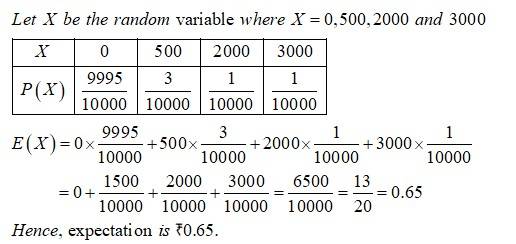
Suppose 10,000 tickets are sold in a lottery, each for Re 1. First prize is of Rs 3000 and the second prize is of Rs 2000. There are three third prizes of Rs 500 each. If you buy one ticket, what is your expectation?
Suppose 10,000 tickets are sold in a lottery, each for Re 1. First prize is of Rs 3000 and the second prize is of Rs 2000. There are three third prizes of Rs 500 each. If you buy one ticket, what is your expectation?
This is a Short Answer Type Questions as classified in NCERT Exemplar
Sol:
 Upvote

Three dice are thrown at the same time. Find the probability of getting three twos, if it is known that the sum of the numbers on the dice was six.
Three dice are thrown at the same time. Find the probability of getting three twos, if it is known that the sum of the numbers on the dice was six.
This is a Short Answer Type Questions as classified in NCERT Exemplar
Sol:
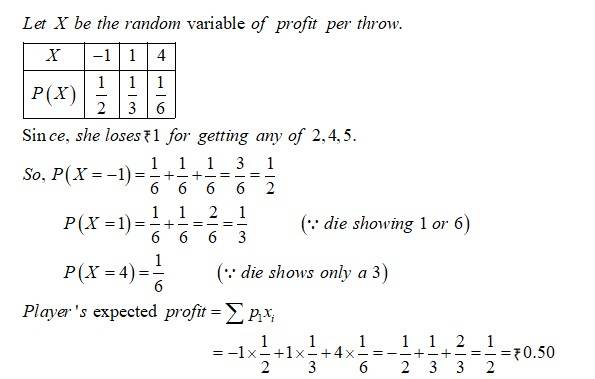
Upvote In a dice game, a player pays a stake of Re1 for each throw of a die. She receives Rs 5 if the die shows a 3, Rs 2 if the die shows a 1 or 6, and nothing otherwise. What is the player’s expected profit per throw over a long series of throws?
In a dice game, a player pays a stake of Re1 for each throw of a die. She receives Rs 5 if the die shows a 3, Rs 2 if the die shows a 1 or 6, and nothing otherwise. What is the player’s expected profit per throw over a long series of throws?
This is a Short Answer Type Questions as classified in NCERT Exemplar
Sol:
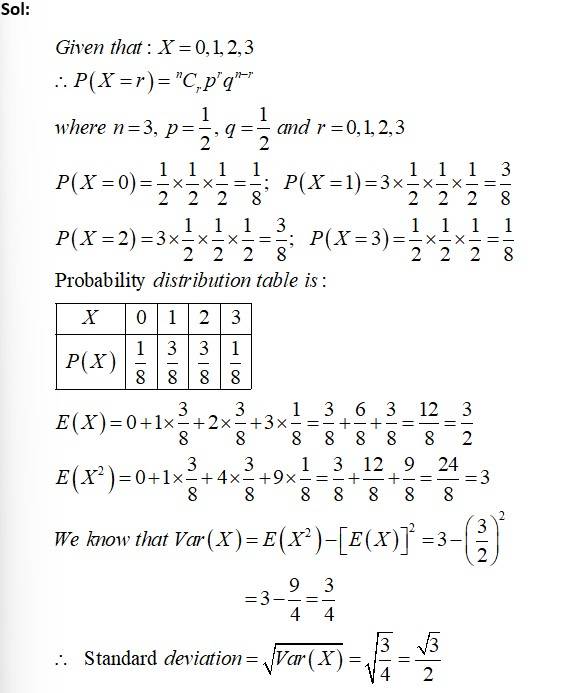
Upvote If X is the number of tails in three tosses of a coin, determine the standard deviation of X.
If X is the number of tails in three tosses of a coin, determine the standard deviation of X.
This is a Short Answer Type Questions as classified in NCERT Exemplar
Upvote This is a Short Answer Type Questions as classified in NCERT Exemplar
Sol:
Upvote A discrete random variable X has the probability distribution given as below:
X
0.5
1
1.5
2
P(X)
k
k2
2k2
k
i. Find the value of k
ii. Determine the mean of the distribution.
A discrete random variable X has the probability distribution given as below:
|
X |
0.5 |
1 |
1.5 |
2 |
|
P(X) |
k |
k2 |
2k2 |
k |
i. Find the value of k
ii. Determine the mean of the distribution.
This is a Short Answer Type Questions as classified in NCERT Exemplar
Sol:
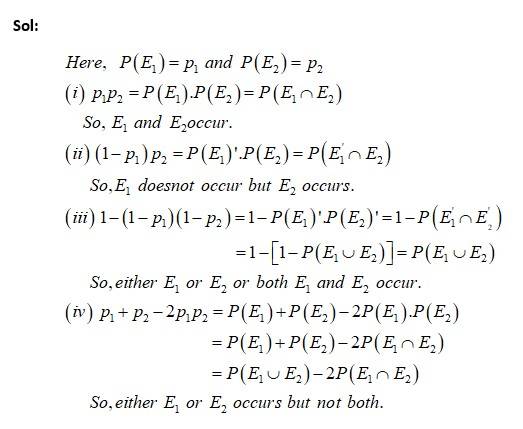
Upvote Let and be two independent events such that and .
Describe in words the events whose probabilities are:
Let and be two independent events such that and .
Describe in words the events whose probabilities are:
This is a Short Answer Type Questions as classified in NCERT Exemplar
Upvote Three events A, B, and C have probabilities , and , respectively. Given that and , find the values of and .
Three events A, B, and C have probabilities , and , respectively. Given that and , find the values of and .
This is a Short Answer Type Questions as classified in NCERT Exemplar
Sol:
Upvote <p><strong>Three events A, B, and C have probabilities <math><mrow><mi>P</mi><mrow><mo>(</mo><mrow><mi>A</mi></mrow><mo>)</mo></mrow><mo>=</mo><mfrac><mrow><mn>2</mn></mrow><mrow><mn>5</mn></mrow></mfrac></mrow></math> , <math><mrow><mo> </mo><mfrac><mrow><mn>1</mn></mrow><mrow><mn>3</mn></mrow></mfrac></mrow></math> and <math><mrow><mfrac><mrow><mn>1</mn></mrow><mrow><mn>2</mn></mrow></mfrac></mrow></math> , respectively. Given that <math><mrow><mi>P</mi><mrow><mo>(</mo><mrow><mi>A</mi><mo>∩</mo><mi>C</mi></mrow><mo>)</mo></mrow><mo>=</mo><mfrac><mrow><mn>1</mn></mrow><mrow><mn>5</mn></mrow></mfrac></mrow></math> and <math><mrow><mi>P</mi><mrow><mo>(</mo><mrow><mi>B</mi><mo>∩</mo><mi>C</mi></mrow><mo>)</mo></mrow><mo>=</mo><mfrac><mrow><mn>1</mn></mrow><mrow><mn>4</mn></mrow></mfrac></mrow></math> , find the values of <math><mrow><mi>P</mi><mrow><mo>(</mo><mrow><mi>C</mi><mo>?</mo><mi>B</mi></mrow><mo>)</mo></mrow></mrow></math> and <math><mrow><mi>P</mi><mrow><mo>(</mo><mrow><msup><mi>A</mi><mo>′</mo></msup><mo>∩</mo><msup><mi>C</mi><mo>′</mo></msup></mrow><mo>)</mo></mrow></mrow></math> .</strong></p>
This is a Short Answer Type Questions as classified in NCERT Exemplar
Sol:
Upvote