
Sequence and Series
Get insights from 114 questions on Sequence and Series, answered by students, alumni, and experts. You may also ask and answer any question you like about Sequence and Series
- 114
Questions
- 0
Discussions
- 0
Active Users
- 1
Followers
Have a question about Sequence and Series? Ask our experts
Keep it short & simple. Type complete word. Avoid abusive language.
80. Find the sum of all two digit numbers which when divided by 4, yields 1 as remainder
80. Find the sum of all two digit numbers which when divided by 4, yields 1 as remainder
80. Two digits no. when divided by 4 yields 1 as remainder are, 12+1, 16+1, 20+1 …., 96+1
13, 17, 21, ………97 which forms an A.P.
So, a = 13
Sum of numbers in A.P. =
= 11× 110
= 1210
 Upvote

79. Find the sum of integers from 1 to 100 that are divisible by 2 or 5.
79. Find the sum of integers from 1 to 100 that are divisible by 2 or 5.
79. An A.P. of numbers from 1 to 100 divisible by 2 is
2, 4, 6, ……….98, 100.
So, a = 2 and d = 4-2 = 2
100
Let,
= 2550
Similarly, an A.P. of numbers from 1 to 100 divisible by 5 is
5,10,15, ……. 95,100
So, a = 5 and d = 100
100
= 1050
As there are also no divisible by both 2 and 5 , i.e.,
Upvote 78. The smallest and largest no. between 200 and 400 which are divisible by 7 is
78. The smallest and largest no. between 200 and 400 which are divisible by 7 is
78.
So we can form an A.P. 203,203+7, …., 399-7, 399
So, i.e. a = 203 and d = 7
l = 399
Sum of the 29 number of the AP = Required sum =
= 8729.
Upvote 77. Let the sum of n, 2n, 3n terms of an A.P. be S1, S2 and S3, respectively, show that S3 = 3(S2 – S1)
77. Let the sum of n, 2n, 3n terms of an A.P. be S1, S2 and S3, respectively, show that S3 = 3(S2 – S1)
77. Let a and d be the first term and common difference of an A.P.
Then,
Now, R.H.S
Upvote 76. If the sum of three numbers in A.P., is 24 and their product is 440, find the numbers.
76. If the sum of three numbers in A.P., is 24 and their product is 440, find the numbers.
76. Let the three numbers a d, a, a + d be in A.P.
Then,
3a = 24
a = 8
and,
Put,
When d = 3, a = 8 the three number are.
8 3, 8, 8 + 3 5,8,11
When d = 3, a = 8 the three numbers are.
Upvote Class 11 Sequence And Series Miscellaneous Exercise NCERT Solution
75. Show that the sum of (m + n)th and (m – n)th terms of an A.P. is equal to twice the mth term.
Class 11 Sequence And Series Miscellaneous Exercise NCERT Solution
75. Show that the sum of (m + n)th and (m – n)th terms of an A.P. is equal to twice the mth term.
75. Let a and d be the first term and common difference of the A.P.
So,
= 2 am
Upvote Find the sum to n terms of the series in Exercises 72 to 74 whose nth terms is given by
72. n(n+1) (n+4).
Find the sum to n terms of the series in Exercises 72 to 74 whose nth terms is given by
72. n(n+1) (n+4).
72. Given that,
an = n(n + 1)(n + 4)
= n(n2 + 4n + n + 4)
=n(n2 + 5n + 4)
= x3 + 5x2 + 4x
So, sum of terms, Sn =
Upvote 71. The given series is 12 + (12 + 22) + (12 + 22 + 32) + …
So, nth term well be
an =12 + 22 + 32 + … + n2.
So, Sn =
Upvote 70. The given series is 3 8 + 11 + 9 14 + …
So, an= (nth term of 3, 6, 9, …) (nth term of 8, 11, 14, …)
i e, a = 3, d = 6- 3 = 3i e, a= 8, d = 11- 8 = 3
= [3 + (n- 1) 3] [8 + (n -1) 3]
= [3 + 3n- 3] [8 + 3n -3]
= 3n (3n + 5)
= 9n2 + 15n.
So, Sn = 9∑n2 + 15∑ n.
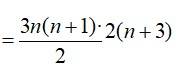
= 3n (n + 1) (n + 3)
Upvote 69. The given series is 52 + 62 + 72 + … + 202
This can be rewritten as (12 +22 + 32 + 42 + 52 + 62 + 72 + … + 202) - (12 + 22 + 32 + 42)
So, sum = (12 + 22 + 32 + 42 … + 202) - (12 + 22+ 32 + 42)
= 2870 30
= 2840.
Upvote