
Surface Tension
Get insights from 6 questions on Surface Tension, answered by students, alumni, and experts. You may also ask and answer any question you like about Surface Tension
- 6
Questions
- 0
Discussions
- 0
Active Users
- 0
Followers
Have a question about Surface Tension? Ask our experts
Keep it short & simple. Type complete word. Avoid abusive language.
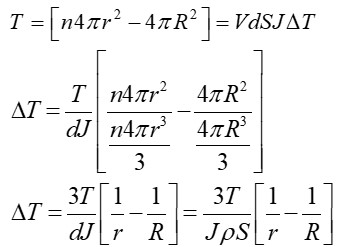
n droplets of water each of radius r coalesce to form a big drop of radius R. If the energy released during coalescence goes into heating the drop, then the rise in temperature will be (take T as surface tension of water and J as mechanical equivalent of heat)
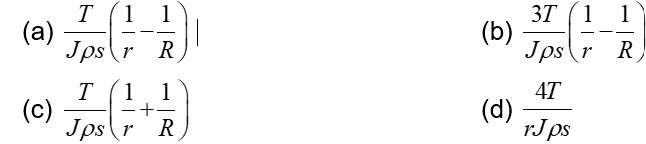
n droplets of water each of radius r coalesce to form a big drop of radius R. If the energy released during coalescence goes into heating the drop, then the rise in temperature will be (take T as surface tension of water and J as mechanical equivalent of heat)
A water drop of diameter 2 cm is broken into 64 equal droplets. The surface tension of water is 0.075N/m. In this process the gain in surface energy will be:
A water drop of diameter 2 cm is broken into 64 equal droplets. The surface tension of water is 0.075N/m. In this process the gain in surface energy will be:
Gain in surface energy,
from volume centenary,
Initial surface area, Ai = 4pR2
final surface area,
 Upvote

If temperature of a liquid is increased, choose the correct option regarding change in its surface tension and viscosity.
<!-- [if !supportLineBreakNewLine]-->
<!--[endif]-->
If temperature of a liquid is increased, choose the correct option regarding change in its surface tension and viscosity.
<!-- [if !supportLineBreakNewLine]-->
<!--[endif]-->
Fact. Due to decrease in intermolecular forces
Upvote When two soap bubbles of radii a and b (b > a) coalesce, the radius of curvature of common surface is:
<!-- [if !supportLineBreakNewLine]-->
<!--[endif]-->
<!--[endif]-->
When two soap bubbles of radii a and b (b > a) coalesce, the radius of curvature of common surface is:
<!-- [if !supportLineBreakNewLine]-->
<!--[endif]-->
<!--[endif]-->
P? - P? = 4T/a
P? - P? = 4T/b
P? - P? = 4T (1/a - 1/b)
Also, P? - P? = 4T/r
4T/r = 4T (1/a - 1/b)
1/r = (b-a)/ab
r = ab / (b-a)
Upvote A large number of water drops, each of radius r, combine to have a drop of radius R. If the surface tension is T and mechanical equivalent of heat is J, the rise in heat energy per unit volume will be
A large number of water drops, each of radius r, combine to have a drop of radius R. If the surface tension is T and mechanical equivalent of heat is J, the rise in heat energy per unit volume will be
From volume conservation
Decrease in surface area =
Energy released (W) =
Heat produced (Q) =
Upvote