
Amines
Get insights from 72 questions on Amines, answered by students, alumni, and experts. You may also ask and answer any question you like about Amines
- 72
Questions
- 0
Discussions
- 0
Active Users
- 1
Followers
Have a question about Amines? Ask our experts
Keep it short & simple. Type complete word. Avoid abusive language.
<p><strong>13.5 How will you convert: </strong></p>
<p><strong>(i) </strong>Ethanoic acid into methanamine</p>
<p><strong> (ii)</strong> Hexanenitrile into 1-aminopentane</p>
<p><strong>(iii)</strong> Methanol to ethanoic acid</p>
<p><strong> (iv)</strong> Ethanamine into methanamine</p>
<p><strong>(v)</strong> Ethanoic acid into propanoic acid</p>
<p><strong> (vi)</strong> Methanamine into ethanamine</p>
<p><strong> (vii) </strong>Nitromethane into dimethylamine</p>
<p><strong> (viii) </strong>Propanoic acid into ethanoic acid? </p>
13.13 Arrange the following:
(i) In decreasing order of the pKb values: C2H5NH2 , C6H5NHCH3 , (C2H5 ) 2NH and C6H5NH2
(ii) In increasing order of basic strength: C6H5NH2 , C6H5N(CH3)2 , (C2H5)2NH and CH3NH2
(iii) In increasing order of basic strength: (a) Aniline, p-nitroaniline and p-toluidine (b) C6H5NH2, C6H5NHCH3 , C6H5CH2NH2
(iv) In decreasing order of basic strength in gas phase: C2H5NH2 , (C2H5)2NH, (C2H5)3N and NH3
(v) In increasing order of boiling point: C2H5OH, (CH3 )2NH, C2H5NH2
(vi) In increasing order of solubility in water: C6H5NH2 , (C2H5 ) 2NH, C2H5NH2 .
Pkb value is the negative logarithm of the basicity constant (Kb) .i.e., pKb = -logKb
Evidently, smaller the value of pKb , stronger is the base (strong tendency to donate electrons). Aliphatic amines(R-NH2) are more basic(tendency to donate electrons) than aromatic amines(C6H5NH2) because of the fol
 Upvote

<p><strong>13.12 Account for the following: </strong></p>
<p><strong>(i) </strong>PKb of aniline is more than that of methylamine.</p>
<p> </p>
<p><strong>(ii)</strong> Ethylamine is soluble in water whereas aniline is not.</p>
<p> </p>
<p><strong>(iii)</strong> Methylamine in water reacts with ferric chloride to precipitate hydrated ferric oxide.</p>
<p> </p>
<p><strong>(iv)</strong> Although amino group is o– and p– directing in aromatic electrophilic substitution reactions, aniline on nitration gives a substantial amount of m-nitroaniline.</p>
<p> </p>
<p><strong>(v)</strong> Aniline does not undergo Friedel-Crafts reaction.</p>
<p> </p>
<p><strong>(vi)</strong> Diazonium salts of aromatic amines are more stable than those of aliphatic amines.</p>
<p> </p>
<p><strong>(vii)</strong> Gabriel phthalimide synthesis is preferred for synthesising primary amines. </p>
<p><strong>13.12 Account for the following: </strong></p>
<p><strong>(i) </strong>pKb of aniline is more than that of methylamine.</p>
<p> </p>
<p><strong>(ii)</strong> Ethylamine is soluble in water whereas aniline is not.</p>
<p> </p>
<p><strong>(iii)</strong> Methylamine in water reacts with ferric chloride to precipitate hydrated ferric oxide.</p>
<p> </p>
<p><strong>(iv)</strong> Although amino group is o– and p– directing in aromatic electrophilic substitution reactions, aniline on nitration gives a substantial amount of m-nitroaniline.</p>
<p> </p>
<p><strong>(v)</strong> Aniline does not undergo Friedel-Crafts reaction.</p>
<p> </p>
<p><strong>(vi)</strong> Diazonium salts of aromatic amines are more stable than those of aliphatic amines.</p>
<p> </p>
<p><strong>(vii)</strong> Gabriel phthalimide synthesis is preferred for synthesising primary amines. </p>
13.11 Give one chemical test to distinguish between the following pairs of compounds.
(i) Methylamine and dimethylamine
(ii) Secondary and tertiary amines
(iii) Ethylamine and aniline
(iv) Aniline and benzylamine
(v) Aniline and N-methylaniline.
13.11 Give one chemical test to distinguish between the following pairs of compounds.
(i) Methylamine and dimethylamine
(ii) Secondary and tertiary amines
(iii) Ethylamine and aniline
(iv) Aniline and benzylamine
(v) Aniline and N-methylaniline.
The best test for distinguishing methyl amine and dimethylamine is the Carbylamines test.
Carbylamine Test: Aliphatic and aromatic primary amines on heating with chloroform and ethanolic potassium hydroxide form foul-smelling isocyanides or carbylamines.
In this case, Methylamine (which is an aliphati
Upvote 13.10 Write IUPAC names of the following compounds and classify them into primary, secondary and tertiary amines.
(i) (CH3 ) 2CHNH2
(ii) CH3 (CH2 ) 2NH2
(iii) CH3NHCH(CH3 ) 2
(iv) (CH3 ) 3CNH2
(v) C6H5NHCH3
(vi) (CH3CH2 ) 2NCH3
(vii) M–BrC6H4NH2
13.10 Write IUPAC names of the following compounds and classify them into primary, secondary and tertiary amines.
(i) (CH3 ) 2CHNH2
(ii) CH3 (CH2 ) 2NH2
(iii) CH3NHCH(CH3 ) 2
(iv) (CH3 ) 3CNH2
(v) C6H5NHCH3
(vi) (CH3CH2 ) 2NCH3
(vii) M–BrC6H4NH2
1 - Methylethanamine
The root name is based on the longest chain with the -NH2 attached. The chain is numbered so as to give the amine unit the lowest possible number. The longest chain is ethane chain which is further suffixed with ‘amine’.
2 - Propan-1-amine
The longest chain here is propane. The nam
Upvote 13.9 Convert
(i) 3-Methylaniline into 3-nitrotoluene.
(ii) Aniline into 1,3,5 – tribromobenzene.
13.9 Convert
(i) 3-Methylaniline into 3-nitrotoluene.
(ii) Aniline into 1,3,5 – tribromobenzene.
1- When 3-methylaniline treated with NaNO2 + HCl it gets converted into chlorine complex.
When that complex reacted with HBF4 It gets converted into Barium Fluoride complex. This complex reacts with NaNO2 in presence of copper to give 3-Nitrotoluene.

When aniline reacts with Br2 water it gets converte
Upvote 13.8 Write structures of different isomers corresponding to the molecular formula, C3H9 N. Write IUPAC names of the isomers which will liberate nitrogen gas on treatment with nitrous acid.
13.8 Write structures of different isomers corresponding to the molecular formula, C3H9 N. Write IUPAC names of the isomers which will liberate nitrogen gas on treatment with nitrous acid.
The different isomers of the molecular formula: C3H9N are given in the table. However only 1° amines will liberate nitrogen gas on the treatment with h=the nitrous acid are given as follows:
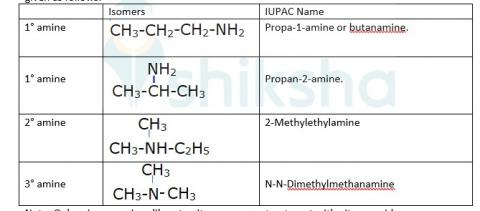
Note: Only primary amines liberate nitrogen gas on treatment with nitrous acid.
Upvote 13.7 Write chemical reaction of aniline with benzoyl chloride and write the name of the product obtained.
13.7 Write chemical reaction of aniline with benzoyl chloride and write the name of the product obtained.
When aniline is treated with benzoyl chloride in the presence of base it gets converted into N-Phenylbenzamide.
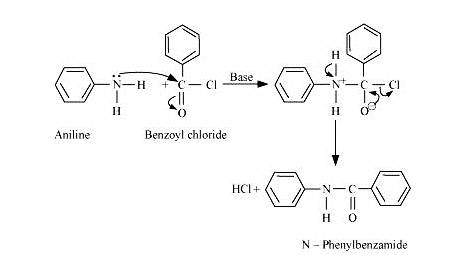 Upvote
13.6 Write reactions of the final alkylation product of aniline with excess of methyl iodide in the presence of sodium carbonate solution.
13.6 Write reactions of the final alkylation product of aniline with excess of methyl iodide in the presence of sodium carbonate solution.
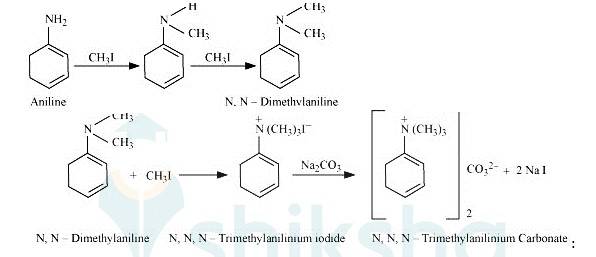
On excessive alkylation with methyl iodide aniline gets converted into N, N-Trimethylanilinium iodide. After reacting it with sodium carbonate it get converted into N, N-Trimethylanilinium carbonate.
Upvote