
Amines
Get insights from 72 questions on Amines, answered by students, alumni, and experts. You may also ask and answer any question you like about Amines
- 72
Questions
- 0
Discussions
- 0
Active Users
- 1
Followers
Have a question about Amines? Ask our experts
Keep it short & simple. Type complete word. Avoid abusive language.
Decarboxylation of all six possible forms of diaminobenzoic acid <!-- [if gte mso 9]><xml>
Decarboxylation of all six possible forms of diaminobenzoic acid <!-- [if gte mso 9]><xml>
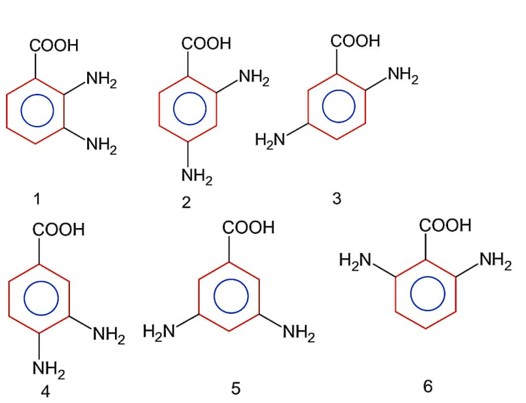
Above are the six possible forms of diaminobenzoic acid.
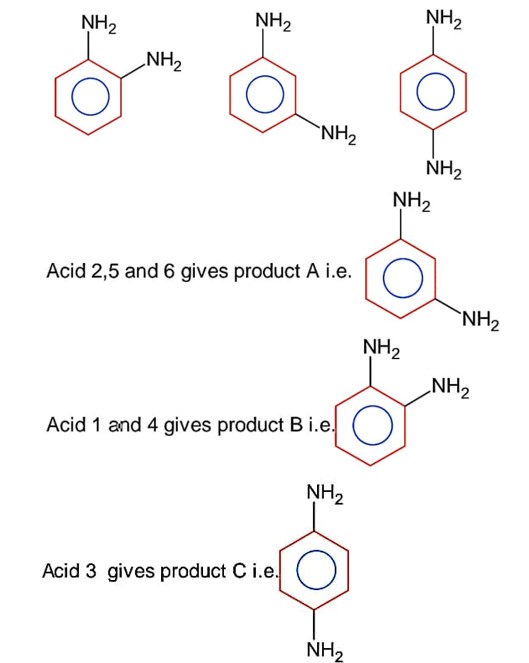
On decarboxylation we get;
 Upvote

13.23 Give plausible explanation for each of the following:
(i) Why are amines less acidic than alcohols of comparable molecular masses?
(ii) Why do primary amines have higher boiling point than tertiary amines?
(iii) Why are aliphatic amines stronger bases than aromatic amines?
13.23 Give plausible explanation for each of the following:
(i) Why are amines less acidic than alcohols of comparable molecular masses?
(ii) Why do primary amines have higher boiling point than tertiary amines?
(iii) Why are aliphatic amines stronger bases than aromatic amines?
(i) Aromatic amines react with nitrous acid (prepared in situ from NaNO2and a mineral acid such as HCl) at 273 - 278 K to form stable aromatic diazonium salts e., NaCl and water.
(ii) Aliphatic primary amines react with nitrous acid (prepared in situ from NaNO2and a mineral acid such as HCl)
Upvote 13.22 Write the reactions of
(i) Aromatic
(ii) Aliphatic primary amines with nitrous acid.
13.22 Write the reactions of
(i) Aromatic
(ii) Aliphatic primary amines with nitrous acid.
(i) Aromatic amines react with nitrous acid (prepared in situ fromNaNO2 and a mineral acid such as HCl) at 273 - 278 K to form stable aromatic diazonium salts i.e., NaCl and water. This reaction is widely used for preparation of variety of compounds.
(ii) Aliphatic primary amines react with n
Upvote 13.21 Why cannot aromatic primary amines be prepared by Gabriel phthalimide synthesis?
13.21 Why cannot aromatic primary amines be prepared by Gabriel phthalimide synthesis?
Gabriel phthalimide synthesis is used for the preparation of aliphatic primary amines. It involves nucleophilic substitution (SN2) of alkyl halides by the anion formed by the phthalimide.But aryl halides do not undergo nucleophilic substitution with the anion formed by the phthalimide.
Therefore arom
Upvote 13.20 Complete the following reactions:
(i) C6H5NH2 + CH3Cl + KOH →
(ii) C6H5N2Cl + H3PO2 + H2O →
(iii) C6H5NH2 + H2SO4 (conc) →
(iv) C6H5N2Cl + C2H5OH à
(v) C6H5NH2 + Br2 (aq) à
(vi) C6H5NH2 + (CH3CO)2O à
(vii) C6H5N2Cl
13.20 Complete the following reactions:
(i) C6H5NH2 + CH3Cl + KOH →
(ii) C6H5N2Cl + H3PO2 + H2O →
(iii) C6H5NH2 + H2SO4 (conc) →
(iv) C6H5N2Cl + C2H5OH à
(v) C6H5NH2 + Br2 (aq) à
(vi) C6H5NH2 + (CH3CO)2O à
(vii) C6H5N2Cl
1- C6H5NH2 + CHCl3 + KOH
It is a carbylamine reaction in which a isocyanide compound is formed along with side products of potassium chloride.Basically the name of reaction is given is due to formation of a foul smelling compound called as isocyanide.
2- C6H5N2Cl + H3PO2 + H2O
Benzenediazonium chloride
Upvote 13.19 An aromatic compound ‘A’ on treatment with aqueous ammonia and heating forms compound ‘B’ which on heating with Br2 and KOH forms a compound ‘C’ of molecular formula C6H7N. Write the structures and IUPAC names of compounds A, B and C.
13.19 An aromatic compound ‘A’ on treatment with aqueous ammonia and heating forms compound ‘B’ which on heating with Br2 and KOH forms a compound ‘C’ of molecular formula C6H7N. Write the structures and IUPAC names of compounds A, B and C.
It is given that compound 'C' having the molecular formula, C6H7N is formed by heating compound 'B' with Br2and KOH. This is a Hoffmann bromamide degradation reaction (in which isocyanide compound is formed). Therefore, compound 'B' is an amide and compound 'C' is an amine. The only amine having the
Upvote 13.18 Give the structures of A, B and C in the following reactions:
13.18 Give the structures of A, B and C in the following reactions:
(i) Ethyl iodide reacts with NaCN gives a substitution reactions to give propanitrile upon partial hydrolysis gives B, upon reaction with sodium hydroxide gives C.
(ii) Benzenediazoniumchloride gives nucleophilic substitution reactions gives A, upon hydrolysis the CN ion is replaced by OH ion
Upvote <p><strong>13.17 Accomplish the following conversions: </strong></p>
<p><strong>(i) </strong>Nitrobenzene to benzoic acid</p>
<p><strong>(ii)</strong> Benzene to m-bromophenol</p>
<p><strong>(iii)</strong> Benzoic acid to aniline</p>
<p><strong>(iv)</strong> Aniline to 2,4,6-tribromofluorobenzene</p>
<p><strong>(v)</strong> Benzyl chloride to 2-phenylethanamine</p>
<p><strong> (vi)</strong> Chlorobenzene to p-chloroaniline</p>
<p><strong> (vii)</strong> Aniline to p-bromoaniline</p>
<p><strong>(viii)</strong> Benzamide to toluene</p>
<p><strong>(ix)</strong> Aniline to benzyl alcohol</p>
13.16 Write short notes on the following:
(i) Carbylamine reaction
(ii) Diazotisation
(iii) Hofmann’s bromamide reaction
(iv) Coupling reaction
(v) Ammonolysis
(vi) Acetylation
(vii) Gabriel phthalimide synthesis.
13.16 Write short notes on the following:
(i) Carbylamine reaction
(ii) Diazotisation
(iii) Hofmann’s bromamide reaction
(iv) Coupling reaction
(v) Ammonolysis
(vi) Acetylation
(vii) Gabriel phthalimide synthesis.
(i) Carbylamine reaction
Carbylamine reaction is used as a test for the identification of primary amines. When aliphatic and aromatic primary amines are heated with chloroform and ethanolic potassium hydroxide, carbylamines (or isocyanides) are formed. These carbylamines have very unpleasant odours.
Upvote 13.6 Describe a method for the identification of primary, secondary and tertiary amines. Also write chemical equations of the reactions involved.
13.6 Describe a method for the identification of primary, secondary and tertiary amines. Also write chemical equations of the reactions involved.
Primary amine: A primary (1°) amine is an amine that has the following general structural formula. R= alkyl or aryl group Secondary amine: A secondary (2°) amine is an amine that has the following general structural formula. R1 and R2= alkyl or aryl group Tertiary amine: A tertiary amine is an amine that has the following structure R1, R2 and R3 are alkyl or aryl groups Identification of Primary, Secondary and Tertiary amines Primary, secondary and tertiary amines can be identified by the following test: Hinsberg's test: This is an excellent test for the identification of primary, secondary and tertiary amines. In this test, the amine is shaken with benzenesulphonyl chloride ( Hinsberg's reagent) in the presence of an excess of aqueous KOH solution when (i) A primary amine gives a clear solution which on acidification gives an N-alkylbenzene sulphonamide which is soluble in Due to the presence of strong electron withdrawing sulphonyl group in the sulphonamide, the H-atom attached to nitrogen can be easily released as a proton. So it is acidic and dissolves in alkali. (ii) A secondary amine reacts with Hinsberg's reagent to give a sulphonamide which is soluble in There is no H-atom attached to the N-atom in the sulphonamide Therefore it is not acidic and soluble in alkali. (iii) A Tertiary amine does not react with Hinsberg's reagent at all |
Upvote