Continuity and Differentiability

Get insights from 335 questions on Continuity and Differentiability, answered by students, alumni, and experts. You may also ask and answer any question you like about Continuity and Differentiability

  • 335

    Questions

  • 0

    Discussions

  • 0

    Active Users

  • 0

    Followers

Have a question about Continuity and Differentiability? Ask our experts

Ask Your Question

Keep it short & simple. Type complete word. Avoid abusive language.

New answer posted•a year ago
A
a year ago

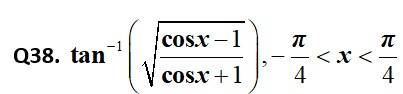
This is a Short Answer Type Questions as classified in NCERT Exemplar

Sol:
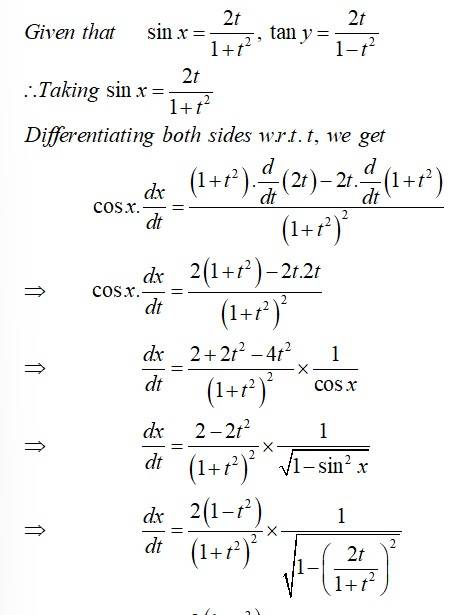
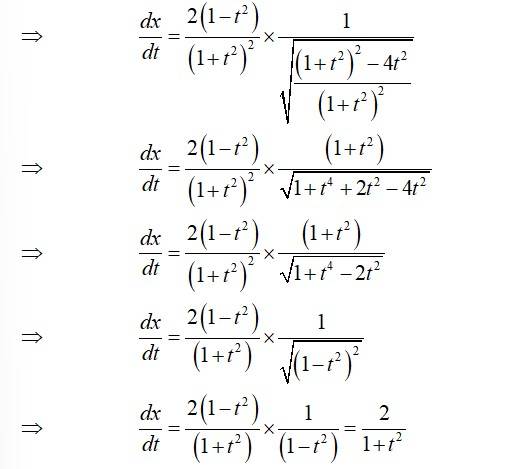
N o w , t a k i n g     t a n y = 2 t 1 − t 2 D i f f e r e n t i a t i n g     b o t h     s i d e s     w . r . t .     t ,     w e     g e t                             d d t ( t a n y ) = d d t ( 2 t 1 − t 2 ) ⇒                     s e c 2 y . d y d t = ( 1 − t 2 ) . d d t ( 2 t ) − 2 t . d d t ( 1 − t 2 ) ( 1 − t 2 ) 2 ⇒                     s e c 2 y . d y d t = 2 . ( 1 − t 2 ) − 2 t . ( − 2 t ) ( 1 − t 2 ) 2 ⇒                       s e c 2 y . d y d t = 2 − 2 t 2 + 4 t 2 ( 1 − t 2 ) 2 ⇒                                                   d y d t = 2 + 2 t 2 ( 1 − t 2 ) 2 × 1 s e c 2 y ⇒                                                   d y d t = 2 ( 1 + t 2 ) ( 1 − t 2 ) 2 × 1 1 + t a n 2 y ⇒                                                   d y d t = 2 ( 1 + t 2 ) ( 1 − t 2 ) 2 × 1 1 + ( 2 t 1 − t 2 ) 2 ⇒                                                   d y d t = 2 ( 1 + t 2 ) ( 1 − t 2 ) 2 × 1 ( 1 − t 2 ) 2 + 4 t 2 ( 1 − t 2 ) 2 ⇒                                                   d y d t = 2 ( 1 + t 2 ) ( 1 − t 2 ) 2 × ( 1 − t 2 ) 2 1 + t 4 − 2 t 2 + 4 t 2 ⇒                                                   d y d t = 2 ( 1 + t 2 ) ( 1 − t 2 ) 2 × ( 1 − t 2 ) 2 1 + t 4 + 2 t 2 ⇒                                                   d y d t = 2 ( 1 + t 2 ) ( 1 − t 2 ) 2 × ( 1 − t 2 ) 2 ( 1 + t 2 ) 2 ⇒                                                   d y d t = 2 1 + t 2 ∴                               d y d x = d y d t d x d t = 2 1 + t 2 2 1 + t 2 = 1 H e n c e ,       d y d x = 1

Thumbs Up IconUpvote Thumbs Down Icon
New answer posted•a year ago
A
a year ago

This is a Short Answer Type Questions as classified in NCERT Exemplar

Sol:
G i v e n     t h a t                     x = 3 c o s θ − 2 c o s 3 θ ,     y = 3 s i n θ − 2 s i n 3 θ D i f f e r e n t i a t i n g     b o t h     t h e     g i v e n     p a r a m e t r i c     f u n c t i o n s     w . r . t .     θ                                   d x d θ = − 3 s i n θ − 6 c o s 2 θ . d d θ ( c o s θ )                                                   = − 3 s i n θ − 6 c o s 2 θ . ( − s i n θ )                                                   = − 3 s i n θ + 6 c o s 2 θ . s i n θ                                   d y d θ = 3 c o s θ − 6 s i n 2 θ . d d θ ( s i n θ )                                                     = 3 c o s θ − 6 s i n 2 θ . c o s θ ∴                               d y d x = d y d θ d x d θ = 3 c o s θ − 6 s i n 2 θ . c o s θ − 3 s i n θ + 6 c o s 2 θ . s i n θ                                                   = c o s θ ( 3 − 6 s i n 2 θ ) s i n θ ( − 3 + 6 c o s 2 θ ) = c o s θ [ 3 − 6 ( 1 − c o s 2 θ ) ] s i n θ [ − 3 + 6 c o s 2 θ ]                                                   = c o t θ ( 3 − 6 + 6 c o s 2 θ − 3 + 6 c o s 2 θ ) = c o t θ ( − 3 + 6 c o s 2 θ − 3 + 6 c o s 2 θ ) = c o t θ H e n c e ,     d y d x = c o t θ

Thumbs Up IconUpvote Thumbs Down Icon
New answer posted•a year ago
A
a year ago

This is a Short Answer Type Questions as classified in NCERT Exemplar

Sol:

G i v e n     t h a t                           x = e θ ( θ + 1 θ ) ,     y = e − θ ( θ − 1 θ ) D i f f e r e n t i a t i n g     b o t h     t h e     p a r a m e t r i c     f u n c t i o n s     w . r . t .     θ                       d x d θ = e θ ( 1 − 1 θ 2 ) + ( θ + 1 θ ) . e θ                       d x d θ = e θ ( 1 − 1 θ 2 + θ + 1 θ )     ⇒ e θ ( θ 2 − 1 + θ 3 + θ θ 2 )                                         = e θ ( θ 3 + θ 2 + θ − 1 ) θ 2                                   y = e − θ ( θ − 1 θ )                           d y d θ = e − θ ( 1 + 1 θ 2 ) + ( θ − 1 θ ) . ( − e − θ )                       d y d θ = e − θ ( 1 + 1 θ 2 − θ + 1 θ )     ⇒ e − θ ( θ 2 + 1 − θ 3 + θ θ 2 )                                       = e − θ ( − θ 3 + θ 2 + θ + 1 ) θ 2                           d y d x = d y d θ d x d θ = e − θ ( − θ 3 + θ 2 + θ + 1 ) θ 2 e θ ( θ 3 + θ 2 + θ − 1 ) θ 2                                           = e − 2 θ ( − θ 3 + θ 2 + θ + 1 θ 3 + θ 2 + θ − 1 ) H e n c e ,     d y d x = e − 2 θ ( − θ 3 + θ 2 + θ + 1 θ 3 + θ 2 + θ − 1 )

Thumbs Up IconUpvote Thumbs Down Icon
New answer posted•a year ago
A
a year ago

This is a Short Answer Type Questions as classified in NCERT Exemplar

Sol:
G i v e n     t h a t                     x = t + 1 t ,       y = t − 1 t D i f f e r e n t i a t i n g     b o t h     t h e     g i v e n     p a r a m e t r i c     f u n c t i o n s     w . r . t .     t                                   d x d t = 1 − 1 t 2 ,         d y d t = 1 + 1 t 2 ∴                               d y d x = d y d t d x d t = 1 + 1 t 2 1 − 1 t 2 = t 2 + 1 t 2 − 1 H e n c e ,     d y d x = t 2 + 1 t 2 − 1

Thumbs Up IconUpvote Thumbs Down Icon
New answer posted•a year ago
A
a year ago

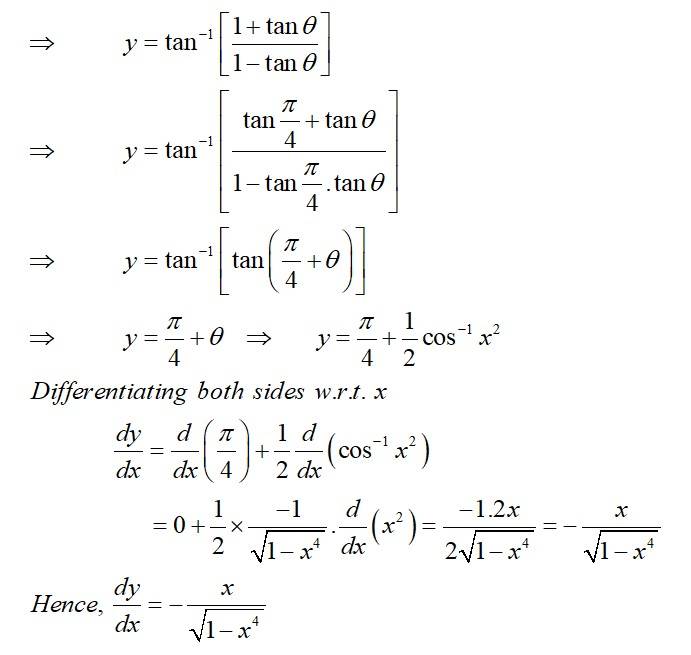
This is a Short Answer Type Questions as classified in NCERT Exemplar

Sol:
Thumbs Up IconUpvote Thumbs Down Icon
New answer posted•a year ago
A
a year ago

This is a Short Answer Type Questions as classified in NCERT Exemplar

Sol:
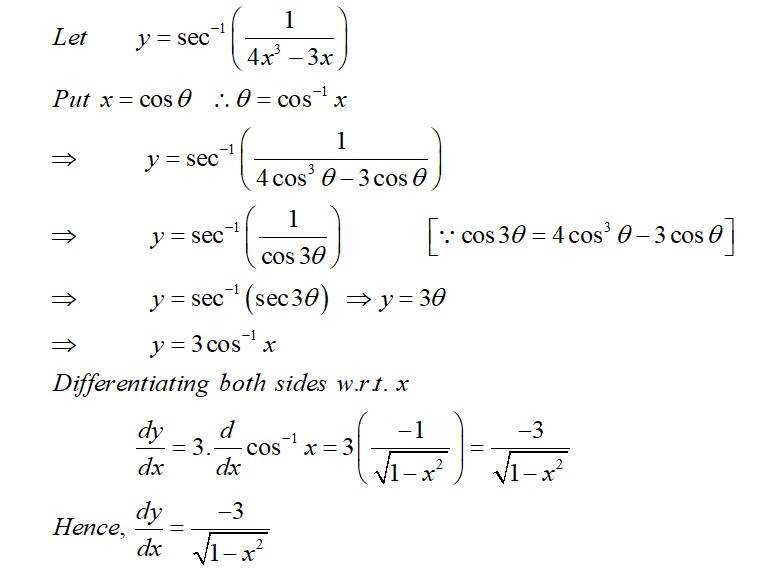
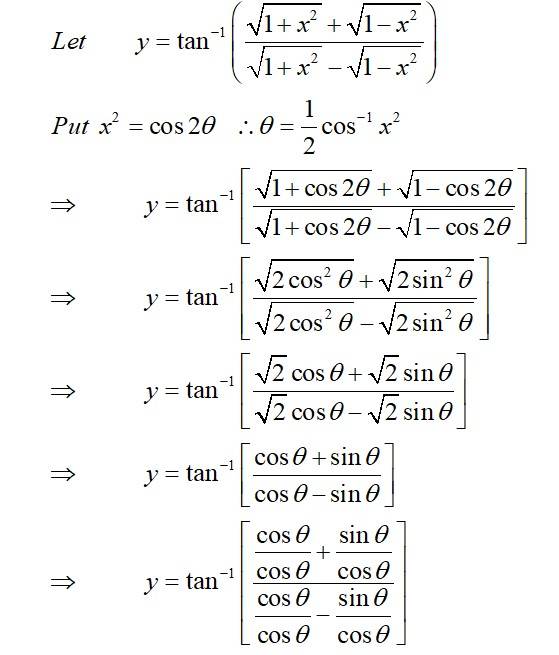
L e t                     y = t a n − 1 [ 3 a 2 x − x 3 a 3 − 3 a x 2 ] P u t     x = a t a n θ           ∴ θ = t a n − 1 x a ⇒                             y = t a n − 1 [ 3 a 2 a t a n θ − a 3 t a n 3 θ a 3 − 3 a . a 2 t a n 2 θ ] ⇒                             y = t a n − 1 [ 3 a 3 t a n θ − a 3 t a n 3 θ a 3 − 3 a 3 t a n 2 θ ] ⇒                             y = t a n − 1 [ 3 t a n θ − t a n 3 θ 1 − 3 t a n 2 θ ] ⇒                             y = t a n − 1 ( t a n 3 θ )                                                     [ ? t a n 3 θ = 3 t a n θ − t a n 3 θ 1 − 3 t a n 2 θ ] ⇒                             y = 3 θ           ⇒                   y = 3 t a n − 1 x a D i f f e r e n t i a t i n g     b o t h     s i d e s     w . r . t .     x                                   d y d x = 3 . d d x ( t a n − 1 x a ) = 3 . 1 1 + x 2 a 2 . d d x . ( x a ) = 3 . a 2 a 2 + x 2 . 1 a = 3 a a 2 + x 2 H e n c e ,     d y d x = 3 a a 2 + x 2

Thumbs Up IconUpvote Thumbs Down Icon
New answer posted•a year ago
A
a year ago

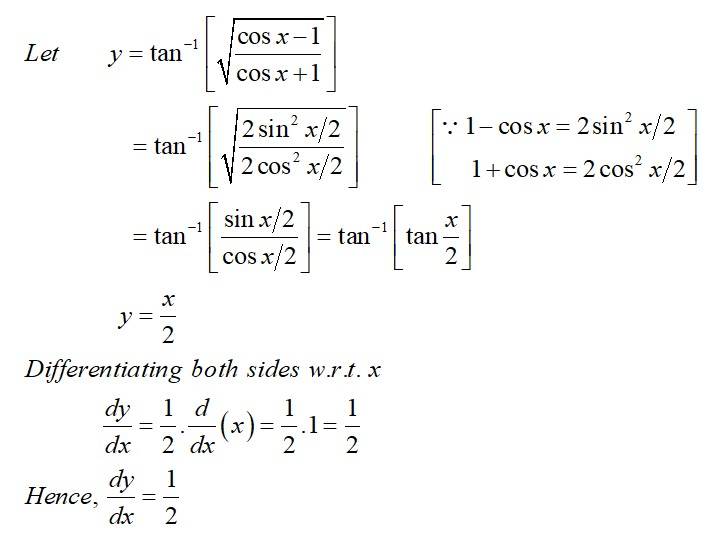
This is a Short Answer Type Questions as classified in NCERT Exemplar

Sol:
Thumbs Up IconUpvote Thumbs Down Icon
New answer posted•a year ago
A
a year ago

This is a Short Answer Type Questions as classified in NCERT Exemplar

Sol:

L e t                     y = t a n − 1 ( a c o s x − b s i n x b c o s x + a s i n x ) ⇒                             y = t a n − 1 [ a c o s x b c o s x − b s i n x b c o s x b c o s x b c o s x + a s i n x b c o s x ] ⇒                               y = t a n − 1 [ a b − t a n x 1 + a b t a n x ] ⇒                               y = t a n − 1 a b − t a n − 1 ( t a n x )                           [ ? t a n − 1 ( x − y 1 + x y ) = t a n − 1 x − t a n − 1 y ] ⇒                               y = t a n − 1 a b − x D i f f e r e n t i a t i n g     b o t h     s i d e s     w . r . t .     x                                     d y d x = d d x [ t a n − 1 a b ] − d d x ( x ) = 0 − 1 = − 1 H e n c e ,     d y d x = − 1

Thumbs Up IconUpvote Thumbs Down Icon
New answer posted•a year ago
A
a year ago

This is a Short Answer Type Questions as classified in NCERT Exemplar

Sol:

L e t                     y = t a n − 1 ( s e c x + t a n x ) D i f f e r e n t i a t i n g     b o t h     s i d e s     w . r . t .     x                                 d y d x = d d x [ t a n − 1 ( s e c x + t a n x ) ]                                                 = 1 1 + ( s e c x + t a n x ) 2 . d d x ( s e c x + t a n x )                                                 = 1 1 + s e c 2 x + t a n 2 x + 2 s e c x t a n x . ( s e c x t a n x + s e c 2 x )                                                 = 1 ( 1 + t a n 2 x ) + s e c 2 x + 2 s e c x t a n x . s e c x ( t a n x + s e c x )                                                 = 1 s e c 2 x + s e c 2 x + 2 s e c x t a n x . s e c x ( t a n x + s e c x )                                                 = 1 2 s e c 2 x + 2 s e c x t a n x . s e c x ( t a n x + s e c x )                                                 = 1 2 s e c x ( s e c x + t a n x ) . s e c x ( t a n x + s e c x ) = 1 2 H e n c e ,     d y d x = 1 2

Thumbs Up IconUpvote Thumbs Down Icon
New answer posted•a year ago
A
a year ago

This is a Short Answer Type Questions as classified in NCERT Exemplar

Sol:

Thumbs Up IconUpvote Thumbs Down Icon