
Exemplar Solution
Get insights from 1.3k questions on Exemplar Solution, answered by students, alumni, and experts. You may also ask and answer any question you like about Exemplar Solution
- 1.3k
Questions
- 0
Discussions
- 0
Active Users
- 0
Followers
Have a question about Exemplar Solution? Ask our experts
Keep it short & simple. Type complete word. Avoid abusive language.
One urn contains two black balls (labeled and ) and one white ball. A second urn contains one black ball and two white balls (labeled and ). Suppose the following experiment is performed: one of the two urns is chosen at random. Next, a ball is randomly chosen from the urn. Then a second ball is chosen at random from the same urn without replacing the first ball.
(a) Write the sample space showing all possible outcomes.
(b) What is the probability that two black balls are chosen?
(c) What is the probability that two balls of opposite color are chosen?
This is a long answer type question as classified in NCERT Exemplar
 Upvote

The accompanying Venn diagram shows three events, A, B, and C, and also the probabilities of the various intersections (for instance, P (A ∩ B) = .07). Determine
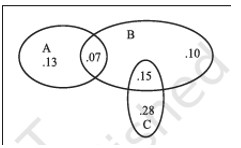
(a) P (A)
(b) P (B ∩ C )
(c) P (A ∪ B)
(d) P (A ∩ B )
(e) P (B ∩ C)
(f) Probability of exactly one of the three occurs.
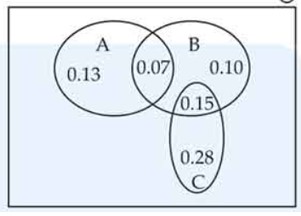
The accompanying Venn diagram shows three events, A, B, and C, and also the probabilities of the various intersections (for instance, P (A ∩ B) = .07). Determine
(a) P (A)
(b) P (B ∩ C )
(c) P (A ∪ B)
(d) P (A ∩ B )
(e) P (B ∩ C)
(f) Probability of exactly one of the three occurs.
This is a short answer type question as classified in NCERT Exemplar
Upvote One of the four persons, John, Rita, Aslam, or Gurpreet, will be promoted next month. Consequently, the sample space consists of four elementary outcomes:
S = {John promoted, Rita promoted, Aslam promoted, Gurpreet promoted}
You are told that the chances of John’s promotion are the same as that of Gurpreet. Rita’s chances of promotion are twice as likely as John’s. Aslam’s chances are four times that of John.
<!-- [if !supportLists]-->(a) Determine P (John promoted)<!-- [if gte mso 9]><xml>
P (Rita promoted),
P (Aslam promoted), and
P (Gurpreet promoted).
<!-- [if !supportLists]-->(b) If A = {John promoted or Gurpreet promoted}, find P(A)<!-- [if gte mso 9]><xml>
One of the four persons, John, Rita, Aslam, or Gurpreet, will be promoted next month. Consequently, the sample space consists of four elementary outcomes:
S = {John promoted, Rita promoted, Aslam promoted, Gurpreet promoted}
You are told that the chances of John’s promotion are the same as that of Gurpreet. Rita’s chances of promotion are twice as likely as John’s. Aslam’s chances are four times that of John.
<!-- [if !supportLists]-->(a) Determine P (John promoted)<!-- [if gte mso 9]><xml>
P (Rita promoted),
P (Aslam promoted), and
P (Gurpreet promoted).
<!-- [if !supportLists]-->(b) If A = {John promoted or Gurpreet promoted}, find P(A)<!-- [if gte mso 9]><xml>
This is a short answer type question as classified in NCERT Exemplar
Upvote A team of medical students doing their internship has to assist during surgeries at a city hospital. The probabilities of surgeries rated as very complex, complex, routine, simple, or very simple are respectively, 0.15, 0.20, 0.31, 0.26, 0.08. Find the probabilities that a particular surgery will be rated:
(a) complex or very complex;
(b) neither very complex nor very simple;
(c) routine or complex;
(d) routine or simple.
A team of medical students doing their internship has to assist during surgeries at a city hospital. The probabilities of surgeries rated as very complex, complex, routine, simple, or very simple are respectively, 0.15, 0.20, 0.31, 0.26, 0.08. Find the probabilities that a particular surgery will be rated:
(a) complex or very complex;
(b) neither very complex nor very simple;
(c) routine or complex;
(d) routine or simple.
This is a short answer type question as classified in NCERT Exemplar
Upvote If <!-- [if gte mso 9]><xml>
(a) <!-- [if gte mso 9]><xml>
(b) <!-- [if gte mso 9]><xml>
(c) <!-- [if gte mso 9]><xml>
(d) <!-- [if gte mso 9]><xml>
(e) <!-- [if gte mso 9]><xml>
(f) <!-- [if gte mso 9]><xml>
If <!-- [if gte mso 9]><xml>
(a) <!-- [if gte mso 9]><xml>
(b) <!-- [if gte mso 9]><xml>
(c) <!-- [if gte mso 9]><xml>
(d) <!-- [if gte mso 9]><xml>
(e) <!-- [if gte mso 9]><xml>
(f) <!-- [if gte mso 9]><xml>
This is a short answer type question as classified in NCERT Exemplar
Upvote In a large metropolitan area, the probabilities are 0.87, 0.36, 0.30 that a family (randomly chosen for a sample survey) owns a colour television set, a black and white television set, or both kinds of sets. What is the probability that a family owns either any one or both kinds of sets?
In a large metropolitan area, the probabilities are 0.87, 0.36, 0.30 that a family (randomly chosen for a sample survey) owns a colour television set, a black and white television set, or both kinds of sets. What is the probability that a family owns either any one or both kinds of sets?
This is a short answer type question as classified in NCERT Exemplar
Upvote A die is loaded in such a way that each odd number is twice as likely to occur as each even number. Find <!-- [if gte mso 9]><xml>
A die is loaded in such a way that each odd number is twice as likely to occur as each even number. Find <!-- [if gte mso 9]><xml>
This is a short answer type question as classified in NCERT Exemplar
Upvote An experiment consists of rolling a die until a 2 appears.
(i) How many elements of the sample space correspond to the event that the 2 appears on the roll of the die?
(ii) How many elements of the sample space correspond to the event that the 2 appears not later than the roll of the die?
An experiment consists of rolling a die until a 2 appears.
(i) How many elements of the sample space correspond to the event that the 2 appears on the roll of the die?
(ii) How many elements of the sample space correspond to the event that the 2 appears not later than the roll of the die?
This is a short answer type question as classified in NCERT Exemplar
Upvote Suppose an integer from 1 through 1000 is chosen at random. Find the probability that the integer is a multiple of 2 or a multiple of 9.
Suppose an integer from 1 through 1000 is chosen at random. Find the probability that the integer is a multiple of 2 or a multiple of 9.
This is a short answer type question as classified in NCERT Exemplar
Upvote Six new employees, two of whom are married to each other, are to be assigned six desks that are lined up in a row. If the assignment of employees to desks is made randomly, what is the probability that the married couple will have nonadjacent desks?
[Hint: First find the probability that the couple has adjacent desks, and then subtract it from 1.]
Six new employees, two of whom are married to each other, are to be assigned six desks that are lined up in a row. If the assignment of employees to desks is made randomly, what is the probability that the married couple will have nonadjacent desks?
[Hint: First find the probability that the couple has adjacent desks, and then subtract it from 1.]
This is a short answer type question as classified in NCERT Exemplar
Upvote