
Ncert Solutions Chemistry Class 12th
Get insights from 2.6k questions on Ncert Solutions Chemistry Class 12th, answered by students, alumni, and experts. You may also ask and answer any question you like about Ncert Solutions Chemistry Class 12th
- 2.6k
Questions
- 0
Discussions
- 0
Active Users
- 79
Followers
Have a question about Ncert Solutions Chemistry Class 12th? Ask our experts
Keep it short & simple. Type complete word. Avoid abusive language.
11.2 Identify allylic alcohols in the above examples.
11.2 Identify allylic alcohols in the above examples.
11.2 Allylic alcohol is an organic compound which has the structural formula CH2 = CHCH2OH. In other words, in these alcohols, the-OH group is attached to sp2 hybridized carbon next to the carbon-carbon double bond, that is to an allylic carbon. Therefore, in the above examples, the following are th
 Upvote

11.1 Classify the following as primary, secondary and tertiary alcohols:
11.1 Classify the following as primary, secondary and tertiary alcohols:
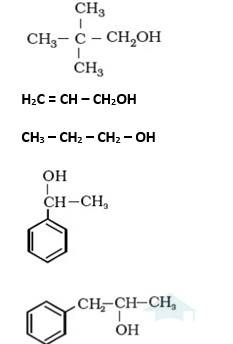
It is primary alcohol because carbon which carries the –OH group is only attached to one alkene group.
It is primary alcohol because the carbon which carries the –OH group is only attached to one
Upvote 1.50 Explain the following with suitable examples: (i) Ferromagnetism (ii) Paramagnetism (iii) Ferrimagnetism (iv) Antiferromagnetism (v) 12-16 and 13-15 group compounds.
1.50 Explain the following with suitable examples: (i) Ferromagnetism (ii) Paramagnetism (iii) Ferrimagnetism (iv) Antiferromagnetism (v) 12-16 and 13-15 group compounds.
Ferromagnetism: The substances that are strongly attracted by a magnetic field are called ferromagnetic substances can be permanently magnetised even in the absence of a magnetic field. Some examples of ferromagnetic substances are iron, cobalt, nickel, gadolinium, and CrO2. In solid state, the meta
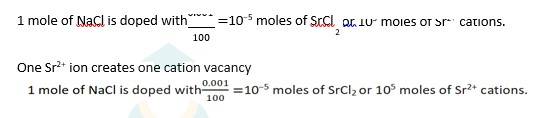
Upvote 1.49 If NaCl is doped with 10^–3 mol % of SrCl2, what is the concentration of cation vacancies?
1.49 If NaCl is doped with 10^–3 mol % of SrCl2, what is the concentration of cation vacancies?
1.49 NaCl is doped with 10−3 mol % of SrCl2
100 moles of NaCl are doped with 0.001 moles of SrCl2
Upvote 1.48 Aluminium crystallises in a cubic close-packed structure. Its metallic radius is 125 pm. (i) What is the length of the side of the unit cell? (ii) How many unit cells are there in 1.00 cm^3 of aluminium?
1.48 Aluminium crystallises in a cubic close-packed structure. Its metallic radius is 125 pm. (i) What is the length of the side of the unit cell? (ii) How many unit cells are there in 1.00 cm^3 of aluminium?
1.48 It is given that aluminum crystallises in a cubic closed packed structure.
Its metallic radius is 125 pm.
For cubic close-packed structure
a=2√2r=2√2×125=354 pm
Here, a is the edge length of the unit cell and r is the atomic radius.
(ii) Volume of one unit cell = a3 =(354 pm)3=4.4×10⁻²³cm3(1 pm=10−1
Upvote 1.47 Explain the following terms with suitable examples: (i) Schottky defect (ii) Frenkel defect (iii) Interstitials and (iv) F-centres
1.47 Explain the following terms with suitable examples: (i) Schottky defect (ii) Frenkel defect (iii) Interstitials and (iv) F-centres
Schottky defect: Schottky defect is basically a vacancy defect shown by ionic solids. In this defect, an equal number of cations and anions are missing to maintain electrical neutrality. It decreases the density of a substance. Significant number of Schottky defects is present in ionic solids. For e
Upvote 1.47 In terms of band theory, what is the difference (i) Between a conductor and an insulator (ii) Between a conductor and a semiconductor?
1.47 In terms of band theory, what is the difference (i) Between a conductor and an insulator (ii) Between a conductor and a semiconductor?
1.47 The energy gap between the valence band and conduction band in an insulator is very large while in a conductor, the energy gap is very small or there is overlapping between valence band and conduction band.
(ii) In a conductor, the valence band is practically filled or there is overlapping betw
Upvote 1.45 Gold (atomic radius = 0.144 nm) crystallises in a face-centred unit cell. What is the length of a side of the cell?
1.45 Gold (atomic radius = 0.144 nm) crystallises in a face-centred unit cell. What is the length of a side of the cell?
1.45 For fcc unit cell, a=2√2?.
Here, a is the edge length and r is the atomic radius (0.144 nm).
a = 2√2 ×0.144 = 0.407 nm
Hence, the length of a side of a cell is 0.407 nm.
Upvote 1.44 Classify each of the following as being either a p-type or a n-type semiconductor: (i) Ge doped with In (ii) Si doped with B
1.44 Classify each of the following as being either a p-type or a n-type semiconductor: (i) Ge doped with In (ii) Si doped with B
1.44 Ge is group 14 element and In is group 13 element. Hence an electron deficient hole is created and therefore, it is p–type.
2. B is group 13 elements and Si is group 14 elements, there will be a free electron. Hence, it is n-type
Upvote 1.43 Ferric oxide crystallises in a hexagonal close-packed array of oxide ions with two out of every three octahedral holes occupied by ferric ions. Derive the formula of the ferric oxide.
1.43 Ferric oxide crystallises in a hexagonal close-packed array of oxide ions with two out of every three octahedral holes occupied by ferric ions. Derive the formula of the ferric oxide.
1.43 There is one octahedral hole for each atom in hexagonal close packed arrangement. If the number of oxide ions (O2−) per unit cell is 1, then the number of
 Upvote