Ncert Solutions Maths class 11th

Get insights from 1.6k questions on Ncert Solutions Maths class 11th, answered by students, alumni, and experts. You may also ask and answer any question you like about Ncert Solutions Maths class 11th

  • 1.6k

    Questions

  • 0

    Discussions

  • 0

    Active Users

  • 83

    Followers

Have a question about Ncert Solutions Maths class 11th? Ask our experts

Ask Your Question

Keep it short & simple. Type complete word. Avoid abusive language.

New answer posted•a year ago
A
a year ago

31. Given, limx→1f (x)−2x2−1=π

limx→1f (x)−2limx→1x2−1=π

⇒limx→1 [f (x)−2]=πlimx→1 (x2−1)

⇒limx→1f (x)−limx→12=π (12−1)

⇒limx→1f (x)−2=0.

⇒limx→1f (x)=2

Thumbs Up IconUpvote Thumbs Down Icon
New answer posted•a year ago
A
a year ago

30. Given, f(x)={|x|+1,x<00,x=0|x|−1,x>0  limx→a f(x)=?

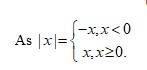
As | x | = {−x  ,  x<0   x  ,   x>0

We can rewrite f (x) = {−x+1  ,  x<0     0      ,x=0    x−1   , x>0.

Case 1: when a<0,

limx→af(x)=limx→a(−x+1)=−a+1

So, limx→af(x) = exist such that a< 0

Case II when a> 0,

limx→af(x)=limx→a(x−1)=a−1

So, limx→af(x) exist such that a>0.

Case III when a = 0.

L.H.L = limx→a−f(x)=limx→a−(−x+1)=limx→0−(−x+1)=1

R.H.L = limx→a+f(x)=limx→a+(x−1)=limx→0+(x−1)=−1

Thus, limx→a−f(x)≠limx→a+f(x)

So, limx→af(x) does not exist at a = 0.

...Read more

Thumbs Up IconUpvote Thumbs Down Icon
New answer posted•a year ago
A
a year ago

28. Given, f (x) =  {a+bx, x<14, x=1b−ax, x>1

Since we need limx→1f (x) we need,

LHL =

limx→1−f (x)=limx→1− (a+bx) = a + b × 1 = a + b

and RHL =

limx→1+f (x)=limx→1+ (b−ax) = b - a × 1 = b - a

Given,  limx→1f (x)=f (1): we have the following equations

a + b = 4 ____ (1)

b - a = 4 ____ (2)

Adding (1) and (2) we get,

2b = 8

b = 4

Putting b = 4 in (1) we get

a + 4 = 4

a = 0

...Read more

Thumbs Up IconUpvote Thumbs Down Icon
New answer posted•a year ago
A
a year ago

27. limx→5f (x)=limx→5|x|−5

= | 5 |− 5

= 5 −5

= 0

Thumbs Up IconUpvote Thumbs Down Icon
New answer posted•a year ago
A
a year ago

26. Given, f (x) {x|x|, x≠00, x=0

L.H.S = limx→0−f (x)=limx→0−x−x=limx→0−−1=−1

R.H.L limx→0+f (x)=limx→0+xx=limx→0+1=1

Thus,  limx→0−f (x)≠limx→0+f (x)

i e,  limx→0f (x) does not exist.

Thumbs Up IconUpvote Thumbs Down Icon
New answer posted•a year ago
A
a year ago

25. Given f (x) = {|x|x,x≠00,x=0,limx→0f(x)=?

We know that, |x|={x,x≥0−x,x<0

Now,

L.H.L = limx→0−f(x)=limx→0−−xx=limx→0−−1=−1

and R.H.L = limx→0+f(x)=limx→0+xx=limx→0+1=1

Thus, limx→0−f(x)≠limx→0+f(x)

i e, limx→0f(x) does not exist.

...Read more

Thumbs Up IconUpvote Thumbs Down Icon
New answer posted•a year ago
A
a year ago

24. Given f (x)= {x2−1, x≤1−x2−1, x>1, limx→1f (x)=?

Now, L.H.L = limx→1−f (x)=limx→1− (x2−1)

12- 1 = 0

And R.H.L = limx→1+f (x)=limx→1+ (−x2−1)  (1)2 1 = 1 = 2.

Thus,  limx→1−f (x)≠limx→1+f (x)

So,  limx→1f (x) does not exist.

...Read more

Thumbs Up IconUpvote Thumbs Down Icon
New answer posted•a year ago
A
a year ago

23. Given f (x) {2x+3,x≤03(x+1),x>0}

for limx→0f(x) ,

left hand limit, L.H.S = limx→0f(x) = limx→0(2x+3)

= 2 0 + 3 = 3.

Right hand limit, R.H.L = limx→0+f(x)=limx→0+3(x+1)

= (0 + 1) = 3 1 = 3.

Thus, limx→0−f(x)=limx→0+f(x)=limx→0−f(x)=3

For limx→1f(x),

L.H.L = limx→1−f(x)=limx→1−3(x+1)=3(1+1)=3×2=6

R.H.L = limx→1+f(x)=limx→1+3(x+1)=3(1+1)=3×2=6.

Thus, limx→1−f(x)=limx→1+f(x)=limx→1f(x)=6.

...Read more

Thumbs Up IconUpvote Thumbs Down Icon
New answer posted•a year ago
A
a year ago

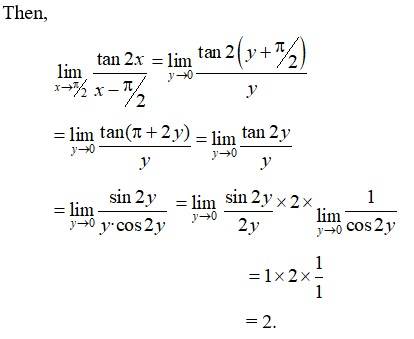
22. limx→x2tan2xx−π2

Put y = x π2 . So that as y 0 cos π2

Thumbs Up IconUpvote Thumbs Down Icon
New answer posted•a year ago
A
a year ago

21. limx→0(cosecx−cotx)=limx→0(1sinx−cosxsinx)

=limx→0(1−cosxsinx)

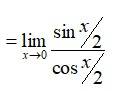
=limx→02sin2x22sinx2cosx2 {?cos2x=1−2sin2x⇒1−cos2x=2sin2x1−cosx=2sin2x2?sin2x=2sinxcosxsinx=2sinx2cosx2{

=limx→0x2

=tan02=  0.

Thumbs Up IconUpvote Thumbs Down Icon