
Ncert Solutions Maths class 11th
Get insights from 1.6k questions on Ncert Solutions Maths class 11th, answered by students, alumni, and experts. You may also ask and answer any question you like about Ncert Solutions Maths class 11th
- 1.6k
Questions
- 0
Discussions
- 0
Active Users
- 83
Followers
Have a question about Ncert Solutions Maths class 11th? Ask our experts
Keep it short & simple. Type complete word. Avoid abusive language.
The locus of the point of intersection of the lines <!-- [if gte mso 9]><xml>
The locus of the point of intersection of the lines <!-- [if gte mso 9]><xml>
K
K =
48 = 16 (e2 – 1)
 Upvote

A function f(x) is given by f(x) = then the sum of the series is equal to
A function f(x) is given by f(x) = then the sum of the series is equal to
Let A1, A2, A3,………. be squares such that for each <!-- [if gte mso 9]><xml>
Let A1, A2, A3,………. be squares such that for each <!-- [if gte mso 9]><xml>
Let an be the side of square An
a1 = 12
an = 12
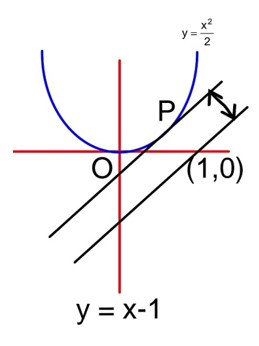
Upvote The shortest distance between the line x – y = 1 and the curve x2 = 2y is
The shortest distance between the line x – y = 1 and the curve x2 = 2y is
Slope = 1
Equation of tangent at P : y - = 1 (x – 1)
dist=
 Upvote
The total number of numbers, lying between 100 and 1000 that can be formed with the digits 1, 2, 3, 4, 5, if the repetition of digits is not allowed and numbers are divisible by either 3 or 5, is…………….
The total number of numbers, lying between 100 and 1000 that can be formed with the digits 1, 2, 3, 4, 5, if the repetition of digits is not allowed and numbers are divisible by either 3 or 5, is…………….
Number divisible by 3;
(a) sum of the digit must be divisible by 3
(i) 3! = 6
(ii) 1, 3, 5 -> 3! = 6
(iii) 2, 3, 4 -> 3! = 6
(iv) 3, 4, 5 = 3! = 6
Total = 24
(b) Divisible by
4 × 3 = 12
(c) Now common divisible by both
2! = 2
For 3, 4 2! = 2
Upvote The image of the point (3, 5) in the line x – y + 1 = 0, lies on:
The image of the point (3, 5) in the line x – y + 1 = 0, lies on:
Equation of given line x – y + 1 = 0 .(i),
equation of per perpendicular line PP’ is
-x – y +
As line passing through (3, 5)
Equation of line PP’ is –x – y + 8 = 0 .(ii)
Solving (i) and (ii)
&nb
Upvote The integer ‘k’ for which the inequality x2 – 2(3k – 1) x + 8k2 – 7 > 0 is valid for every x in R, is:
The integer ‘k’ for which the inequality x2 – 2(3k – 1) x + 8k2 – 7 > 0 is valid for every x in R, is:
a = 1 > 0 and D < 0
4 (3k – 1)2 – 4 (8k2 – 7) < 0
K = 3
Upvote The equation of the line through the point (0, 1, 2) perpendicular to the line
<!-- [if gte mso 9]><xml>
The equation of the line through the point (0, 1, 2) perpendicular to the line
<!-- [if gte mso 9]><xml>
For ‘B’, x = 2r + 1, y = 3r – 1, z = -2r + 1
As AB is perpendicular to the line,
->
direction ratios of AB
(2r + 1, 3r – 2, -2r – 1)
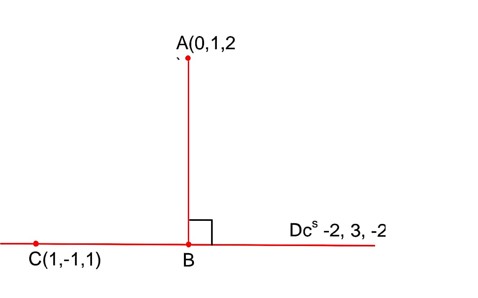
Equation of AB
Upvote Let a be the angle between the lines whose direction cosines satisfy the equations I + m – n = 0 and I2 + m2 – n2 = 0. Then the value of sin4a + cos4a is:
Let a be the angle between the lines whose direction cosines satisfy the equations I + m – n = 0 and I2 + m2 – n2 = 0. Then the value of sin4a + cos4a is:
l + m – n = 0
l + m = n . (i)
l2 + m2 = n2
Now from (i)
l2 + m2 = (l + m)2
->2lm = 0
->lm = 0
l = 0 or m = 0
->m = n Þ l = n
if we take direction consine of line
cos α =
Upvote