
Ncert Solutions Maths class 12th
Get insights from 2.5k questions on Ncert Solutions Maths class 12th, answered by students, alumni, and experts. You may also ask and answer any question you like about Ncert Solutions Maths class 12th
- 2.5k
Questions
- 0
Discussions
- 0
Active Users
- 65
Followers
Have a question about Ncert Solutions Maths class 12th? Ask our experts
Keep it short & simple. Type complete word. Avoid abusive language.
Let <!-- [if gte mso 9]><xml>
If <!-- [if gte mso 9]><xml>
Let <!-- [if gte mso 9]><xml>
If <!-- [if gte mso 9]><xml>
Let f(x) =
a1 = 18, a2 = 16
a1 + a2 = 34
 Upvote

Let f (θ) = Then the value of <!-- [if gte mso 9]><xml>
Let f (θ) = Then the value of <!-- [if gte mso 9]><xml>
f(q) = a sin q + b cos q
Solving (i) & (ii) we get a =
Upvote The number of points where the function f(x) = [t] denotes the greatest integer t is discontinuous is __________-.
The number of points where the function f(x) = [t] denotes the greatest integer t is discontinuous is __________-.
Let a line having direction ratios 1, -4, 2 intersect the lines <!-- [if gte mso 9]><xml>
Let a line having direction ratios 1, -4, 2 intersect the lines <!-- [if gte mso 9]><xml>
and
AB2 = 84
f(-1) = 1
f(1) = 3
Hence f(x) will be discontinuous at x = 1 and also 4x2 – 1 = 0 , 1 , 2
Upvote The number of one-one functions f:{a, b, c, d} ® {0, 1, 2, ……., 10} such that 2f (a) – f(b) + 3f(c) + f(d) = 0 is ___________.
The number of one-one functions f:{a, b, c, d} ® {0, 1, 2, ……., 10} such that 2f (a) – f(b) + 3f(c) + f(d) = 0 is ___________.
f(b) = 2f(a) + 3f(c) + f(d)
Value of f(c) Value of f(a) Number of functions
Upvote The number of choices for <!-- [if gte mso 9]><xml>
The number of choices for <!-- [if gte mso 9]><xml>
Case I
When is same as
Then becomes
which is always true, so x becomes tautology.
Case II
When is same as
Then becomes is T, then is false, so x cannot be tautology.
Case III
When is same as
Then&
Upvote The value of <!-- [if gte mso 9]><xml>
The value of <!-- [if gte mso 9]><xml>
If a random variable X follows the Binomial distribution B (33, p) such that 3P (X = 0) = P (X = 1) then the value of is equal to :L
If a random variable X follows the Binomial distribution B (33, p) such that 3P (X = 0) = P (X = 1) then the value of is equal to :L
n = 33, p = success, q = failure
3P (x = 0) = P (x = 1)
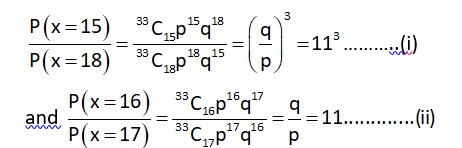
Subtracting, (ii) – (i), we get 1320
Upvote Let <!-- [if gte mso 9]><xml>
Let <!-- [if gte mso 9]><xml>