Ncert Solutions Maths class 12th

Get insights from 2.5k questions on Ncert Solutions Maths class 12th, answered by students, alumni, and experts. You may also ask and answer any question you like about Ncert Solutions Maths class 12th

  • 2.5k

    Questions

  • 0

    Discussions

  • 0

    Active Users

  • 65

    Followers

Have a question about Ncert Solutions Maths class 12th? Ask our experts

Ask Your Question

Keep it short & simple. Type complete word. Avoid abusive language.

New answer posted•a year ago
S
a year ago

This is a Objective Type Questions as classified in NCERT Exemplar

Sol: 

W e     h a v e       y = 4 x 2 + 2 x − 8                                                                 … ( i ) a n d                           y = x 3 − x + 1 3                                                                 … ( i i ) D i f f e r e n t i a t i n g     e q . ( i )     w . r . t .     x ,     w e     h a v e                                 d y d x = 8 x + 2             ⇒ m 1 = 8 x + 2 [ m 1     i s     s l o p e     o f     c u r v e ( i ) ] D i f f e r e n t i a t i n g     e q . ( i i )     w . r . t .     x ,     w e     g e t                                 d y d x = 3 x 2 − 1             ⇒ m 2 = 3 x 2 − 1 [ m 2     i s     s l o p e     o f     c u r v e ( i i ) ] I f     t h e     t w o     c u r v e s     t o u c h     e a c h     o t h e r ,     t h e n     m 1 = m 2 ∴                                                               8 x + 2 = 3 x 2 − 1 ⇒                                   3 x 2 − 8 x − 3 = 0                   ⇒ 3 x 2 − 9 x + x − 3 = 0 ⇒ 3 x ( x − 3 ) + 1 ( x − 3 ) = 0                         ⇒ ( x − 3 ) ( 3 x + 1 ) = 0 ∴                                             x = 3 ,     − 1 3 P u t t i n g     x = 3     i n     e q ( i ) ,     w e     g e t                                                     y = 4 ( 3 ) 2 + 2 ( 3 ) − 8 = 3 6 + 6 − 8 = 3 4 So,  the  required  point  is  (3,34) N o w     f o r     x = − 1 3                                           y = 4 ( − 1 3 ) 2 + 2 ( − 1 3 ) − 8 = 4 × 1 9 − 2 3 − 8                                                   = 4 9 − 2 3 − 8 = 4 − 6 − 7 2 9 = − 7 4 9 ∴          Other  required  point  is  (−13,−749). Hence,  the  re

Thumbs Up IconUpvote Thumbs Down Icon
New answer posted•a year ago
S
a year ago

This is a Objective Type Questions as classified in NCERT Exemplar

Sol: 
W e     h a v e                                     f ( x ) = ( 1 x ) x T a k i n g     l o g     o f     b o t h     s i d e s ,     w e     h a v e                                                           l o g f ( x ) = x l o g 1 x                                                           l o g f ( x ) = x l o g x − 1                 ⇒ l o g [ f ( x ) ] = − [ x l o g x ] D i f f e r e n t i a t i n g     b o t h     s i d e s     w . r . t .   x ,     w e     g e t                                                           1 f ( x ) f ' ( x ) = − [ x . 1 x + l o g x . 1 ] ⇒                                                                           f ' ( x ) = − f ( x ) [ 1 + l o g x ] = − ( 1 x ) x [ 1 + l o g x ] For  local  maxima  and  local  minima  f'(x)=0             − ( 1 x ) x [ 1 + l o g x ] = 0                   ⇒ ( 1 x ) x [ 1 + l o g x ] = 0               ( 1 x ) x ≠ 0         ∴     1 + l o g x = 0 ⇒         l o g x = − 1         ⇒ x = e − 1         ⇒ x = 1 e So,  x=1e  is  the  stationary  point. N o w ,     f ' ( x ) = − ( 1 x ) x [ 1 + l o g x ]                           f ' ' ( x ) = − [ ( 1 x ) x ( 1 x ) + ( 1 + l o g x ) . d d x ( x ) x ]                           f ' ' ( x ) = − [ ( e ) 1 / e ( e ) + ( 1 + l o g 1 e ) d d x ( 1 e ) 1 / e ]                         x=1e=−e1e+1<0  maxima ∴    Maximum  value  of  the  function  at  x=1e  is                       f ( 1 e ) = ( 1 1 / e ) 1 / e H e n c e ,     t h e     c o r r e c t     o p t i o n     i s     ( c ) .

...Read more

Thumbs Up IconUpvote Thumbs Down Icon
New answer posted•a year ago
S
a year ago

This is a Objective Type Questions as classified in NCERT Exemplar

Sol.

W e     h a v e                                     f ( x ) = x x T a k i n g     l o g     o f     b o t h     s i d e s ,     w e     h a v e                                                           l o g f ( x ) = x l o g x D i f f e r e n t i a t i n g     b o t h     s i d e s     w . r . t .   x ,     w e     g e t                                                           1 f ( x ) f ' ( x ) = x . 1 x + l o g x . 1 ⇒                                                                           f ' ( x ) = f ( x ) [ 1 + l o g x ] = x x [ 1 + l o g x ] To  find  stationary  point,  f'(x)=0 ∴                                                                                   x x [ 1 + l o g x ] = 0       x x ≠ 0         ∴     1 + l o g x = 0 ⇒                                                     l o g x = − 1         ⇒ x = e − 1         ⇒ x = 1 e H e n c e ,     t h e     c o r r e c t     o p t i o n     i s     ( b ) .

Thumbs Up IconUpvote Thumbs Down Icon
New answer posted•a year ago
S
a year ago

This is a Objective Type Questions as classified in NCERT Exemplar

Sol: 

G i v e n     t h a t       y = − x 3 + 3 x 2 + 9 x − 2 7 S o ,                                   d y d x = − 3 x 2 + 6 x + 9 ∴     S l o p e     o f     t h e     g i v e n     c u r v e ,                                                     m = − 3 x 2 + 6 x + 9                                               d m d x = − 6 x + 6 For  local???  maxima  and  local  minima,  dmdx=0 ∴             − 6 x + 6 = 0 ⇒           x = 1 Now         d2mdx2=−6<0  maxima ∴Maximum  value  of  the  slope  at  x=1  is                                       m x = 1 = − 3 ( 1 ) 2 + 6 ( 1 ) + 9 = − 3 + 6 + 9 = 1 2 H e n c e ,     t h e     c o r r e c t     o p t i o n     i s     ( b ) .

...Read more

Thumbs Up IconUpvote Thumbs Down Icon
New answer posted•a year ago
S
a year ago

This is a Objective Type Questions as classified in NCERT Exemplar

Sol: 

W e     h a v e       f ( x ) = 2 s i n 3 x + 3 c o s 3 x S o ,                           f ' ( x ) = 2 c o s 3 x . 3 − 3 s i n 3 x . 3 = 6 c o s 3 x − 9 s i n 3 x                                       f ' ' ( x ) = − 6 s i n 3 x . 3 − 9 c o s 3 x . 3                                                                   = − 1 8 s i n 3 x − 2 7 c o s 3 x Now    f''(5π6)=−18sin3(5π6)−27cos3(5π6)                                                                     = − 1 8 s i n ( 5 π 2 ) − 2 7 c o s ( 5 π 2 )                                                                     = − 1 8 s i n ( 2 π + π 2 ) − 2 7 c o s ( 2 π + π 2 )                                                                     = − 1 8 s i n π 2 − 2 7 c o s π 2 = − 1 8 . 1 − 2 7 . 0                                   =−18<0  maxima       Maximum  value  of  f(x)  at  x=5π6               f ( 5 π 6 ) = 2 s i n 3 ( 5 π 6 ) + 3 c o s 3 ( 5 π 6 ) = 2 s i n ( 5 π 2 ) + 3 c o s ( 5 π 2 )                                                 = 2 s i n ( 2 π + π 2 ) + 3 c o s ( 2 π + π 2 ) = 2 s i n π 2 + 3 c o s π 2 = 2 H e n c e ,     t h e     c o r r e c t     o p t i o n     i s     ( a ) .

...Read more

Thumbs Up IconUpvote Thumbs Down Icon
New answer posted•a year ago
S
a year ago

This is a Objective Type Questions as classified in NCERT Exemplar

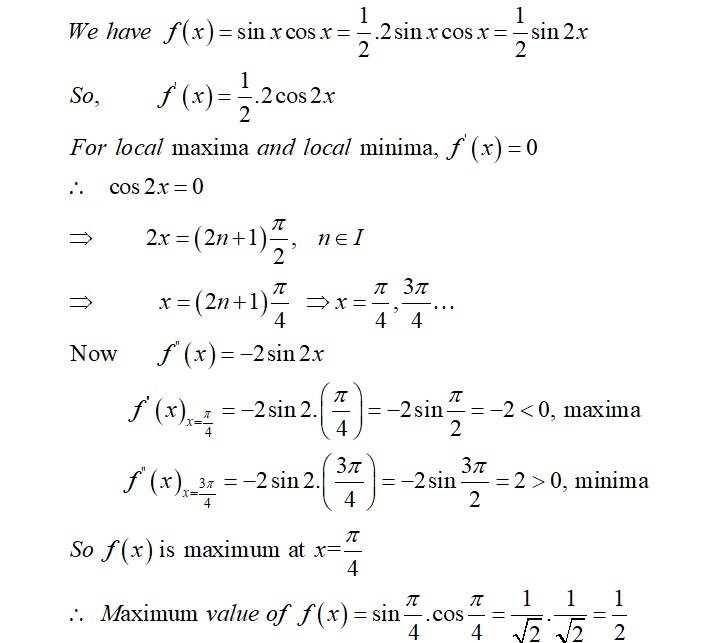
Sol:

Thumbs Up IconUpvote Thumbs Down Icon
New answer posted•a year ago
S
a year ago

This is a Objective Type Questions as classified in NCERT Exemplar

Sol:

W e     h a v e       f ( x ) = 2 x 3 − 3 x 2 − 1 2 x + 4 S o ,                             f ' ( x ) = 6 x 2 − 6 x − 1 2 For  local???  maxima  and  local  minima,  f'(x)=0 ∴             6 x 2 − 6 x − 1 2 = 0 ⇒                         x 2 − x − 2 = 0 ⇒     x 2 − 2 x + x − 2 = 0         ⇒ x ( x − 2 ) + 1 ( x − 2 ) = 0 ⇒           ( x + 1 ) ( x − 2 ) = 0 ∴                                   x = − 1 , 2 So,     x=−1,2  are  the  points  of  local???  maxima  and  local  minima. Now         f''(x)=12x−6                       f''(x)x=−1=12(−1)−6=−12−6=−18<0,  maxima                       f''(x)x=2=12(2)−6=24−6=18>0,  minima So  the  function  is  maximum  at  x=−1  and  minimum  at  x=2 H e n c e ,     t h e     c o r r e c t     o p t i o n     i s     ( c ) .

...Read more

Thumbs Up IconUpvote Thumbs Down Icon
New answer posted•a year ago
S
a year ago

This is a Objective Type Questions as classified in NCERT Exemplar

Sol:

L e t                   f ( x ) = x 3 − 1 8 x 2 + 9 6 x S o ,                   f ' ( x ) = 3 x 2 − 3 6 x + 9 6 For  local???  maxima  and  local  minima,  f'(x)=0 ∴                             3 x 2 − 3 6 x + 9 6 = 0 ⇒                               x 2 − 1 2 x + 3 2 = 0 ⇒                               x 2 − 8 x − 4 x + 3 2 = 0                     ⇒ x ( x − 8 ) − 4 ( x − 8 ) = 0 ⇒                               ( x − 8 ) ( x − 4 ) = 0 ∴                                                         x = 8 , 4 ∈ [ 0 , 9 ] So,     x=4,8  are  the  points  of  local???  maxima  and  local  minima. Now  we  will  calculate  the  absolute  maxima  or  absolute  minima  at  x=0,4,8,9 ∴                                               f ( x ) = x 3 − 1 8 x 2 + 9 6 x                                             f ( x ) x = 0 = 0 − 0 + 0 = 0                                             f ( x ) x = 4 = ( 4 ) 3 − 1 8 ( 4 ) 2 + 9 6 ( 4 )                                                                                 = 6 4 − 2 8 8 + 3 8 4 = 4 4 8 − 2 8 8 = 1 6 0                                             f ( x ) x = 8 = ( 8 ) 3 − 1 8 ( 8 ) 2 + 9 6 ( 8 )                                                                                 = 5 1 2 − 1 1 5 2 + 7 6 8 = 1 2 8 0 − 1 1 5 2 = 1 2 8                                             f ( x ) x = 9 = ( 9 ) 3 − 1 8 ( 9 ) 2 + 9 6 ( 9 )                                                                                 = 7 2 9 − 1 4 5 8 + 8 6 4 = 1 5 9 3 − 1 4 5 8 = 1 3 5 So  the  absolute  minimum  value  of &th


...Read more

Thumbs Up IconUpvote Thumbs Down Icon
New answer posted•a year ago
S
a year ago

This is a Objective Type Questions as classified in NCERT Exemplar

Sol:

L e t                   f ( x ) = x 2 − 8 x + 1 7 S o ,                   f ' ( x ) = 2 x − 8 For  local???  maxima  and  local  minima,  f'(x)=0 ∴                             2 x − 8 = 0                     ⇒ x = 4 So,     x=4  is  the  point  of  local???  maxima  and  local  minima.                         f''(x)=2>0  minima  at  x=4 ∴                                             f ( x ) x = 4 = ( 4 ) 2 − 8 ( 4 ) + 1 7                                                                                       = 1 6 − 3 2 + 1 7 = 3 3 − 3 2 = 1 So  the  minimum  value  of  the  function  is  1 H e n c e ,     t h e     c o r r e c t     o p t i o n     i s     ( c ) .

...Read more

Thumbs Up IconUpvote Thumbs Down Icon
New answer posted•a year ago
S
a year ago

This is a Objective Type Questions as classified in NCERT Exemplar

Sol:

L e t         f ( x ) = t a n x − x S o ,           f ' ( x ) = s e c 2 x − 1                           ⇒ f ' ( x ) > 0     ∀ ∈ R So,      f (x)  is  always  increasing H e n c e ,     t h e     c o r r e c t     o p t i o n     i s     ( a ) .

...Read more

Thumbs Up IconUpvote Thumbs Down Icon