
Ncert Solutions Maths class 12th
Get insights from 2.5k questions on Ncert Solutions Maths class 12th, answered by students, alumni, and experts. You may also ask and answer any question you like about Ncert Solutions Maths class 12th
- 2.5k
Questions
- 0
Discussions
- 0
Active Users
- 65
Followers
Have a question about Ncert Solutions Maths class 12th? Ask our experts
Keep it short & simple. Type complete word. Avoid abusive language.
If y = x? – 10 and x changes from 2 to 1.99, what is the change in *y
(A) 0.32
(B) 0.032
(C) 5.68
(D) 5.968
If y = x? – 10 and x changes from 2 to 1.99, what is the change in *y
(A) 0.32
(B) 0.032
(C) 5.68
(D) 5.968
This is a Objective Type Questions as classified in NCERT Exemplar
Sol.
 Upvote

If the curves ay + x² = 7 and x³ = y cut orthogonally at (1, 1), then the value of a is:
(A) 1
(B) 0
(C) –6
(D) 6
If the curves ay + x² = 7 and x³ = y cut orthogonally at (1, 1), then the value of a is:
(A) 1
(B) 0
(C) –6
(D) 6
This is a Objective Type Questions as classified in NCERT Exemplar
Sol:
Upvote If the curves ay + x² = 7 and x³ = y cut orthogonally at (1, 1), then the value of a is:
(A) 1
(B) 0
(C) –6
(D) 6
If the curves ay + x² = 7 and x³ = y cut orthogonally at (1, 1), then the value of a is:
(A) 1
(B) 0
(C) –6
(D) 6
This is a Objective Type Questions as classified in NCERT Exemplar
Sol:
Upvote The equation of the normal to the curve *3x² – y² = 8, which is parallel to the line *x + 3y = 8, is:
(A) 3x – y = 8
(B) 3x + y + 8 = 0
(C) x + 3y ± 8 = 0
(D) x + 3y = 0
The equation of the normal to the curve *3x² – y² = 8, which is parallel to the line *x + 3y = 8, is:
(A) 3x – y = 8
(B) 3x + y + 8 = 0
(C) x + 3y ± 8 = 0
(D) x + 3y = 0
This is a Objective Type Questions as classified in NCERT Exemplar
Sol:
Upvote The curve y = x1/? has at (0, 0):
(A) A vertical tangent (parallel to y-axis)
(B) A horizontal tangent (parallel to x-axis)
(C) An oblique tangent
(D) No tangent
The curve y = x1/? has at (0, 0):
(A) A vertical tangent (parallel to y-axis)
(B) A horizontal tangent (parallel to x-axis)
(C) An oblique tangent
(D) No tangent
This is a Objective Type Questions as classified in NCERT Exemplar
Sol.
Upvote <p><strong>A ladder, 5 meters long, standing on a horizontal floor, leans against a vertical wall. If the top of the ladder slides downwards at the rate of 10 cm/sec, then the rate at which the angle between the floor and the ladder is decreasing when the lower end of the ladder is 2 meters from the wall is:</strong></p>
<p><strong>(A)</strong> 1/10 radian/sec</p>
<p><strong>(B)</strong> 1/20 radian/sec</p>
<p><strong>(C)</strong> 20 radian/sec</p>
<p><strong>(D) </strong>10 radian/sec</p>
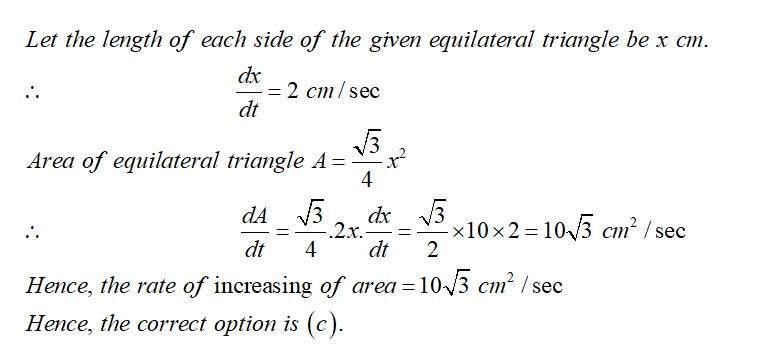
The sides of an equilateral triangle are increasing at the rate of 2 cm/sec. The rate at which the area increases when the side is 10 cm is:
(A) 10 cm²/s
(B) √3 cm²/s
(C) 10 cm²/s
(D) 10/3 cm²/s
The sides of an equilateral triangle are increasing at the rate of 2 cm/sec. The rate at which the area increases when the side is 10 cm is:
(A) 10 cm²/s
(B) √3 cm²/s
(C) 10 cm²/s
(D) 10/3 cm²/s
This is a Objective Type Questions as classified in NCERT Exemplar
Sol:
 Upvote
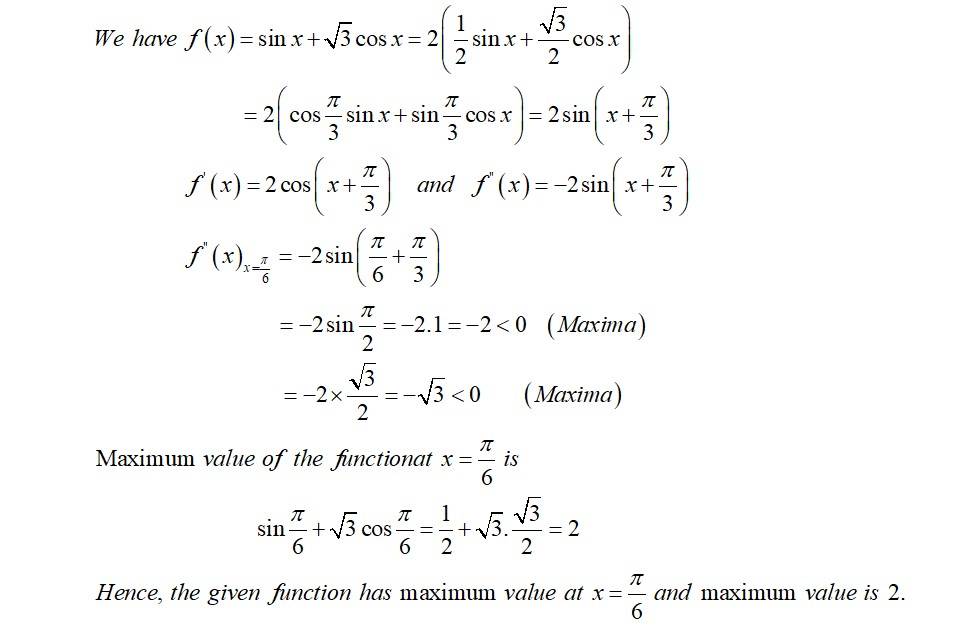
Prove that f(x) = sinx + cosx has a maximum value at x = , .
Prove that f(x) = sinx + cosx has a maximum value at x = , .
This is a Short Answer Type Question as classified in NCERT Exemplar
Sol:
Upvote <p><strong>Prove that <em>f</em>(<em>x</em>) = sin<em>x</em> + </strong> <strong>cos<em>x</em> has a maximum value at <em>x</em> = ,</strong> <span contenteditable="false"> <math> <mrow> <mo> </mo> <mfrac> <mrow> <mi>π</mi> </mrow> <mrow> <mn>6</mn> </mrow> </mfrac> </mrow> </math> </span><strong>.</strong></p>
At what point is the slope of the curve y = –x³ + 3x² + 9x – 27 maximum? Also, find the maximum slope.
At what point is the slope of the curve y = –x³ + 3x² + 9x – 27 maximum? Also, find the maximum slope.
This is a Short Answer Type Question as classified in NCERT Exemplar
Sol.
Upvote