Ncert Solutions Maths class 12th

Get insights from 2.5k questions on Ncert Solutions Maths class 12th, answered by students, alumni, and experts. You may also ask and answer any question you like about Ncert Solutions Maths class 12th

  • 2.5k

    Questions

  • 0

    Discussions

  • 0

    Active Users

  • 65

    Followers

Have a question about Ncert Solutions Maths class 12th? Ask our experts

Ask Your Question

Keep it short & simple. Type complete word. Avoid abusive language.

New answer posted•a year ago
S
a year ago

This is a Short Answer Type Question as classified in NCERT Exemplar

Sol: 

G i v e n     t h a t     f ( x ) = t a n − 1 ( s i n x + c o s x )     i n     ( 0 , π 4 ) D i f f e r e n t i a t i n g     b o t h     s i d e s     w . r . t .     x ,     w e     g e t                           f ' ( x ) = 1 1 + ( s i n x + c o s x ) 2 . d d x ( s i n x + c o s x ) ⇒                 f ' ( x ) = 1 × ( c o s x − s i n x ) 1 + ( s i n x + c o s x ) 2 ⇒                 f ' ( x ) = ( c o s x − s i n x ) 1 + s i n 2 x + c o s 2 x + 2 s i n x c o s x ⇒                 f ' ( x ) = ( c o s x − s i n x ) 1 + 1 + 2 s i n x c o s x                     ⇒ f ' ( x ) = c o s x − s i n x 2 + 2 s i n x c o s x For  an  increasing  function,  f'(x)≥0 ∴                                       c o s x − s i n x 2 + 2 s i n x c o s x ≥ 0 ⇒                                                 c o s x − s i n x ≥ 0                       [ ? ( 2 + s i n 2 x ) ≥ 0     i n     ( 0 , π 4 ) ] ⇒                 c o s ≥ s i n x ,     w h i c h     i s     t r u e     f o r     ( 0 , π 4 ) Hence,  the  given  function  f(x)  is  an  increasing  function  in  (0,π4).

Thumbs Up IconUpvote Thumbs Down Icon
New answer posted•a year ago
S
a year ago

This is a Short Answer Type Question as classified in NCERT Exemplar

Sol: 
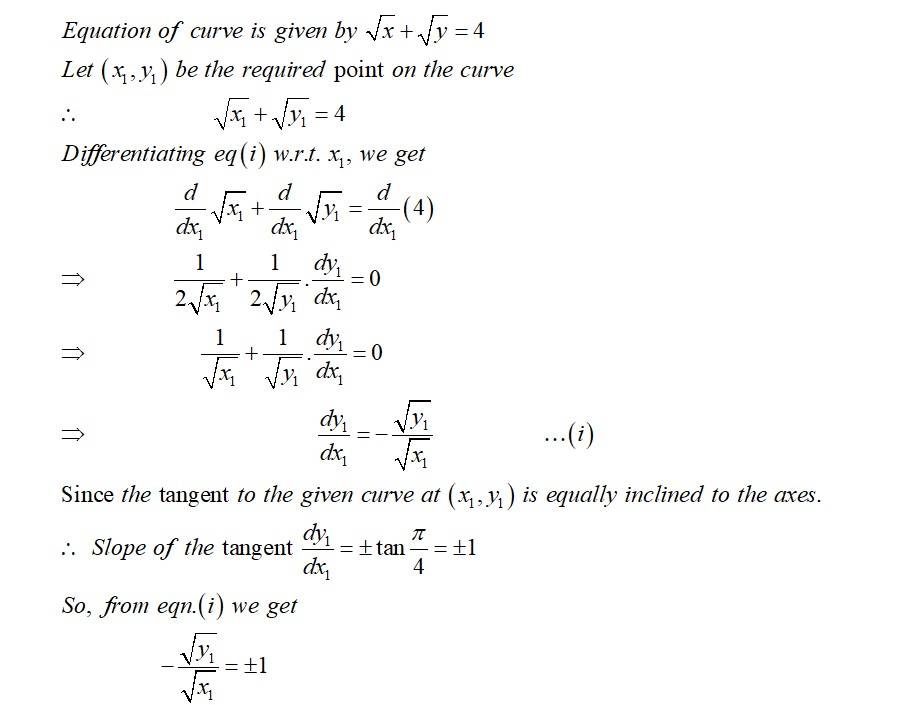
G i v e n     t h a t     f ( x ) = s i n x − c o s x − 2 a x + b ,     a ≥ 1 D i f f e r e n t i a t i n g     b o t h     s i d e s     w . r . t .     x ,     w e     g e t                           f ' ( x ) = c o s x + s i n x − 2 a For  decreasing  function,  f'(x)<0 ∴                                       c o s x + s i n x − 2 a < 0 ⇒         2 ( 2 c o s x + 1 2 s i n x ) − 2 a < 0 ⇒                                   2 c o s x + 1 2 s i n x − a < 0 ⇒ ( c o s π 6 c o s x + s i n π 6 s i n x ) − a < 0 ⇒                                                                 c o s ( x − π 6 ) − a < 0 Since  cosx∈[−1,1]  and  a≥1 ∴                                                                                                                       f ' ( x ) < 0 Hence,  the  given  function  is  decreasing  function  in  R.

...Read more

Thumbs Up IconUpvote Thumbs Down Icon
New answer posted•a year ago
S
a year ago

This is a Short Answer Type Question as classified in NCERT Exemplar

Sol. 

G i v e n     t h a t     f ( x ) = 2 x + c o t − 1 x + l o g ( − x ) D i f f e r e n t i a t i n g     b o t h     s i d e s     w . r . t .     x ,     w e     g e t                           f ' ( x ) = 2 − 1 1 + x 2 + 1 − 1 × d d x ( − x )                                                       = 2 − 1 1 + x 2 + ( 1 2 × ( 2 x − 1 ) ) − 1                                                       = 2 − 1 1 + x 2 + x − ( − x )                                                       = 2 − 1 1 + x 2 − − x ( − x )                                                       = 2 − 1 1 + x 2 − 1 For  increasing  function,  f'(x)≥0 ∴                 2 − 1 1 + x 2 − 1 ≥ 0 ⇒ 2 ( 1 + x 2 ) − 1 + 1 + x 2 ≥ 0           ⇒ 2 + 2 x 2 − 1 + ≥ 0 ⇒ 2 x 2 + 1 + ≥ 0               2 x 2 + 1 ≥ − S q u a r i n g     b o t h     s i d e s ,     w e     g e t     4 x 4 + 1 + 4 x 2 ≥ 1 + x 2 ⇒                 4 x 4 + 4 x 2 − x 2 ≥ 0         ⇒ 4 x 4 + 3 x 2 ≥ 0         ⇒ x 2 ( 4 x 2 + 3 ) ≥ 0 w h i c h     i s     t r u e     f o r     a n y     v a l u e     o f     x ∈ R Hence,  the  given  function  is  an  increasing  function  over  R.

Thumbs Up IconUpvote Thumbs Down Icon
New answer posted•a year ago
S
a year ago

This is a Short Answer Type Question as classified in NCERT Exemplar

Sol: 
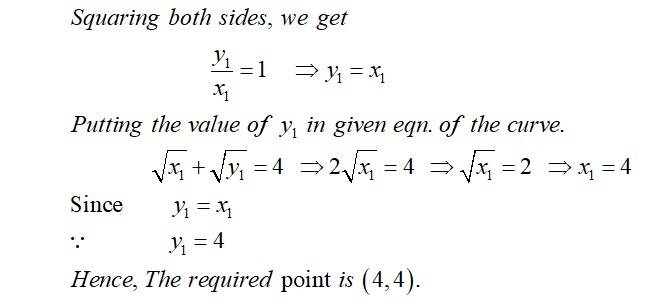
G i v e n     t h a t     e q u a t i o n     o f     t h e     c u r v e     i s     y = b . e − x / a a n d     t h e     e q u a t i o n     o f     t h e     l i n e     i s       x a + y b = 1 Let  the  coordinates  of  the  point  where  the  curve  intersects  the  y−axis  be  (0,y1) N o w ,     d i f f e r e n t i a t i n g     y = b . e − x / a     b o t h     s i d e s     w . r . t .     x ,     w e     g e t                                                   d y d x = b . e − x / a ( − 1 a ) = − b a . e − x / a So,  the  slope  of  the  tangent,  m1=−ba.e−x/a D i f f e r e n t i a t i n g     x a + y b = 1     b o t h     s i d e s     w . r . t .     x ,     w e     g e t ∴                                                   1 a + 1 b . d y d x = 0 So,  the  slope  of  the  line,  m2=−ba I f     t h e     l i n e     t o u c h e s     t h e     c u r v e ,     t h e n       m 1 = m 2 ⇒                                                                     − b a . e − x / a = − b a                     ⇒ e − x / a = 1 ⇒                                                                         − x a l o g e = l o g 1                     ( T a k i n g     l o g     o n     b o t h     s i d e s ) ⇒                                                                                                 − x a = 0                   ⇒ x = 0 P u t t i n g     x = 0     i n     e q u a t i o n     y = b . e − x / a ⇒                                             y = b . e 0 = b Hence,  the  given  equation  of  the  curve  intersects  at  (0,b)  i.e.  on  y−axis.

Thumbs Up IconUpvote Thumbs Down Icon
New answer posted•a year ago
S
a year ago

This is a Short Answer Type Question as classified in NCERT Exemplar

Sol: 

G i v e n     t h a t     e q u a t i o n     o f     t h e     c u r v e     i s     x 2 + y 2 − 2 x − 4 y + 1 = 0                           … ( i ) D i f f e r e n t i a t i n g     b o t h     s i d e s     w . r . t .     x ,     w e     g e t                                                   2 x + 2 y . d y d x − 2 − 4 . d y d x = 0         ⇒ ( 2 y − 4 ) d y d x = 2 − 2 x ⇒                                                                                                                             d y d x = 2 − 2 x 2 y − 4                                                                                                     … ( i i ) Since  the  tangent  to  the  curve  is  parallel  to  the  y−axis. ∴                                                                                       S l o p e     d y d x = t a n π 2 = ∞ = 1 0 S o ,     f r o m     e q n . ( i i )     w e     g e t                                                                     2 − 2 x 2 y − 4 = 1 0         ⇒ 2 y − 4 = 0         ⇒ y = 2 P u t t i n g     t h e     v a l u e     o f     y     i n     e q n . ( i ) ,     w e     g e t ⇒               x 2 + ( 2 ) 2 − 2 x − 8 + 1 = 0 ⇒                             x 2 − 2 x + 4 − 8 + 1 = 0         ⇒ x 2 − 2 x − 3 = 0 ⇒                                           x 2 − 3 x − x − 3 = 0 ⇒                           x ( x − 3 ) + 1 ( x − 3 ) = 0 ⇒         ( x − 3 ) ( x + 1 ) = 0 ⇒                                                                                                  

Thumbs Up IconUpvote Thumbs Down Icon
New answer posted•a year ago
S
a year ago

This is a Short Answer Type Question as classified in NCERT Exemplar

Sol:

W e     h a v e     e q u a t i o n     o f     t h e     c u r v e     3 x 2 − y 2 = 8 D i f f e r e n t i a t i n g     b o t h     s i d e s     w . r . t .     x ,     w e     g e t                                                   6 x − 2 y . d y d x = 0         ⇒ − 2 y d y d x = − 6 x         ⇒ d y d x = 3 x y Slope  of  the  tangent  to  the  given  curve=3xy ∴  Slope  of  the  normal  to  the  curve=−13xy=−y3x. N o w     d i f f e r e n t i a t i n g     b o t h     s i d e s     t h e     g i v e n     l i n e     x + 3 y = 4 ⇒                                       1 + 3 . d y d x = 0         ⇒ d y d x = − 1 3 Since  the  normal  to  the  curve  is  parallel  to  the  given  line  x+3y=4. ∴                                             − y 3 x = − 1 3           ⇒ y = x P u t t i n g     t h e     v a l u e s     o f     y     i n     3 x 2 − y 2 = 8 ,     w e     g e t                 3 x 2 − x 2 = 8         ⇒ 2 x 2 = 8         ⇒ x 2 = 4         ⇒ x = ± 2 ∴                             y = ± 2 ∴   The  points  on  the  curve  are  (2,2)  and  (−2,−2). Now  equation  of  the  normal  to  the  curve  at  (2,2)  is                                                           y − 2 = − 1 3 ( x − 2 ) ⇒                                             3 y − 6 = − x + 2               ⇒ x + 3 y = 8 a t ( − 2 , − 2 )                 y + 2 = − 1 3 ( x + 2 ) ⇒                                                 3 y + 6 = − x − 2           ⇒ x + 3 y = − 8 H e n c e ,     t h e     r e q u i r e d     e q u a t i o n s     a r e     x + 3 y = 8     a n d     x + 3 y = − 8     o r     x + 3 y = ± 8 .

Thumbs Up IconUpvote Thumbs Down Icon
New answer posted•a year ago
S
a year ago

This is a Short Answer Type Question as classified in NCERT Exemplar

Sol: 

G i v e n     t h a t     t h e     e q u a t i o n     o f     t h e     t w o     c u r v e s     a r e     y 2 = 4 x                                                   … ( i ) a n d                                                                       x 2 + y 2 − 6 x + 1 = 0                                                                                                                       … ( i i ) D i f f e r e n t i a t i n g     e q ( i )     w . r . t .     x ,     w e     g e t                                                   2 y d y d x = 4         ⇒ d y d x = 2 y Slope  of  the  tangent  at  (1,2),  m1=22=1 D i f f e r e n t i a t i n g     e q ( i i )     w . r . t .     x ,     w e     g e t ⇒                                           2 x + 2 y . d y d x − 6 = 0             ⇒ 2 y . d y d x = 6 − 2 x         ⇒ d y d x = 6 − 2 x 2 y ∴  Slope  of  the  tangent  at  the  same  point  (1,2),  m2=6−2×12×2=44=1 We  see  that  m1=m2=1  at  the  point  (1,2). Hence,  the  given  circles  touch  each  other  at  the  same  point  (1,2).

Thumbs Up IconUpvote Thumbs Down Icon
New answer posted•a year ago
S
a year ago

This is a Short Answer Type Question as classified in NCERT Exemplar

Sol: 

Thumbs Up IconUpvote Thumbs Down Icon
New answer posted•a year ago
S
a year ago

This is a Short Answer Type Question as classified in NCERT Exemplar

Sol: 

G i v e n     c i r c l e s     a r e                   2 x y = 4                                                                           … ( i ) a n d                                                               x 2 + y 2 = 8                                                                         … ( i i ) D i f f e r e n t i a t i n g     e q ( i )     w . r . t .     x ,     w e     g e t                                                   x . d y d x + y . 1 = 0 ⇒                 d y d x = − y x             ⇒ m 1 = 1 y ( m1  =slope  of  the  tangent  to  the  curve ) D i f f e r e n t i a t i n g     e q ( i i )     w . r . t .     x ,     w e     g e t ∴                                                     2 x + 2 y . d y d x = 0         ⇒ d y d x = − x y         ⇒ m 2 = − x y     ( m2  =slope  of  the  other  tangent  to  the  curve ) To  find  the  point  of  contact  of  the  two  circles t h e n                                   m 1 = m 2 ⇒                                         − y x = − x y         ⇒         x 2 = y 2 P u t t i n g     t h e     v a l u e     o f     y 2     i n     e q . ( i i )                                     x 2 + x 2 = 8         ⇒ 2 x 2 = 8         ⇒ x 2 = 4 ∴                                           x = ± 2 ?                                       x 2 = y 2         ⇒ y = ± 2 ∴  The  point  of  contact  of  the  two  circles  are  (2,2)  and  (−2,2).

Thumbs Up IconUpvote Thumbs Down Icon
New answer posted•a year ago
S
a year ago

This is a Short Answer Type Question as classified in NCERT Exemplar

Sol.

The  two  circles  intersect  orthogonally  if  the  angle  between  the  tangents  drawn  to  the  two  circles   at  the  point  of  their intersection  is 900. E q u a t i o n     o f     t h e     t w o     c i r c l e s     a r e     g i v e n   a s                                                           2 x = y 2                                                                     … ( i ) a n d                                       2 x y = k                                                                         … ( i i ) D i f f e r e n t i a t i n g     e q ( i )     a n d     e q ( i i )       w . r . t .     x ,     w e     g e t                                                   2 . 1 = 2 y . d y d x ⇒                 d y d x = 1 y           ⇒ m 1 = 1 y ( m1  =slope  of  the  tangent ) ⇒                                       2 x y = k ⇒                                       2 [ x . d y d x + y . 1 ] = 0 ∴                                                     d y d x = − y x         ⇒ m 2 = − y x     ( m2  =slope  of  the  other  tangent ) If  the  two  tangents  are  perpendicular  to  each  other, t h e n                                   m 1 × m 2 = − 1 ⇒                                         1 y × − y x = − 1         ⇒ 1 x = 1         ⇒ x = 1 N o w     s o l v i n g                               2 x = y 2                                                             [ F r o m ( i ) ] a n d                                               &thinsp


...Read more

Thumbs Up IconUpvote Thumbs Down Icon

