
Physics
Get insights from 5.7k questions on Physics, answered by students, alumni, and experts. You may also ask and answer any question you like about Physics
- 5.7k
Questions
- 0
Discussions
- 18
Active Users
- 0
Followers
Have a question about Physics? Ask our experts
Keep it short & simple. Type complete word. Avoid abusive language.
A body of man 100 kg travelled 10 m before coming to rest. If m = 0.4, work done against friction is (motion is happening on horizontal surface, take g=10 m/s2)
A body of man 100 kg travelled 10 m before coming to rest. If m = 0.4, work done against friction is (motion is happening on horizontal surface, take g=10 m/s2)
v2 = 2 × mgs
v2 = 2 × (0.4) × 10 × 10
v2 = 80
Wf = Dk
=
Wf = – 4000
 Upvote

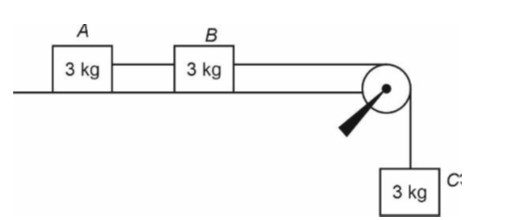
If wire BC has Young’s modulus of Y = 2 × 10¹¹ N/m2 and cross section area of 5 × 10⁻⁴ cm2. Find strain in wire BC (in unit of 10–4)
If wire BC has Young’s modulus of Y = 2 × 10¹¹ N/m2 and cross section area of 5 × 10⁻⁴ cm2. Find strain in wire BC (in unit of 10–4)
a = , For C, 3g – T = 3a = (3) g
T = 2g = 20 N
Upvote Energy stored in circuit 1 is E. If capacitors in circuit 1 and circuit 2 are connected in parallel as shown, the energy stored becomes , find x.
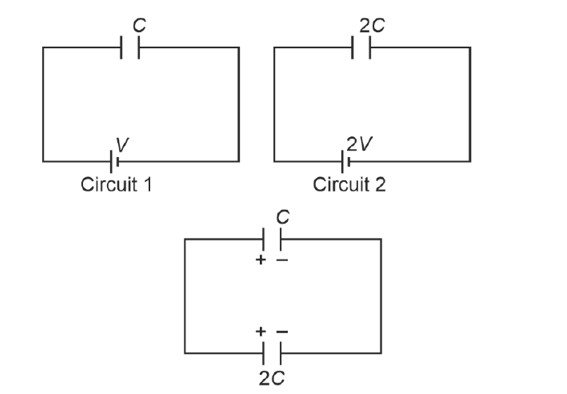
Energy stored in circuit 1 is E. If capacitors in circuit 1 and circuit 2 are connected in parallel as shown, the energy stored becomes , find x.
Charge on C1 = CV
Charge on C2 = 4CV
When connected in parallel
x = 50
Upvote Two cell one of emf 8 V, internal resistance 2 W and other of emf 2 V and internal resistance 4 W are connected as shown in figure.
Find potential difference (in V) across point AC.
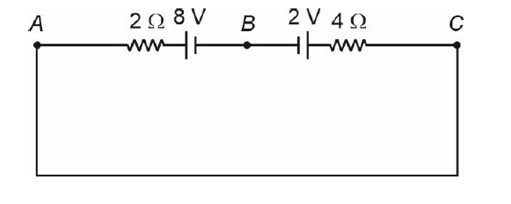
Two cell one of emf 8 V, internal resistance 2 W and other of emf 2 V and internal resistance 4 W are connected as shown in figure.
Find potential difference (in V) across point AC.
Current in circuit (I) = = 1 A.
So, VC – 4 (1) – 2 + 8 – 2 (1) = VA
VC – 6 – 2 + 8 = VA
VC – VA = 0 V
Upvote A uniform disc of mass 5 kg and radius 2 m is rotating with 10 rad/s. Now another identical disc is gently placed on first disc. Because of friction, both disc acquire common angular velocity. Loss of kinetic energy in process is _______ J.
A uniform disc of mass 5 kg and radius 2 m is rotating with 10 rad/s. Now another identical disc is gently placed on first disc. Because of friction, both disc acquire common angular velocity. Loss of kinetic energy in process is _______ J.
COAM gives Iw0 = 2Iw
Loss in KE =
Upvote A particle is having uniform acceleration. If its displacement from t to (t + 1) second is 120 m and change in velocity is 50 m/s. Find its displacement (in m) in (t + 2) second.
A particle is having uniform acceleration. If its displacement from t to (t + 1) second is 120 m and change in velocity is 50 m/s. Find its displacement (in m) in (t + 2) second.
Dv = a (t + 1 – t)
a = 50 m/s2
u = 120 – 25 (2t +1)
In (t + 2)th second
= u + 25 (2t + 3)
= 120 – 25 (2t) – 25 + 25 (2t) + 75
S' = 170 m
Upvote Distance between virtual image, which is of twice of size of object placed in front of mirror and object is 45 cm. Magnitude of focal length of mirror is _______ cm.
Distance between virtual image, which is of twice of size of object placed in front of mirror and object is 45 cm. Magnitude of focal length of mirror is _______ cm.

|v| = |2u|
n + 2n = 45
n = 15 cm
u = –15
v = 30
f = 30 cm
Upvote A block of mass 2 kg is placed on a disc which is rotating at constant angular velocity 4 rad/s. Find the friction force (in N) between block and disc if block is not sliding.
A block of mass 2 kg is placed on a disc which is rotating at constant angular velocity 4 rad/s. Find the friction force (in N) between block and disc if block is not sliding.

Block is not slipping, so
f = mrw2 = 2 × 1 × 16 = 32
Upvote Match the two columns.
Column 1
Column 2
P.
Surface tension
1.
[ML2T–2]
Q.
Viscosity
2.
[ML2T–1]
R.
Angular momentum
3.
[ML–1T–1]
S.
Rotational kinetic energy
4.
[ML0T–2]
Match the two columns.
|
|
Column 1 |
|
Column 2 |
|
P. |
Surface tension |
1. |
[ML2T–2] |
|
Q. |
Viscosity |
2. |
[ML2T–1] |
|
R. |
Angular momentum |
3. |
[ML–1T–1] |
|
S. |
Rotational kinetic energy |
4. |
[ML0T–2] |
[S] = [MT–2]
L º [ML2T–1]
KE º ML2T−2
Upvote