
Solid States
Get insights from 78 questions on Solid States, answered by students, alumni, and experts. You may also ask and answer any question you like about Solid States
- 78
Questions
- 0
Discussions
- 0
Active Users
- 0
Followers
Have a question about Solid States? Ask our experts
Keep it short & simple. Type complete word. Avoid abusive language.
In the following questions match the items given in Column I with the items given in Column II.
In some questions more than one item of Column I and Column II may match.
68. Match the defects given in Column I with the statements given.
Column I
Column II
(i) Simple vacancy defect
(a) shown by non-ionic solids and increases density of the solid.
(ii) Simple interstitial defect
(b) shown by ionic solids and decreases density of the solid.
(iii) Frenkel defect
(c) shown by non-ionic solids and density of the solid decreases
(iv) Schottky defect
(d) shown by ionic solids and density of the solid remains the same
In the following questions match the items given in Column I with the items given in Column II.
In some questions more than one item of Column I and Column II may match.
68. Match the defects given in Column I with the statements given.
|
Column I |
Column II |
|
(i) Simple vacancy defect |
(a) shown by non-ionic solids and increases density of the solid. |
|
(ii) Simple interstitial defect |
(b) shown by ionic solids and decreases density of the solid. |
|
(iii) Frenkel defect |
(c) shown by non-ionic solids and density of the solid decreases |
|
(iv) Schottky defect |
(d) shown by ionic solids and density of the solid remains the same |
68. (i) → (c); (ii) → (a); (iii) → (d); (iv) → (b)
 Upvote

67. Which of the following defects decrease the density?
(i) Interstitial defect
(ii) Vacancy defect
(iii) Frankel defect
(iv) Schottky defect
67. Which of the following defects decrease the density?
(i) Interstitial defect
(ii) Vacancy defect
(iii) Frankel defect
(iv) Schottky defect
67. Options (ii) and (iv) are correct since Vacancy and Schottky, both the defects lead to the decrease in the density while in the Frenkel and Interstitial defect there is no change in the density of the substance.
Upvote 66. Frenkel defect is also known as ________.
(i) Stoichiometric defect
(ii) Dislocation defect
(iii) Impurity defect
(iv) Non-stoichiometric defect
66. Frenkel defect is also known as ________.
(i) Stoichiometric defect
(ii) Dislocation defect
(iii) Impurity defect
(iv) Non-stoichiometric defect
66. Options (i) and (ii) are correct since in this defect an atom is displaced from its lattice point to an interstitial site and thus creating a vacancy at the lattice point. This usually occurs when the size of anion is quite large as compared to that of the cation due to which it leads to th
Upvote 65. In which of the following arrangements octahedral voids are formed?
(i) Hcp
(ii) Bcc
(iii) Simple cubic
(iv) Fcc
65. In which of the following arrangements octahedral voids are formed?
(i) Hcp
(ii) Bcc
(iii) Simple cubic
(iv) Fcc
65. Options (i) and (iv) are correct since when the tetrahedral void of the first layer and the tetrahedral void of the second layer align together, they form an octahedral void, and this is possible in case of hep and fcc arrangements.
Upvote 64. Which of the following cannot be regarded as molecular solid?
(i) SiC (Silicon carbide)
(ii) AlN
(iii) Diamond
(iv) I2
64. Which of the following cannot be regarded as molecular solid?
(i) SiC (Silicon carbide)
(ii) AlN
(iii) Diamond
(iv) I2
64. Options (i), (ii) and (iii) are correct since SiC, AlN, and diamond are not regarded as molecular solids, instead they come under network or covalent solids.
Upvote 63. Which of the following features are not shown by quartz glass?
(i) This is a crystalline solid.
(ii) Refractive index is same in all the directions.
(iii) This has definite heat of fusion.
(iv) This is also called super cooled liquid.
63. Which of the following features are not shown by quartz glass?
(i) This is a crystalline solid.
(ii) Refractive index is same in all the directions.
(iii) This has definite heat of fusion.
(iv) This is also called super cooled liquid.
63. Options (i) and (iii) are correct since quartz glass is an amorphous solid so, it does not exhibit a definite heat of fusion.
Upvote 62. Which of the following statements are correct?
(i) Ferrimagnetic substances lose ferrimagnetism on heating and become paramagnetic.
(ii) Ferrimagnetic substances do not lose ferrimagnetism on heating and remain ferrimagnetic.
(iii) Antiferromagnetic substances have domain structures similar to ferromagnetic substances and their magnetic moments are not cancelled by each other.
(iv) In ferromagnetic substances, all the domains get oriented in the direction of magnetic field and remain as such even after removing magnetic field.
62. Which of the following statements are correct?
(i) Ferrimagnetic substances lose ferrimagnetism on heating and become paramagnetic.
(ii) Ferrimagnetic substances do not lose ferrimagnetism on heating and remain ferrimagnetic.
(iii) Antiferromagnetic substances have domain structures similar to ferromagnetic substances and their magnetic moments are not cancelled by each other.
(iv) In ferromagnetic substances, all the domains get oriented in the direction of magnetic field and remain as such even after removing magnetic field.
62. Options (i) and (iv) are correct since these statements agrees with the ferrimagnetic and ferromagnetic nature of the substances respectively.
Upvote 61. A perfect crystal of silicon (Fig. 1.1) is doped with some elements as given in the options. Which of these options show n-type semiconductors?
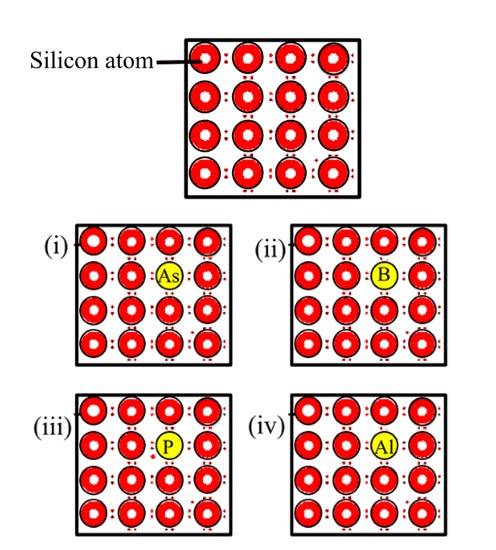
61. A perfect crystal of silicon (Fig. 1.1) is doped with some elements as given in the options. Which of these options show n-type semiconductors?

61. Options (i) and (iii) are correct since n-type semiconductors are prepared by doping silicon with pentavalent elements of group 15 (like P or As). Some of the lattice sites in silicon crystals are occupied by the fifth electron which is left over as extra electron and couldn't form a bond w
Upvote 60. Amorphous solid can also be called ________.
(i) Pseudo solids
(ii) True solids
(iii) Super cooled liquids
(iv) Super cooled solids
60. Amorphous solid can also be called ________.
(i) Pseudo solids
(ii) True solids
(iii) Super cooled liquids
(iv) Super cooled solids
60. Options (i) and (iii) are correct since the structure of the amorphous solids is similar to that of the liquids and hence they tend to flow like liquids, although very slowly. So, sometimes they are known as super cooled liquids or pseudo solids.
Upvote 59. The number of tetrahedral voids per unit cell in NaCl crystal is ________.
(i) 4
(ii) 8
(iii) Twice the number of octahedral voids.
(iv) Four times the number of tetrahedral voids.
59. The number of tetrahedral voids per unit cell in NaCl crystal is ________.
(i) 4
(ii) 8
(iii) Twice the number of octahedral voids.
(iv) Four times the number of tetrahedral voids.
59. Options (ii) and (iii) are correct since the number of tetrahedral voids per unit cell in NaCl is calculated as-
Since NaCl crystal forms fcc lattice so,
The number of atoms (n) per unit cell = 4
So, the number of octahedral voids = n = 4
While the number of tetrahedral voids
Upvote