Beyond the Syllabus: Six engineering marvels in India
 Call 8585951111Got Doubts?
“One man’s ‘magic’ is another man’s engineering. ‘Supernatural’ is a null word,” said American science fiction writer Robert A. Heinlein.
And yet the world is full engineering mysteries. From the Göbekli Tepe to the Pyramids, Chinese Terracotta Army to Macchu Picchu – we humans are still trying to solve the mysteries of the world and universe.
India too, has its own share of engineering mysteries.
In this series of Beyond the Syllabus, Shiksha.com takes a look at six unique engineering marvels – most of which are a part of ancient and lost India that we are still trying to re-discover.
1. Living Root bridges, Meghalaya
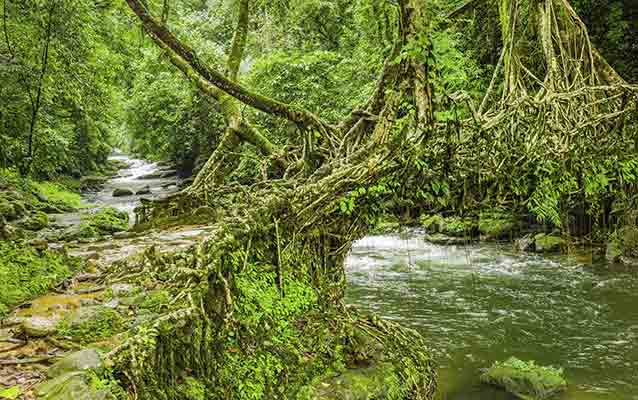
What a wonderful example of the coming together of nature and man!
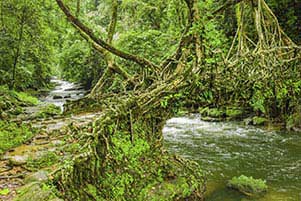
Around Cherrapunji in Northeast India, there’s something called ‘living root bridges’. These bridges are not constructed but grown.

“The development and upkeep of (living root) bridges is a community affair. Initially, a length of bamboo is secured across a river divide and a banyan plant, Ficus benghalensis is planted on each bank. Over the months and years, the roots and branches of the rapidly growing Ficus are trained along the bamboo until they meet in the middle and eventually supersede its support. At later stages in the evolution of the bridge, stones are inserted into the gaps and eventually become engulfed by the plant forming the beautiful walkways. Later still, the bridges are improved upon with the addition of hand rails and steps,” says Timothy Allen in humanplanet.com.
These root bridges can take ten to fifteen years to become fully functional, but are extraordinarily strong and can support fifty or more people at a time. Some of the bridges are more than 500 years old.
2. The Thanjavur Brihadeeswarar Temple
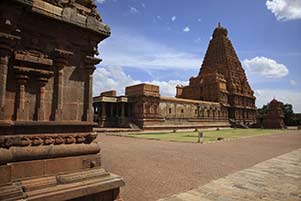
This 1000-year old temple’s engineering mystery hasn’t been solved till date.
Built by Raja Raja Chola, the entire process of construction of the temple is a mystery to archaeologists. It is not only one of the tallest temples in the world (tallest in India) but also the first complete granite temple of the world. Take a look at some interesting facts:
- The shadow of the temple disappears at noon.
- Archaeologists have no clue from where they the builders get such massive chunks of granite for construction. There’s no granite quarry within 100 km radius of the temple. Advanced techniques of epic proportions were used to get the granite stones to the construction site.
- A huge 81.3-ton capstone lies at the top of the temple tower. For ages, scientists couldn’t solve how such a huge stone could be placed at such heights. Later, remains of ramp (thousand years old) with gentle six-degree slope, pointing towards the top of the temple was found. The ramp began one mile away from the temple, and gradually intersected with the top of the tower 216 feet in the air.
- The temple has more than 100 underground passages (including secret passages) in the temple.
- The temple walls are adorned with beautiful colour paintings and murals
3. Yaganti Temple, Andhra Pradesh
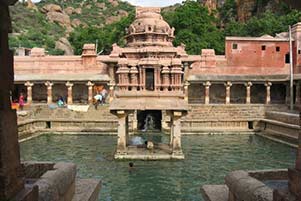
Pic Courtesy: Porus via Wikimedia Commons
Sri Yaganti Uma Maheswara Temple or Yaganti is a temple dedicated to Lord Shiva in Kurnool, Andhra Pradesh. There’s a small pond of water on the temple premises, known as Pushkarini. Water flows into this Pushkarini from the bottom of a hill through the mouth of Nandi (bull), Shiva’s vanah (mount). No one knows how the water reaches the pond throughout the year.
4. Indus Dancing Girl, Mohenjodaro

Pic Courtesy: National Museum, Delhi
Created in 2500 BC, the dancing girl is one of the rarest artefacts of the world, presenting the lifestyle, taste and cultural excellence of the people of an ancient civilization, Mohenjodaro.
According to the national museum artifacts, “The statue, recovered in excavation from 'HR area' of Mohenjo-Daro, is suggestive of two major breaks-through, one, that the Indus artists knew metal blending and casting and perhaps other technical aspects of metallurgy, and two, that a well developed society Indus people had innovated dance and other performing arts as modes of entertainment.”
A lost wax process (cire perdue) has been used to create this 4500 year old bronze statue.
5. The Iron Pillar, Qutub Minar
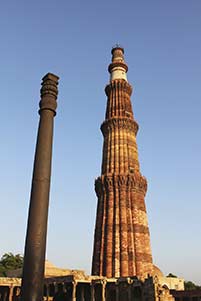
Our fifth engineering marvel lies within the complex of the famous Qutub Minar. The 23.8 feet tall Iron Pillar (built in fourth century) has baffled scientists for the rust-resistant composition of the metals used in construction. Also, the pillar has been brought from somewhere, else, as no other relics of the fourth century are found at the site.
After some scientific experiments, it has been found that the pillar is astonishingly pure or low in carbon compared with modern commercial iron. Scientists have also proved that “a thin layer of "misawite", a compound of iron, oxygen and hydrogen, has protected the cast iron pillar from rust.” (View source)
6. Sewage system of the of the Indus Valley Civilization
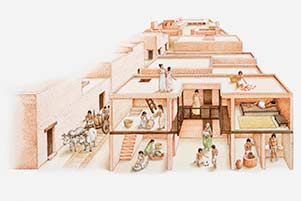
The ancient people too flushed toilets! And you thought it was modern science marvel. Indus valley civilization is known for their water-management. “They had well-constructed wells, tanks, public baths, a wide drinking system and a city sewage system. The Great Bath of Mohenjodaro is one of the best-known structures among the ruins. The civilization built the world’s first known drainage system. A central system connected every household with a drinking water well and a private bathroom.
What caused the end of the Indus civilization also remains a mystery.
