How to crack JEE Advanced 2014? Get tips from 2013 topper
 Call 8585951111Got Doubts?
Madiha Jawed | shiksha.com
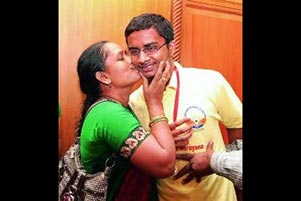
P Sai Sanddep
Two years of consistent and focused efforts led P Sai Sandeep climb the ladder of success in JEE Advanced 2013. With an All India Rank 1, this topper, started to prepare for the debutant exam early from Class 11th.
According to Sai, preparing efficiently without wasting any time and keeping yourself calm and confident are some of the mantras to crack JEE Advanced. However, letting yourself off the target and panicking at any stage of preparation are the things to avoid while taking the exam.
In an interview with shiksha.com, Sai gives the 2014 aspirants a sneak peak into his preparation strategy for the exam last year and also shares some tips and tricks to crack JEE Advanced.
Q. According to you, what is the minimum time frame needed to prepare well for JEE Advanced? How long did you prepare for it? What was your preparation strategy?
The minimum time required is to start preparing from class 11th. Two years of focused effort can give success in JEE advanced. Even I started preparing for JEE from class 11th. My strategy was:
- Complete syllabus in first year.
- Revise once (three times faster than in first year) by December. Remaining four months are for doing past year papers, other institute test papers, revising the theoretical aspects, especially, Chemistry.
Q. Is it necessary to join a coaching institute or is self-study good enough? What study plan did you follow for your prep?
Joining a coaching institute is not necessary but I would recommend joining one. A good competitive environment is very essential to bring the best in us and that is what the coaching institutes offer other than fine teaching and good practice papers.
Q. How did you divide your time between chapters/section? Which chapters/sections did you spend more time on?How did you work on improving your weak areas?
By the end of first reading (for me, by the end of Std 11th), one should get a clear idea about one's weak topics. To improve, you must get the conceptual clarity first. Read some good books on that topic.
I recommend reading more than one reference book. Read the notes your teachers give you. Getting your doubts clarified is the next part. This is very important. Ask your teachers, mentors, or try to find from the references. It is a very good habit to note down doubts and the answers to them from the beginning of preparation for JEE. The next important thing is practice. Practice gives confidence. Confidence is essential for cracking tough exams like JEE.
Q. How much time did you spend on revision?
I am less confident in Chemistry compared to Maths and Physics. So I used to spend half of my preparation time on Chemistry, remaining half distributed equally between Maths and Physics. I completed my syllabus by the end of Std 11th and spent the entire time in Std 12 in revising the syllabus.
Chemistry requires more time than Maths and Physics because there are a lot of things to remember in Chemistry than in Maths or Physics. We need to revise it many times. Writing short notes (a note where you write all the essential formulae, equations and properties) is highly recommended.
Topic that required special attention and more time is Inorganic Chemistry. It has lot of memory based stuff especially qualitative analysis.
In Maths, Integral Calculus and Probability are important topics to focus on.
In physics, Rotational Dynamics and Modern Physics are more important.
Q. Any useful study material/ reference books you can recommend to JEE Advanced aspirants?
For Maths:
- Arihant publications Integral Calculus and Differential Calculus
- R.D.Sharma
For Physics:
- Doing H.C.Verma is a must
- Irodov problems in physics
- Fundamentals of Mechanics and Fundamentals of Electrodynamics by Irodov are very good books
- D.C.Pandey series is also good, especially for practice.
For Chemistry reading NCERT books is very essential.
For Organic Chemistry:
l.G.Wade is a good book for theory and Himanshu Pandey for practice. Peter Sykes is also good book for concepts.
For Inorganic Chemistry:
- JD Lee is a good book
For Physical Chemistry:
- Peter Atkins & De Paula is an excellent book. Numerical Chemistry by Bahadur is a good book for practice.
Q. What did you do right to crack it?
Doing the right work at the right time along with completing my syllabus fast, and revising well, helped me achieve this rank.
Efficiency while working is an important factor. We should read efficiently. Concentration is the key for efficiency. Students should prepare with full concentration to achieve great results.
Q. 5 Top tips for JEE Advanced 2014
- Focus more on Chemistry and your weak chapters in all subjects
- Prepare efficiently. Plan every day and do not waste time.
- Always keep yourself calm and confident.
- Do rough work in exams neatly so that when you come back to questions later, you need not start all over again.
- Divide time wisely during the exam. Postpone any question that is taking more than the stipulated time. Come back to those questions at the end. Do not get stuck at a single question. You could rather do three easy ones in that time.
Q. 5 mistakes to avoid in JEE Advanced
- Do not panic at any stage of preparation and even in the exam. Tough questions will be tough for everyone not only you.
- Avoid bubbling mistakes.
- Do not take the results of exams conducted by coaching institutes too seriously. Always focus on the advanced exam. Do not feel over-confident if you do well in internal exams or otherwise. Don’t get discouraged if you don't do well in internal exams.
- Do not study from references outside the scope of JEE. See the syllabus of JEE. Keep a copy of the syllabus sheet. It is available online. It won't change much every year. Download previous year’s syllabus or the latest version, if available. Read the subtopics in reference books or materials which are there in the JEE syllabus.
- Focus. Do not let yourself go off the mark.
Explore more:
