Maths: Preparation Strategy for JEE (Main) 2014
 Call 8585951111Got Doubts?
By Ramesh Batlish
Mathematics is a subject where in many students face difficulties. However, aspires to clear JEE Mains, he needs to be an expert in this subject. So, let us decode JEE Mains 2014 maths exam and find out how you can easily score well.
Joint Entrance Examination (Main) is for all engineering aspirants who have appeared /passed Class XII Exam from National /State recognised boards. This Exam is conducted for admission to the National Institutes of Technology(NITs), Indian Institutes of Information Technology (IIITs), Indian Institute of Information Technology and Management (IIITM), Self Financed Deemed Universities and other Central & State Government Funded Institutions .
The structure of the exam:
Paper- I & Paper- II (Pattern)
Aspirants have the choice of appearing in anyone of the two types of papers or both. Paper - I is for those who wish to go only for B.E./B.Tech courses in colleges accepting JEE(Main)ranks while Paper - II is for those who wish to pursue a course in B.Arch/ B.Planning.
Paper – I : This is a 3 hr paper comprising of three sections Part I - Physics, Part II - Chemistry & Part III-Mathematics. There are 30 questions in each of three subjects Physics, Chemistry & Mathematics. The questions are of objective type- multiple choice with single correct answer. In each section there are 30 questions of 4 marks each. One should be very careful as there is ¼th negative marking for every question.
Paper – II : This 3 hr paper consists of Part I - Mathematics, Part II -Aptitude & Part III -Drawing . The Mathematics section has 30 objective type multiple choice questions with single correct option and ¼th negative marking. In this part, the syllabus for Mathematics are common topics from XI/XII CBSE/State board. The Aptitude section has 50 objective - multiple choice questions with four options and ¼th negative marking. This will test a student for Visualising three dimensional objects from two dimensional drawings, Visualising different sides of three dimensional objects and also analytical reasoning and mental ability. The Aptitude Test is designed to evaluate a candidate’s perception, imagination, observation, creativity and architectural awareness. The Drawing section has two to three questions involving sketching of scenes and activities from memory of urban-scape (public space, market, festivals, street scenes, monuments, recreational spaces etc.), landscape (river fronts, jungles, gardens, trees, plants etc.) and rural life.
Candidates must carry pencils, own geometry box set, erasers and colour pencils and crayons for the Aptitude Test.
A. Relevant Study material:
Books shaping your conceptual understanding should be preferred while preparing for JEE (Main). There is a plethora of problem solving books. Also solving other competitive examination problems never harms. Practice a lot. We have a comprehensive and pattern- proof study material for our students. We have the expertise and wherewithal to constantly upgrade the material.
In JEE (Main)-2013, the paper was of total 360 marks and there were 90 questions (30 each in Physics, Chemistry and Mathematics) each of 4 marks along with 1/4th negative marking.

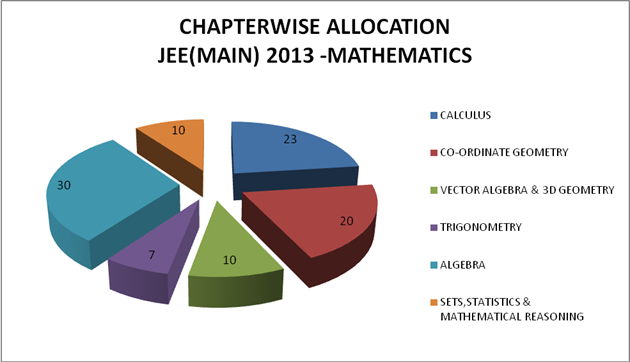
In Mathematics, 32% questions were easy, 58% Medium level and 10% difficult. More weightage was given to chapters of Algebra, Calculus and Co-Ordinate Geometry.
Tips for JEE (Mains): Mathematics
- Previous JEE papers suggest that more attention should be paid on Vectors and 3-D than probability or Indefinite integration as vectors and 3-D offers very less scope to examiner, as far as variety in problem is concerned. One more chapter is Complex Number, every year 2-3 problems (of purely complex no.) are asked. Hence mastering complex numbers, vectors, 3-D and Definite integral must be on top priority.
- Keeping in mind the trend of last years’ paper all topics had been covered with more importance given to topics of Algebra, Calculus and Co-ordinate Geometry.
- To tackle questions from Co-ordinate Geometry all aspects and the results of Algebraic Calculations of properties of conics must be known.
- Trigonometry though having less weightage must not be ignored as it is scoring. One must grasp all important important formulae in Trigonometry.
- Chapters like Mathematical Reasoning /Determinants must also be covered to fetch some quick marks as the questions from this chapter are relatively simple.
- Refer to past years’ AIEEE papers, and sample test papers to understand what to expect in the exam.
