Physics: Preparation Strategy for JEE (Main) 2014
 Call 8585951111Got Doubts?
By Ramesh Batlish
Joint Entrance Examination (Main) is for all Engineering aspirants who have appeared /passed Class XII Exam from National /State recognised boards. This exam is conducted for admission to the 30 National Institutes of Technology(NITs), 9 Indian Institutes of Information Technology (IIITs), Indian Institute of Information Technology and Management (IIITM), 32 Self Financed Deemed Universities and other 14 Central & State Government Funded Institutions . The exam also restricts the number of attempts to three. JEE (Main) 2014 will be held offline on April 6, 2014 at 127 cities (including Bahrain, Dubai, Muscat & Riyadh) and Online between April 9 -19, 2014 at 365 cities (including 7 cities abroad).
What are the subjects and what is the level of difficulty?
Clearing JEE (Main) is not a difficult task .Systematic approach towards its preparation will help students get admission into one of the top National Institutes of Technology (NITs). JEE (Main) consists of CBSE syllabus of Physics Chemistry & Mathematics and some common topics from 11th & 12th of State boards. About 25% questions in the examinations paper are easy, 50% are average and 25% are difficult. The cut-off for JEE (Main) is generally around 60% for NITs & IIITs.
How to prepare for JEE (Main)?
FIITJEE expert says, a two year planned, organized preparation for JEE (Main) is all that is required. Every set of problems needs to be approached differently and with a separate methodology. Regular practice makes a student confident to tackle the problems. Speed and Accuracy is the key to success.

Books shaping your conceptual understanding should be preferred while preparing for JEE (Mains). There is a plethora of problem solving books. Also solving other competitive examination problems never harms. Practice a lot. FIITJEE have a comprehensive and pattern- proof study material for our students. We have the expertise and wherewithal to constantly upgrade the material.
In JEE(Main) -2013, the paper was of total 360 marks and there were 90 questions (30 each in Physics, Chemistry and Mathematics) each of 4 marks along with 1/4th negative marking.
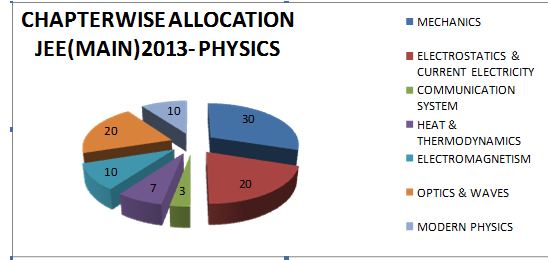
In Physics it was found that 40% questions were easy, 52% medium level and 8% difficult. More weight age was given to chapters like Mechanics, Electrostatics & Current Electricity and Optics& Waves.
Useful tips to crack Physics in JEE Main 2014:
1. Mechanics is one topic of Physics that is considered less scoring by most experts. However to add to the dilemma this is also the topic that forms the major portion of the JEE (Main) in terms of marks. So this topic cannot be neglected.
2. One must also try to concentrate on other scoring topics to ensure a better performance, for example Optics, Electricity and Magnetism, etc.
3. Kinematics and Particle dynamics are very important topics of Mechanics that make regular appearance in the AIEEE papers.
4.Refer to past years’ AIEEE papers, and sample test papers to understand what to expect in the exam when you have started solving advanced level problems.
5. According to the general trends, Mechanics and Electricity and Magnetism are the most important topics in terms of the number of questions asked in AIEEE of previous years.
6. In the decreasing order of the marks they carry are listed different topics of Physics according to their appearance in previous year’s papers.
- Mechanics and Electricity and Magnetism (Equal importance)
- Modern Physics
- Optics
- Heat and Thermodynamics and Waves and Sound
- Measurement and errors
7. Thermodynamics is important from the terms of both Physics and Chemistry so concentrate on that as well. It is wise to cover Wave Optics first in ‘Optics’ topic. The reason is that the portion is smaller compared to Ray Optics thus quick to cover.
8. As it has already been discussed that Mechanics and Electricity and Magnetism are the most important topics of Physics, it must be kept in mind to have a clear understanding of the basic concepts of these chapters. Vector is one concept that students very commonly encounter in dealing with any of these topics, so effort must be taken to understand it properly.
About the author:
IITJEE & AIEEE expert Ramesh Batlish is Centre Head, NOIDA FIITJEE. He holds a BE in Electronics &Telecom (Hons). He is a senior Mathematics faculty with over a decade of successful association with IIT JEE.

Comments
(1)