Shiksha Opinion: Are we ready for one-nation-one-exam?
 Call 8585951111Got Doubts?
Chhavi Sharma | Shiksha.com
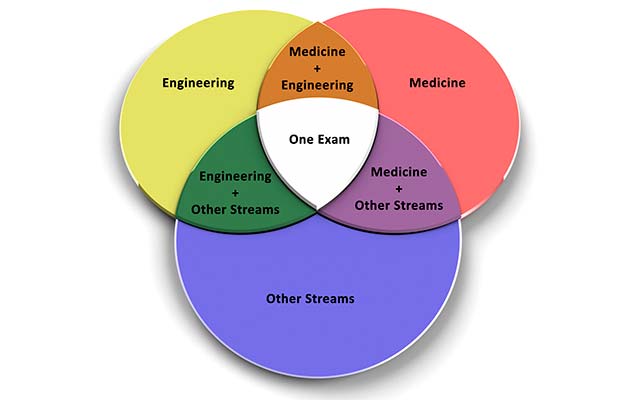
In 2012, the then Human Resource Development Minister Kapil Sibal had proposed a one-nation-one-exam plan, hoping that such an initiative would help bring clarity in the minds of students and also reduce exam stress. The idea was to emphasise more on Class 12th board exams, rather than the entrance tests.
After all, most students start preparing for their engineering or medical entrances right after their Class 10th board exams. What’s worse is that some even lodge themselves at the various engineering coaching centres at towns like Kota for more than two years in an attempt to get that prestigious IIT seat.
And then, apart from the all-important JEE, there are other exams like EAMCET, BITSAT, TANCET, VITEEE, etc not to mention the common entrance tests conducted by various states. Most students take multiple exams merely as a back-up plan rather than due to any keen interest in those specific institutes and the courses they offer. In the process, they need to prepare for each of these exams in a different fashion, leaving them almost clueless at the end of the day regarding what they actually want to pursue. And mind you, here we are not even talking about the huge amounts parents dish out on coaching centre fees, hoping that will help equip their children to face the toughest entrance tests.

Yet another issue with the multiple exams that troubles me is that a certain set (read that as the creamy layer) of 10-15 students make the toppers’ list of almost every other entrance exam, thus blocking seats in all institutions and I feel this leads to avoidable stress situation for students at the lower end of the rank list.
When NEET (National Eligibility-cum-Entrance Test) was introduced in 2013 for medicine courses, there was hope that it was a step in the right direction. It was hoped that eventually, medicine aspirants would be saved the trouble of taking multiple entrance exams in the attempt to gain an MBBS admission. But due to widespread apprehension and the resultant uncertainty it brought along for the students, the exam was scrapped within one year of being launched, taking us back to square one.
If anything, the whole episode made it clear that students, parents and even educators (institutions) seem attuned to a certain system and refuse to accept change. We crib about the sorry state of our education system but when the government does take a step forward to improve things, we are often found taking a step backwards.
The recent introduction of computer-based JEE in 2013, is another glaring example of this, wherein, out of the 12.8 lakh students who applied for the exam only 1.7 lakh chose the computer-based option. Some students I spoke to shared that since there was not a pen-and-pencil exam centre in their vicinity, they travelled to the closest centre just to be able to take the exam in the pen-and-pencil mode and escape the pressure of giving a computer-based exam which they felt "could be flawed". In a country where software and IT industries thrive, we don't seem to trust technology for some of the major decisions we need to take.
The concept of multiple entrance exams seems to have one thing in its favour. If a student is not able to sit for one exam, say the JEE, due to some personal reason or sudden illness then he/she has the option to take an attempt at the state CETs. But that issue could be solved with the single entrance exam too.
We have excellent examples in solving all these issues in international exams such as SAT (Scholastic Aptitude Test) and GMAT (Graduate Management Aptitude Test) where students can book a date for their exam as per their convenience and if the exam doesn’t go well the first time they even have the option to re-take the exam in a given time frame. The questions are customised during the exam to suit the students' aptitude. The performance of a student is not judged in terms of ranks, thus taking away the entire concept of toppers and the resultant stress.
However, in India, we still have a long way to go, I am not expecting changes overnight. But bringing NEET back or even making JEE a common entrance test for all engineering colleges should not be all that difficult.
I might be a minority here but I feel in the long run a centralized entrance exam pattern is the way to go and I also believe the government is looking to make it a reality in the interest of the students. However, they need to put in extra efforts and a foolproof methodology in devising the perfect entrance exam pattern keeping the Indian education system in mind. It looks like a daunting task right now, but could pave the way for a brighter future.
