Shiksha opinion: Is our education system fair to general category students?
 Call 8585951111Got Doubts?

Come admission time in schools or colleges, perhaps one of the most discussed topics, apart from cut-offs, is quotas / reservations / categories. An inconclusive debate with no clear cut lines has raged on in the country for nearly two decades now, sometimes in increased volumes and at other times in lower tones but never really going away.
As far as I know, the reservation system was introduced to bring the underprivileged classes at par with the more privileged. Traditionally marginalised societies, castes and tribes, it was hoped, would benefit from these. However, looking at the current scenario, the whole premise of establishing this system seems to have lost its purpose and value. Sometimes, perhaps, in our attempts to neutralise the effects of marginalising a community, we are harming others.
Let's take the case of JEE (Joint Entrance Examination), one of the most crucial engineering exams in the country. On May 3, JEE Main 2014 Paper 1 cut-offs were declared through which candidates were to apply for JEE Advanced. The cut-off for the general category (Common Merit List -CML) was 115, the cut off for OBC (NCL), SC and ST was 74, 53 and 47, respectively. And almost immediately social media exploded with reactions of students over the issue of reservations and the resulting differences in cut-offs.

While it left students from the general category fuming over the cut offs, I, belonging to the "reserved" category, too felt the system wasn’t fair. And I know others like me who feel the same.
Soon after, on May 12, 2014, following the orders of the HRD Ministry, the National Institutes of Technology (NITs) across the country doubled their annual course fees from the current academic year to Rs. 70,000 per student per year.
While this hike in itself was a shock, the appaling fact was that the fee hike was only for the non-reserved category students (general category students) and there were no changes in the existing exemptions of tuition fees for SC and ST students.
It certainly left me amazed, irritated and worried; worried for the future of the general category students in this country. Is our system of quotas and reservations hindering a large section of students and curbing their opportunities?
Check out this image below. In 2013-15, a general category candidate with a 98 % score (4000 rank out of approximately 200,000 applicants) did not get admission into IIM-A. However, a 90%ile (20,000 rank) from OBC, a 72 %ile (56,000 rank) from SC and a measely 40%ile (120,000 rank and probably a negative score) from ST category did.
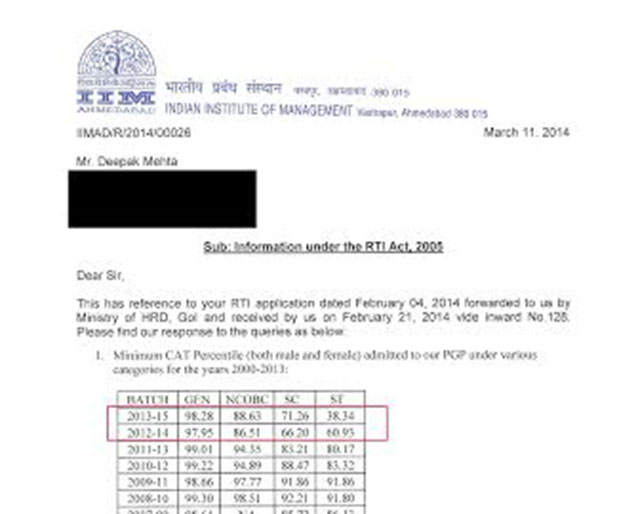
We could take a satirical view of considering general category for ‘Reservation’. Afterall, general category students feel like individuals from the reserved category because of the striking difference and disparity they are subjected to. After all, in some universities or institutes, the general category seats are less than 10%.
We are not saying that general category or the reserved category students should be given more importance or benefits over the other, but that there should be equality, so that students from any of these categories aren't left cynical or disparaged by our education system. After all, qualifying students based on their merit is the basis of these exams.
While we commonly acknowledge that research and development is one of the most ignored fields in Indian institutes, the quotas and reservations add another layer of difficulty in attracting and admitting the right talent.
The reservations might also be an important factor adding to brain drain. Facing the difficulty of caste-based reservations in India; parents who can afford sending their wards abroad may encourage these students to go and fend for themselves in countries offering them equal opportunities among their peers.
Factually, reservation was supposed to last for only 5 years after independence. But through an ever-expanding scheme of reservation, we have lost sight of what our aim was in the first place. Are these reservation still prevalent to ensure that all communities achieve equal status or is it basically to derive political mileage, we are left wondering!

Comments
(1)
s
2014-05-23 16:27:39