“Everything about us is international!”
 Call 8045680126Got Doubts?
Garima Upadhyay Rawat
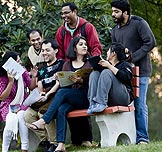
The South Asian University (SAU) situated in Delhi promises to offer you excellent faculty, an exciting course curriculum, and a culturally enriching environment. It is an international university which was set up by the South Asian Association for Regional Cooperation (SAARC) member nations and started its academic journey in 2010. Here, Shiksha.com interviews the vice president of SAU, Rajiv K. Saxena to understand the university and its future plans. Excerpts from an email interview…
Q. In its third year currently, the South Asian University has come a long way from being a prestigious project of the SAARC nations to an international university. How has the academic journey been? What have been the biggest challenges?
The academic journey at South Asian University since the first session started in July 2010 has been nothing less than an exciting one – despite many challenges that start-up institutions usually face and especially a unique set up like ours, we have been able to put in place an excellent set of faculty members, course curricula that may become models of reference for the world and create a highly stimulating academic atmosphere.
In this short span of three years, the dream that was envisaged at the inception of this university is already taking concrete shape. Space constraint has been a challenge we have been facing but very soon it will be over as the Government of India has quite considerately allotted us a 100 acre campus in Maidan Garhi, where the construction is expected to start very soon.
Q. SAU is a blend of different cultures, nationalities and beliefs. How does this eclectic assortment add to the all-round development of any individual studying here?
South Asian University is a platform that gives exposure to the students of the South Asian region in a unique way. Students get new perspectives and learn to appreciate different viewpoints from students coming from different countries and cultural backgrounds. It also gives them an opportunity to learn and discover first hand about the vibrant cultures of the region. The students celebrate festival and cultural events of the region together with inspiring camaraderie.
One of the main objectives of establishing South Asian University, besides equipping the young minds of the region with cutting edge knowledge on various subjects, is to imbibe a sense of belongingness to the region, something we term as ‘regional consciousness’. We have many instances in our campus where we have evidenced this feeling among our students.
Q. Intertwined history and geo-political events unite students at SAU. How does the university take cognizance of this in its curricula and teaching pedagogy?
What differentiates SAU, when it comes to the course curricula, from other institutions of higher studies in the region is the content of the programmes of studies, which are prepared keeping in view the larger perspective of the region and the world. We have also introduced a compulsory course titled “Introduction to South Asia”, which every student must pass to get their final degrees. Very carefully structured with well researched content, this course will keep the students of SAU well abreast with the history, commonalities, challenges and future prospects of the region. I may also mention here that our faculty is drawn from various SAARC nations and hence makes for an enriching experience for the students.
Q. Why should any student consider studying at the South Asian University?
For many reasons, in fact. SAU is an international university which provides exceptional exposure to a unique environment. The faculty here is comparable to that of the best universities in the world. The programmes of studies offered here are unique in nature. The university provides a number of student-friendly facilities. The fees are highly subsidised for students from the SAARC nations. Liberal number of scholarships and other financial assistance are on offer for meritorious and students with limited resources.
Q. Where do your students go after completing their degrees?
Only one batch of MA Development Economics has passed out so far from the university. Many of these students are currently employed in research institutions across the South Asian region while some are preparing to pursue further studies. A large number of students are passing out in 2013 from our university and we are quite excited to think of the prospects. A degree from SAU opens up a lot of possibilities for the students.
We have set up a Placement Cell that is looking into the placement and career opportunities for our students. Incidentally, we are starting our doctoral programmes from this academic year and we are overwhelmed with the number of applications we have received, many of our past and existing students have also applied for the same.
Q. Can you shed some light on the kind of research projects that are taking place in the university?
SAU is essentially a post graduate and research university and at the time of recruitment, research acumen of the candidates carries the maximum weightage . We are currently running seven academic programmes and faculty members of each of these departments carryout research in their own areas. Research work in social science disciplines (Sociology, International Relations, Law and Economics) is generally focused on research problems in the South Asian context. Science is essentially international in nature and the research problems pursued by the Faculty of Biotechnology, Computer Science and Applied Mathematics are in the cutting edges of these disciplines. Faculty of Biotechnology especially has developed research facilities that are state of the art.
Q. Do you have some student exchange programmes with other universities in SAARC member countries? Can you elaborate in what areas you have these partnerships?
Currently we don’t have any partnership with any university. We are contemplating many offers for partnerships at various levels. Being a young university, we have to take into account many factors before accepting offers or before reaching out for partnerships with institutions of higher education in the South Asian region or around the world.
Q. Since the university is in India, how much does the ‘idea of India’ influence the university’s functioning?
South Asian University, like I mentioned earlier, is an international university and everything about it is international – right from the student, faculty and staff composition. We have a rigidly guarded quota system for all the SAARC nations. Although India has about 75% of the total population of the region, the number of students from India must not exceed 50% of the total students. The university administration is governed by various committees which have uniform representation of members from all the participating countries. The highest such authority, for example, namely the Governing Board has two members each from the member nations. The President’s office would be occupied on a rotational basis. Hence everything about the university is fairly democratic, even though the government of India is bearing the entire capital cost for the construction of the campus and is taking care of about half of the total operational cost.
Q. Can you shed some light on financial assistance/ scholarships you offer students?
A liberal number of scholarships is being provided to the students. The scholarship schemes at SAU broadly come under three major categories: SAU President’s Award — to those successful candidates who top the entrance examination merit list of their respective countries and are placed within the top 10 percentile of the combined merit list of their subject; the SAARC-India Silver Jubilee Scholarship — awarded to students belonging to the least developed SAARC countries and the SAU Scholarship/Financial Support — awarded to students on a need cum merit basis. Of the 260 students who applied for the scholarship programme at the South Asian University (SAU) for this academic year, as many as 256 have been awarded scholarships and financial support of various kinds. A maximum SAU Scholarship carries a total fee waiver on the tuition fee which works out to around Rs.22,000 per semester and a monthly living allowance of Rs.7000. The awardee also gets to stay in the hostel without having to worry about the fee. Additionally, a fixed one time start-up amount is also given to all the fresh scholarship awardees.
Q. Any new partnerships or announcements in the offing for SAU?
Well, we are starting the PhD programmes from July 2013. We are also working out to soon launch the Institute of South Asian Studies, which will be a think tank research centre for the scientists, academicians and scholars from the region. The construction of the main campus at Maidan Garhi is expected to start sometime this year.
