Online Education in India: Trends & Future Prospects, Growth Opportunities
 Call 8045680126Got Doubts?
The online education in India is at a boom and is undergoing rapid changes driven by technological advancements and the changing needs of society. Read the article below to know more about the online education trends and its future prospects in India.

Online Education in India: With the development and advancement of technology, India has witnessed an enhanced acceptance of online education over a period of a few years. Online education in India has skyrocketed, and the concept of learning has undergone changes. Many students and working professionals have joined different e-learning platforms in the past few years in order to enhance their skills. And, looking at trends, the number of people adopting online education platforms is expected to increase significantly in the near future. According to studies, online education has grown by 900% since 2000, and it is expected to take a big leap by 2028.
There has been a significant shift in India's approach towards education and learning. With a rapid technological transformation and a spurring in internet usage, the trend of online education in India has democratized access to quality education by overcoming geographical and socio-economic barriers. This massive transformation is driven by rapid digital adoption, EdTech innovations.
Emerging Trends in the Indian Online Higher Education System
India has one of the largest higher education systems in the world. It mainly consists of three parts: university, college, and course. And, all parts of the higher education system are governed by the University Grants Commission and its professional councils.
There has been a huge change in the dynamics of learning. Online higher education in India is evolving, and different private universities have emerged offering undergraduate and postgraduate e-learning courses to students. However, as compared to graduation and diploma courses, the demand for online higher education is dominated by post-graduation courses such as MBA and MCA (as evident in the graph below).
According to various education websites and platforms, the field of business management studies has seen the highest shift towards online education, with a 28% increase.
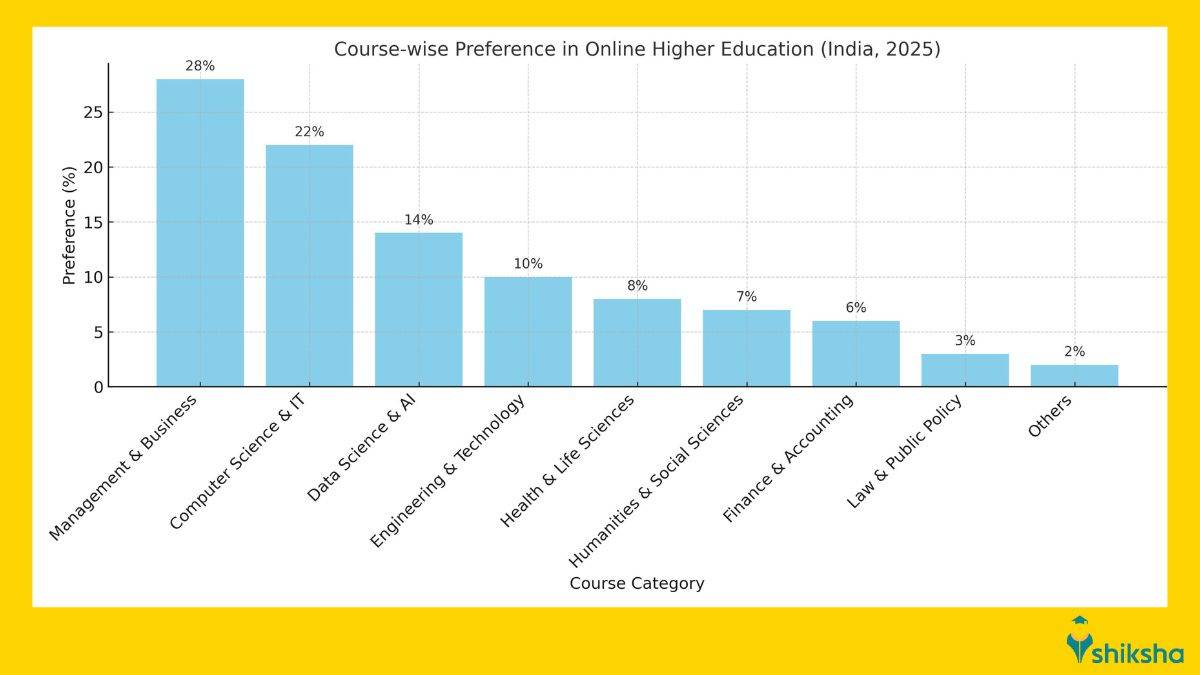
Course-wise preference of online education in India
Also, look at the kind of courses adopted by students and working professionals in tier 1 and tier 2 cities.

Online course preference across tier 1 and tier 2 cities
Source: KPMG Report: Online Education in India: 2021
As is evident in the graph above, tier 1 cities have higher adoption of various postgraduate courses such as MBA, MCA, MTech, and BEd/MEd. However, in tier 2 cities there is a high demand for only those courses that can offer lucrative job opportunities to students such as MBA and MCA.

Commonly asked questions
Yes, candidates are required to submit proof of domicile in case availing the home-state quota in NITs. It is only NIT where admission is offered against the Home State quota.
Candidates home state is determined based on the state from which you appear for your 12th board exam and on the basis of the state to which you belong.
The participating institutes of JEE Main are the colleges that participate in the JoSAA counselling for admission in various Engineering, Architecture and Planning courses. Besides JEE Main participating institutes, many colleges offer admission based on the scores of JEE Main but are not a part of JoSAA. Such institutes organise their counselling process for admission.
There are a total of 31 NITs, 25 IIITs and 19 other GFTIs that participate in JoSAA counselling. The number of seats in these institutes can be checked below. Other institutes which offer admission based on JEE Main scores are from the states which do not conduct their entrance exams for engineering admission and include U.P., Bihar, M.P., Delhi, among others.
Mechanics portion in class 11th is huge. The chapters are:
- Units of Measurement
- Laws of Motion
- Motion in straight line
- Motion in plane
- Work, Energy and Power
- System of Particles and Rotational Motion
- Rotational Dynamics
- Gravitation
- Mechanical properties of Solids and Fluids.
Yes, BSc Nursing course admission is conducted through NEET scores for certain colleges. Hence, if you are planning to pursue Nursing courses, then you can appear for NEET. While filling the NEET application form, you need to select the courses or colleges. If you qualify for the exam by securing the cutoff marks, and be eligible for the counselling process, there you have to select the Nursing courses or colleges which you are vying for. However, a few top colleges or institutes are still conducting their own Nursing entrance exams, such as AIIMS, PGIMER, KGMU, to name a few.
Explore more B.Tech exams with upcoming dates

24 Oct '26
30 Oct '26
1 Jun '26 - 31 Oct '26
31 Oct '26
7 Nov '26
JEE Main

1 Nov '26 - 30 Nov '26
1 Nov '26 - 30 Nov '26
18 Dec '26
9 Jan '27 - 10 Jan '27
Online Education: Why it is Gaining Popularity and Future Prospects
There are many reasons why students and working professionals are moving towards e-learning/ online education. Have a look at some such reasons below:
- Personalized Learning Modules: One of the major reasons for this significant shift towards online education and e-learning is the availability of personalised learning modules. Students no longer need to follow one-size-fits-all approach. Instead, they have the opportunity to access the content and learning materials tailored according to their need and preferences.
- Mobile Learning and Social Media: Learning for students has become easily accessible. One does not really have to set foot on the campus to get an official degree. With the proliferation of mobile phones and tablets, M-learning or mobile learning has become a very popular trend. Students prefer learning materials which can be accessed anytime and anywhere. This has made learning accessible and convenient. There is also an option of virtual classrooms. This enables global accessibility and inclusivity. Online education can reach learners from around the world. Universities are constantly working on increasing their global reach. This has fueled the internet development and infrastructure. The future of online education points at accesibility of education to every student regardless of their background, location and opportunities.
- Flexibility of Time: This is specifically true for working professionals who have time constraints in pursuing an offline course. Pursuing a course in an online mode allows a person to multitask with other work and family commitments. Also with the growth of e-learning and online education, the job markets have become highly competitive. Many learners are opting for short-term courses which are more targetted to education experiences. In the upcoming years, the demand of short term courses and micro-credentials is expected to grow significantly. Some university and institutes have already started offering such courses and credentials in fields like data science, Artificial Intelligence, Digital Marketing, etc.
- Quality Education: There are areas in India which lack quality offline education. Enrollment in online education in India has been ever-growing. There was a 70% increase in online education enrolment from 2021 to 2022. Online education comes with the support of the concept of life long learnings. Online education focuses on soft skills such as communication, adaptability and problem-solving along with technical skills at the core. This is crucial for the rapidly changing job market needs.
Also read: Student Enrollment in Universities: Regular vs Distance Education
- Government Initiatives and Augmented Virtual Reality: The government’s initiatives, such as SWAYAM, e-Basta, and Digital India, are expected to strengthen the infrastructure needed by students to pursue education in an online mode. The integration of Augmented virtual reality technology has revolutionised the online education trend in India and across the world. It is predicted that by the year 2025, integration of virtual reality and AI will become more accessible and affordable, offering the students opportunities in ways unimaginable.
- Accessibility and Affordability: Online courses offered at UG or PG level are much more affordable than traditional programmes. As said above, online education has surpassed socio-economic barriers and has democratized the learning process. Advances in technology and waves of internet accessibility is growing and will continue to grow that will ensure that students in even the remotest areas can access quality education.
Also Read: Best free online education resources
- Exam preparation through online education: The number of students adopting online platforms for exam preparation is expected to increase significantly in the coming years. The different online platforms could either act as a substitute or complement the existing offline test prep market to provide coaching to students for various exams such as JEE Main, NEET, CAT, Bank PO, and CLAT. About 90 per cent of the students prefer online modes over offline coaching.
Many new players have emerged in the online test prep market which have launched exam-specific mobile applications for students. Apart from that, the lack of good faculty in tier 2 and 3 cities is also driving candidates from these areas to adopt online platforms for exam preparation.
A hybrid model is expected to gain traction in future, where online players are expected to open offline centres to provide classroom-like experiences to students. Also, gamification, the approach of introducing fun elements like video game design in learning, is likely to gain popularity in India.
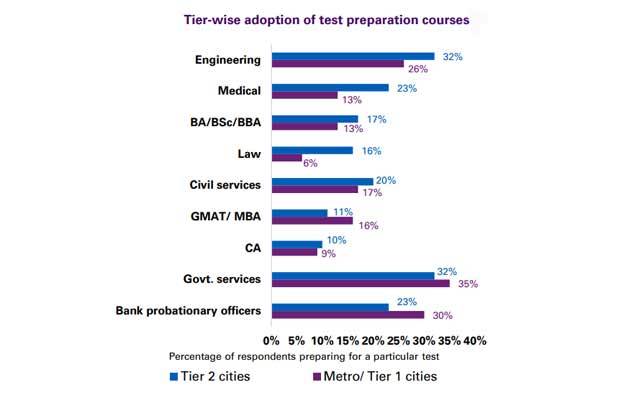
Tier-Wise Adoption of Online Test Prep Courses
Source: KPMG Report: Online Education in India: 2021
There is a higher adoption rate for job-focused test prep (such as for Bank PO, GMAT/ MBA, and other government services) courses in tier 1 cities. On the other hand, in tier 2 cities, candidates are more inclined toward taking online test prep for UG courses (related to streams such as Engineering, Medical, and Law).
Ways in which online education helps candidates prepare efficiently for different competitive exams are as follows:
- Webinar: A seminar conducted in the online mode is referred to as a webinar. These days many online players conduct webinars that help candidates with conceptual clarity.
- Mock tests: Mock tests are emerging as a popular course component for students wherein they participate in a series of tests and get a comparative assessment (with other students) of their performance. With mock tests, candidates also get to know their areas of improvement as well as the exam pattern of the competitive exam they are planning to appear for.
- Videos: Videos are helpful for candidates in solving exam papers and other problem areas.
- Counselling: As a differentiator, players in the online test prep market have also started offering course and career counselling services to students.
Read More:
Comments
(3)
Z
5 years ago
S
6 years ago
6 years ago
Saumya Jain is an English Literature graduate from the University of Delhi. She has over 8 years of editorial and content writing experience. At Shiksha.com, she has spent more than six years creating research, stud
Read Full Bio