
Application of Derivatives
Get insights from 282 questions on Application of Derivatives, answered by students, alumni, and experts. You may also ask and answer any question you like about Application of Derivatives
- 282
Questions
- 0
Discussions
- 0
Active Users
- 0
Followers
Have a question about Application of Derivatives? Ask our experts
Keep it short & simple. Type complete word. Avoid abusive language.
The number of points, where the function f : R R,
is NOT differentiable, is:
The number of points, where the function f : R R,
is NOT differentiable, is:
x = 1, 4 (doubtful points)
Diff. at x = 1
Not diff. at x = 4
 Upvote

Let f be a differentiable function in If then is equal to.
Let f be a differentiable function in If then is equal to.
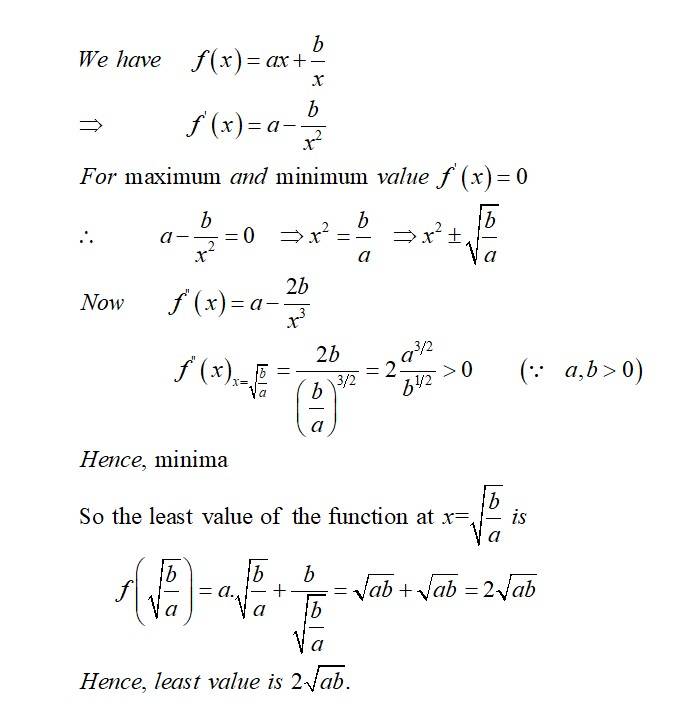
The least value of the function f(x) = ax + ( ), where a > 0, b > 0, x > 0, is ___.
The least value of the function f(x) = ax + ( ), where a > 0, b > 0, x > 0, is ___.
This is a Objective Type Questions as classified in NCERT Exemplar
Sol:
 Upvote
The function f(x) = , x > 0 decreases in the interval ___.
The function f(x) = , x > 0 decreases in the interval ___.
This is a Objective Type Questions as classified in NCERT Exemplar
Sol:
Upvote The values of a for which the function f(x) = sinx – ax + b increases on R are __.
The values of a for which the function f(x) = sinx – ax + b increases on R are __.
This is a Objective Type Questions as classified in NCERT Exemplar
Sol.
Upvote The equation of the normal to the curve y = tanx at (0, 0) is ____.
The equation of the normal to the curve y = tanx at (0, 0) is ____.
This is a Objective Type Questions as classified in NCERT Exemplar
Sol.
Upvote The curves y = 4x² + 2x – 8 and y = x³ – x + 13 touch each other at the point ___.
The curves y = 4x² + 2x – 8 and y = x³ – x + 13 touch each other at the point ___.
This is a Objective Type Questions as classified in NCERT Exemplar
Sol:
Upvote The maximum value of (1/x)x is:
(A) e
(B)
(C)
(D)
The maximum value of (1/x)x is:
(A) e
(B)
(C)
(D)
This is a Objective Type Questions as classified in NCERT Exemplar
Sol:
Upvote