
Electrochemistry
Get insights from 145 questions on Electrochemistry, answered by students, alumni, and experts. You may also ask and answer any question you like about Electrochemistry
- 145
Questions
- 0
Discussions
- 0
Active Users
- 0
Followers
Have a question about Electrochemistry? Ask our experts
Keep it short & simple. Type complete word. Avoid abusive language.
Λ0m(NH4OH) is equal to ______________.
(i) Λ0m(NH4OH) + Λ0m(NH4Cl) - Λ0(HCl)
(ii) Λ0m(NH4Cl)+ Λ0m(NaOH) – Λ0 (NaCl)
(iii) Λ0m(NH4Cl)+ Λ0m (NaCl) – Λ0(NaOH)
(iv) Λ0m(NaOH) + Λ0m (NaCl) –Λ0(NH4Cl)
Λ0m(NH4OH) is equal to ______________.
(i) Λ0m(NH4OH) + Λ0m(NH4Cl) - Λ0(HCl)
(ii) Λ0m(NH4Cl)+ Λ0m(NaOH) – Λ0 (NaCl)
(iii) Λ0m(NH4Cl)+ Λ0m (NaCl) – Λ0(NaOH)
(iv) Λ0m(NaOH) + Λ0m (NaCl) –Λ0(NH4Cl)
This is a Multiple Choice Questions as classified in NCERT Exemplar
Ans: Correct Option: (ii)
Given: Salt ammonium hydroxide
Apply Kohlrausch Law
Kohlrausch law of states that limiting molar conductivity of any salt species is equal to the sum of the limiting molar conductivity of cations and anio
 Upvote

While charging the lead storage battery ______________.
(i) PbSO4 anode is reduced to Pb.
(ii) PbSO4 cathode is reduced to Pb.
(iii) PbSO4 cathode is oxidised to Pb.
(iv) PbSO4 anode is oxidised to PbO2 .
While charging the lead storage battery ______________.
(i) PbSO4 anode is reduced to Pb.
(ii) PbSO4 cathode is reduced to Pb.
(iii) PbSO4 cathode is oxidised to Pb.
(iv) PbSO4 anode is oxidised to PbO2 .
This is a Multiple Choice Questions as classified in NCERT Exemplar
Ans: Correct Option: (i)
In the lead storage battery, a reverse reaction occurs and lead sulfate is formed at the anode, and at the cathode, it is converted into lead and lead oxide respectively. The reaction is as follows
At the catho
Upvote The cell constant of a conductivity cell _____________.
(i) Changes with the change of electrolyte.
(ii) Changes with the change of concentration of electrolyte.
(iii) Changes with the temperature of the electrolyte.
(iv) Remains constant for a cell.
The cell constant of a conductivity cell _____________.
(i) Changes with the change of electrolyte.
(ii) Changes with the change of concentration of electrolyte.
(iii) Changes with the temperature of the electrolyte.
(iv) Remains constant for a cell.
This is a Multiple Choice Questions as classified in NCERT Exemplar
Ans: Correct Option: (iv)
The cell constant is described as the ratio of the length of the object and the area of cross-section. It can be written as follow
G=
As l and A remains constant for an object it can be inferred that the cell
Upvote The quantity of charge required to obtain one mole of aluminium from Al2O3 is ___________.
(i) 1F
(ii) 6F
(iii) 3F
(iv) 2F
The quantity of charge required to obtain one mole of aluminium from Al2O3 is ___________.
(i) 1F
(ii) 6F
(iii) 3F
(iv) 2F
This is a Multiple Choice Questions as classified in NCERT Exemplar
Correct Option: (iii)
Ans: Given: One mole of aluminium
Calculate the number of electrons required to convert Al2O3 to Al
It is the charge required to obtain one mole of aluminium from Al2O3
The dissociation of aluminium oxide is a
Upvote Use the data of Q.8 and find out the most stable oxidised species.
(i) Cr3+
(ii) MnO4–
(iii) Cr2O72–
(iv) Mn2+
Use the data of Q.8 and find out the most stable oxidised species.
(i) Cr3+
(ii) MnO4–
(iii) Cr2O72–
(iv) Mn2+
This is a Multiple Choice Questions as classified in NCERT Exemplar
Ans: Correct Option: (i)
According to the given table, 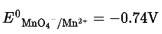 has the most negative value among the given species. So
Cr3+ is the most stable oxidized species.
Upvote Use the data given in Q.8 and find out the most stable ion in its reduced form.
(i) Cl–
(ii) Cr3+
(iii) Cr
(iv) Mn2+
Use the data given in Q.8 and find out the most stable ion in its reduced form.
(i) Cl–
(ii) Cr3+
(iii) Cr
(iv) Mn2+
This is a Multiple Choice Questions as classified in NCERT Exemplar
Ans: Correct Option: (iv)
 Upvote
Using the data given in Q.8 find out in which option the order of reducing power is correct.
(i) Cr3+ < Cl– < Mn2+ < Cr
(ii) Mn2+ < Cl– < Cr3+ < Cr
(iii) Cr3+ < Cl– < Cr2O72– < MnO4 –
(iv) Mn2+ < Cr3+ < Cl– < Cr
Using the data given in Q.8 find out in which option the order of reducing power is correct.
(i) Cr3+ < Cl– < Mn2+ < Cr
(ii) Mn2+ < Cl– < Cr3+ < Cr
(iii) Cr3+ < Cl– < Cr2O72– < MnO4 –
(iv) Mn2+ < Cr3+ < Cl– < Cr
This is a Multiple Choice Questions as classified in NCERT Exemplar
Ans: Correct Option: (iii)
According to the electrochemical series, the lower the reduction potential higher is the reducing power.
Therefore, the order of reducing power is Mn2+ < Cl– < Cr3+ < Cr
Upvote Use the data given in Q.8 and find out which of the following is the strongest oxidizing agent.
(i) Cl–
(ii) Mn2+
(iii) MnO4–
(iv) Cr3+
Use the data given in Q.8 and find out which of the following is the strongest oxidizing agent.
(i) Cl–
(ii) Mn2+
(iii) MnO4–
(iv) Cr3+
This is a Multiple Choice Questions as classified in NCERT Exemplar
Ans: Correct Option: (iii)
According to the electrochemical series higher the positive value of standard reduction potential of metal ion, the higher is the oxidizing power
Therefore, MnO4− is the strongest oxidizing agent.
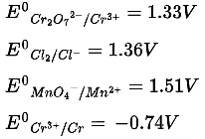
Upvote Using the data given below find out the strongest reducing agent
(i) Cl–
(ii) Cr
(iii) Cr3+
(iv) Mn2+
Using the data given below find out the strongest reducing agent
(i) Cl–
(ii) Cr
(iii) Cr3+
(iv) Mn2+
This is a Multiple Choice Questions as classified in NCERT Exemplar
Ans: Correct Option: (ii)
According to the electrochemical series and standard reduction potential of metal, the higher the negative value of standard reduction potential stronger will be the reducing agent
In the given options, the st
Upvote