
Hydrogen
Get insights from 183 questions on Hydrogen, answered by students, alumni, and experts. You may also ask and answer any question you like about Hydrogen
- 183
Questions
- 0
Discussions
- 0
Active Users
- 0
Followers
Have a question about Hydrogen? Ask our experts
Keep it short & simple. Type complete word. Avoid abusive language.
This is a short answer type question as classified in NCERT Exemplar
Because of hydrogen bonding HF is liquid whereas HCl is gas as there is lack of hydrogen bonding in HCl.
 Upvote

Dihydrogen reacts with dioxygen (O2) to form water. Write the name and formula of the product when the isotope of hydrogen which has one proton and one neutron in its nucleus is treated with oxygen. Will the reactivity of both the isotopes be the same towards oxygen? Justify your answer.
Dihydrogen reacts with dioxygen (O2) to form water. Write the name and formula of the product when the isotope of hydrogen which has one proton and one neutron in its nucleus is treated with oxygen. Will the reactivity of both the isotopes be the same towards oxygen? Justify your answer.
This is a short answer type question as classified in NCERT Exemplar
Dihydrogen reacts with dioxygen to form water. The reaction is highly exothermic.
H2 (g) + O2 (g) → H2O (l)
? H = -285.9KJmol-1
The isotope of hydrogen which has one proton and one neutron is deuterium. When it reacts with O2 it forms
Upvote Melting point, enthalpy of vaporization and viscosity data of H2O and D2O is given below:
On the basis of this data explain in which of these liquids intermolecular forces are stronger?
Melting point, enthalpy of vaporization and viscosity data of H2O and D2O is given below:
On the basis of this data explain in which of these liquids intermolecular forces are stronger?
This is a short answer type question as classified in NCERT Exemplar
D2O has greater intermolecular force of attraction. This is because D2O exhibits higher values for melting point, enthalpy of vaporization, and viscosity compared to H2O, indicating stronger intermolecular interactions needed to ove
Upvote (i) Draw the gas phase and solid phase structure of H2O2.
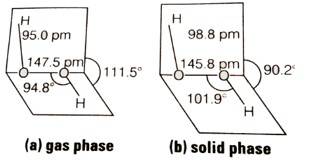
(ii) H2O2 is a better oxidising agent than water. Explain.
(i) Draw the gas phase and solid phase structure of H2O2.

(ii) H2O2 is a better oxidising agent than water. Explain.
This is a short answer type question as classified in NCERT Exemplar
In H2O2 oxygen is in -1 oxidation state which has tendency to become -2 that is why it is a better oxidising agent than water.
Upvote This is a short answer type question as classified in NCERT Exemplar
2H2O2 → 2H2O+O2
5 volume H2O2 means IL of H2O2 will give 5L of O2 at STP.
On the basis of the equation it is clear that 22.7 L of O2 is produced by 68 g of H2O2.
5L of O2 is produced by = = = g of H2O2=14.9g
i.e. 15 g H2O2 dis
Upvote Write one chemical reaction for the preparation of D2O2.
Write one chemical reaction for the preparation of D2O2.
This is a short answer type question as classified in NCERT Exemplar
Peroxodisulphate, obtained by electrolytic oxidation of acidified sulphate solutions at high current density, on hydrolysis yields hydrogen peroxide.
2HSO4- (aq) → HO3SOOSO3 2HSO4- (aq)+2H+ (aq)+H2O2 (aq)
This method is now used for t
Upvote How is heavy water prepared? Compare its physical properties with those of ordinary water.
How is heavy water prepared? Compare its physical properties with those of ordinary water.
This is a short answer type question as classified in NCERT Exemplar
Heavy water can be made by electrolyzing water repeatedly or as a by-product in the fertiliser industry. It's a deuterium compound that's used to make other deuterium compounds.
Physical Properties of H2O and D2O
Property | H2O | D2O |
Molecular mass (g mol-1) | 18.015 | 20.0276 |
Melting point/K | 273.0 | 276.8 |
Boiling point/K | 373.0 | 374.4 |
Enthalpy of formation/kJ mol- | -285.9 | -294.6 |
Enthalpy of Vaporisation (373 K)/kJ mol-1 | 40.66 | 41.61 |
Enthalpy of fusion/kJ mol-1 | 6.01 | — |
Temp of max. density/K | 276.98 | 284.2 |
Density (298 K)/g cm-3 | 1.0000 | 1.1059 |
Viscosity/centipoise | 0.8903 | 1.107 |
Dielectric constant/C2/N.m2 | 78.39 | 78.06 |
Upvote Molecular hydrides are classified as electron deficient, electron precise and electron rich compounds. Explain each type with two examples.
Molecular hydrides are classified as electron deficient, electron precise and electron rich compounds. Explain each type with two examples.
This is a short answer type question as classified in NCERT Exemplar
(a) Electron deficient hydrides are those that lack sufficient number of electrons to form typical covalent bonds. Group 13 hydrides, for example (BH3, AlH3, etc.).
(b) Electron precise: Electron precise hydrides are those that hav
Upvote Discuss briefly de-mineralisation of water by ion exchange resin.
Discuss briefly de-mineralisation of water by ion exchange resin.
This is a short answer type question as classified in NCERT Exemplar
Water demineralization using organic or synthetic ion exchange resins (ion exchange resins):
a. Synthetic resins are insoluble polymeric solids that contain a large hydrocarbon network with reactive acidic or basic groups.
Upvote What do you understand about the term ‘autoprotolysis of water’? What is its significance?
What do you understand about the term ‘autoprotolysis of water’? What is its significance?
This is a short answer type question as classified in NCERT Exemplar
Self ionization of water is known as autoprotolysis of water.
H2O (l) + H2O (l) → H2O2 (aq
Upvote