
Ncert Solutions Maths class 12th
Get insights from 2.5k questions on Ncert Solutions Maths class 12th, answered by students, alumni, and experts. You may also ask and answer any question you like about Ncert Solutions Maths class 12th
- 2.5k
Questions
- 0
Discussions
- 0
Active Users
- 65
Followers
Have a question about Ncert Solutions Maths class 12th? Ask our experts
Keep it short & simple. Type complete word. Avoid abusive language.
An ordinary dice is rolled for a certain number of times. If the probability of getting an odd number 2 times is equal to the probability of getting an even number 3 times, then the probability of getting an off number of times is:
An ordinary dice is rolled for a certain number of times. If the probability of getting an odd number 2 times is equal to the probability of getting an even number 3 times, then the probability of getting an off number of times is:
Let total number of throws = n
Probability of getting 2 times = Probability of getting an even number 3 times.
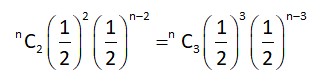
[as probability of getting odd number = probability of getting even number = ]

Probability of getting an odd number for odd number of times =
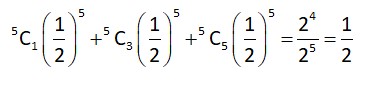
 Upvote

Let Bi (i = 1, 2, 3) be three independent events in a sample space. The probability that only B1 occurs is a, only B2 occurs is b and B3 occurs is <!-- [if gte mso 9]><xml>
Let Bi (i = 1, 2, 3) be three independent events in a sample space. The probability that only B1 occurs is a, only B2 occurs is b and B3 occurs is <!-- [if gte mso 9]><xml>
Let P (B1) = a P (B2) = b P (B3) = c
Given a (1 – b) (1 – c) = a . (i)
b (1 – a) (1 – c) = b . (ii)
c (1 – b) (1 – a) =
Upvote If the least and the largest real values of a, for which the equation z + a <!-- [if gte mso 9]><xml>
If the least and the largest real values of a, for which the equation z + a <!-- [if gte mso 9]><xml>
Let z = x + iy
for
= 0
Upvote Let <!-- [if gte mso 9]><xml>
Let <!-- [if gte mso 9]><xml>
=
=
55 + 135 + 120 = 310
Upvote For the statement s p and q, consider the following compound statements:
(a) <!-- [if gte mso 9]><xml>
(b) <!-- [if gte mso 9]><xml>
Then which of the following statements is correct?
For the statement s p and q, consider the following compound statements:
(a) <!-- [if gte mso 9]><xml>
(b) <!-- [if gte mso 9]><xml>
Then which of the following statements is correct?
(A)
P | q |
|
| p->q |
|
|
T | T | F | F | T | F | T |
T | F | F | T | F | F | T |
F | T | T | F | T | F | T |
F | F | T | T | T | T | T |
tautology
(B)
|
|
|
T | F | T |
T | F | T |
T | T | T |
F | F | T |
&n
Upvote Le tf be a twice differentiable function defined on R such that f(0) = 1, f’(0) = 2 and f(x) <!-- [if gte mso 9]><xml>
Le tf be a twice differentiable function defined on R such that f(0) = 1, f’(0) = 2 and f(x) <!-- [if gte mso 9]><xml>
Integrating on both sides
again integrating on both side
ln f(x) = 2X + k
f(x) = e2x + k
f(0) = ek = ek = 1-> k = 0
Upvote