
Relations and Functions
Get insights from 232 questions on Relations and Functions, answered by students, alumni, and experts. You may also ask and answer any question you like about Relations and Functions
- 232
Questions
- 0
Discussions
- 0
Active Users
- 1
Followers
Have a question about Relations and Functions? Ask our experts
Keep it short & simple. Type complete word. Avoid abusive language.
67. Consider the binary operations*: R ×R → and o: R × R → R defined as a * b = |a - b| and ao b = a, &mn For E; a, b ∈ R. Show that * is commutative but not associative, o is associative but not commutative. Further, show that &mn For E;a, b, c ∈ R, a*(b o c) = (a * b) o (a * c). [If it is so, we say that the operation * distributes over the operation o]. Does o distribute over *? Justify your answer.
67. Consider the binary operations*: R ×R → and o: R × R → R defined as a * b = |a - b| and ao b = a, &mn For E; a, b ∈ R. Show that * is commutative but not associative, o is associative but not commutative. Further, show that &mn For E;a, b, c ∈ R, a*(b o c) = (a * b) o (a * c). [If it is so, we say that the operation * distributes over the operation o]. Does o distribute over *? Justify your answer.
It is given that*: and is defined as
For , we have:
The operation* is commutative.
It can be observed that,
The operation* is not associative.
Now, consider the operation o:
It can be observed that
The operation o is not commutative.
Let, .
 Upvote

66. Let S = {a, b, c} and T = {1, 2, 3}. Find F−1 of the following functions F from S to T, if it exists.
(i) F = {(a, 3), (b, 2), (c, 1)} (ii) F = {(a, 2), (b, 1), (c, 1)}
66. Let S = {a, b, c} and T = {1, 2, 3}. Find F−1 of the following functions F from S to T, if it exists.
(i) F = {(a, 3), (b, 2), (c, 1)} (ii) F = {(a, 2), (b, 1), (c, 1)}
S = {a, b, c}, T = {1, 2, 3}
(i) F: S → T is defined as:
F = { (a, 3), (b, 2), (c, 1)}
⇒ F (a) = 3, F (b) = 2, F (c) = 1
Therefore, F−1 : T → S is given by
F−1 = { (3, a), (2, b), (1, c)}.
(ii) F: S → T is defined as:
F = { (a, 2), (b, 1), (c, 1)}
Since F (b) = F (c) = 1, F is not
Upvote 65. Find the number of all onto functions from the set {1, 2, 3, … , n) to itself.
65. Find the number of all onto functions from the set {1, 2, 3, … , n) to itself.
Onto functions from the set {1, 2, 3, …, n} to itself is simply a permutation on n symbols 1, 2, …, n.
Thus, the total number of onto maps from {1, 2, …, n} to itself is the same as the total number of permutations on n symbols 1, 2, …, n, which is n!
Upvote 28. Find the domain and the range of the real function f defined by 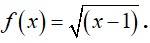
28. Find the domain and the range of the real function f defined by
28. Given, f (x)= 
The given fxn is valid for all x such that x – 1 ≥ 0 ⇒x≥ 1
∴ Domain of f (x)= [1,∞)
As x ≥ 1
⇒ x – 1 ≥ 1 – 1
⇒ x – 1 ≥ 0
⇒ ≥ 0
⇒ f (x) ≥ 0
So, range of f (x)= [0,∞ )
Upvote 64. Given a non-empty set X, consider the binary operation *: P(X) × P(X) → P(X) given by A * B = A ∩ B &mn For E; A, B in P(X) is the power set of X. Show that X is the identity element for this operation and X is the only invertible element in P(X) with respect to the operation*.
64. Given a non-empty set X, consider the binary operation *: P(X) × P(X) → P(X) given by A * B = A ∩ B &mn For E; A, B in P(X) is the power set of X. Show that X is the identity element for this operation and X is the only invertible element in P(X) with respect to the operation*.
Let S be a non-empty set and P (S) be its power set. Let any two subsets A and B of S.
It is given that: is defined as
We know that
Thus, X is the identity element for the given binary operation*.
Now, an element is invertible if there exists such that
&
Upvote 63. Given a non empty set X, consider P(X) which is the set of all subsets of X.
Define the relation R in P(X) as follows: For subsets A, B in P(X), ARB if and only if A ⊂ B. Is R an equivalence relation on P(X)? Justify you answer:
63. Given a non empty set X, consider P(X) which is the set of all subsets of X.
Define the relation R in P(X) as follows: For subsets A, B in P(X), ARB if and only if A ⊂ B. Is R an equivalence relation on P(X)? Justify you answer:
Since every set is a subset of itself, ARA for all A ∈ P (X).
∴R is reflexive.
Let ARB ⇒ A ⊂ B.
This cannot be implied to B ⊂ A.
For instance, if A = {1, 2} and B = {1, 2, 3}, then it cannot be implied that B is related to A.
∴ R is not symmetric.
Further, if ARB and BRC, then A ⊂ B and B ⊂ C.
⇒ A ⊂ C
⇒
Upvote 62. Given examples of two functions f: N → N and g: N → N such that gof is onto but f is not onto.
(Hint: Consider f(x) = x + 1 and
62. Given examples of two functions f: N → N and g: N → N such that gof is onto but f is not onto.
(Hint: Consider f(x) = x + 1 and
Define by
And, by,
We first show that g is not onto.
For this, consider element 1 in co-domain N. it is clear that this element is not an image of any of the elements in domain.
is not onto.
Now, is defined by,
Then, it is clear that for , there exists
Upvote 27. Given, f (x)=
The given function is valid if denominator is not zero.
So, if x2 – 8x+12=0.
⇒ x2 – 2x – 6x+12=0
⇒ x (x – 2) –6 (x – 2)=0
⇒ (x – 2) (x – 6)=0
⇒ x=2 and x=6.
So, f (x) will be valid for all real number x except x=2,6.
∴ Domain of f (x)=R – {2,6}
Upvote 61. Give examples of two functions f: N → Z and g: Z → Z such that g o f is injective but g is not injective.
(Hint: Consider f(x) = x and g(x) = |x| )
61. Give examples of two functions f: N → Z and g: Z → Z such that g o f is injective but g is not injective.
(Hint: Consider f(x) = x and g(x) = |x| )
Define as and as
We first show that g is not injective.
It can be observed that:
is not injective.
Now, is defined as
Let such that
Since , both are positive.
Hence, gof is injective
Upvote 60. Show that the function f: R → R given by f(x) = x3 is injective.
60. Show that the function f: R → R given by f(x) = x3 is injective.
f: R → R is given as f (x) = x3.
Suppose f (x) = f (y), where x, y ∈ R.
⇒ x3 = y3 … (1)
Now, we need to show that x = y.
Suppose x ≠ y, their cubes will also not be equal.
⇒ x3 ≠ y3
However, this will be a contradiction to (1).
∴ x = y
Hence, f is injective.
Upvote