From ₹93,224 crore to ₹1.39 lakh crore: How India’s Education Budget Has Been Recast in Five Years


India’s education budget has undergone a structural expansion over past five years, rising from INR 93,224 crore in 2021-22 to INR 1.39 lakh crore in 2026-27, according to Union Budget allocations. Increase is not just incremental but directional with funding increasingly tied to employability, industry-linked education, emerging technologies and regional capacity building rather than only enrolment expansion.
Union Finance Minister, Nirmala Sitharaman today allocated over INR 1,39,000 Crpre to education sector.
Five-year funding trend shows steady climb
A review of Budget Estimates (BE) presented between 2021-22 and 2026-27 shows that allocations to Ministry of Education have grown by nearly 50%, signalling sustained prioritisation despite fiscal pressures in other sectors.
Total Education Allocation (2021‑22 to 2026‑27)
| Fiscal Year | Total Allocation (₹ crore) | Notes |
|---|---|---|
| 2021‑22 |
93,224 | Budget Estimate |
| 2022‑23 | 1,04,277 | Budget Estimate |
| 2023‑24 | 1,12,628 | Budget Estimate |
| 2024‑25 | 1,20,628 | Budget Estimate |
| 2025‑26 | 1,28,650 | Budget Estimate |
| 2026‑27 |
1,39,289 | Budget Estimate |
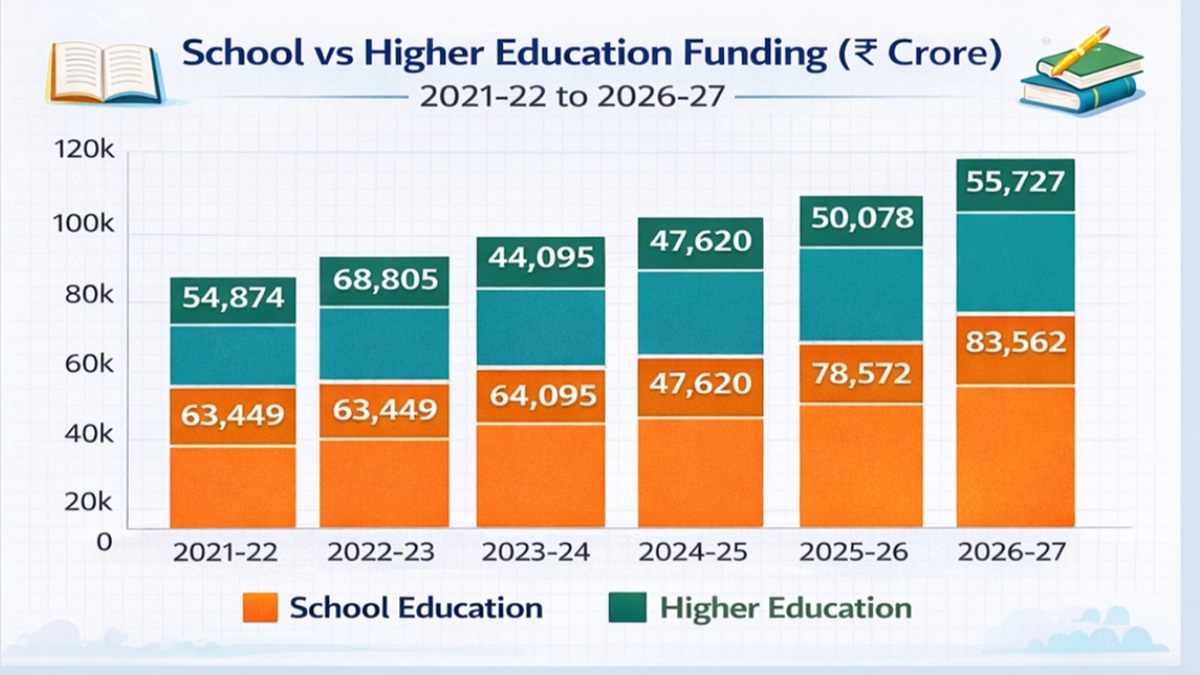
School education retains lead, higher education grows faster
| Fiscal Year | School Education (₹ crore) | Higher Education (₹ crore) |
|---|---|---|
| 2021‑22 | 54,874 | 38,351 |
| 2022‑23 | 63,449 | 40,828 |
| 2023‑24 | 68,805 | 44,095 |
| 2024‑25 | 73,008 | 47,620 |
| 2025‑26 | 78,572 | 50,077 |
| 2026‑27 | 83,562 |
55,727 |
Key Institutional Allocations
| Institution | 2020‑21 | 2021‑22 | 2022‑23 | 2023‑24 | 2024‑25 | 2025‑26 |
2026‑27 |
|---|---|---|---|---|---|---|---|
| IITs | 7,182 | 7,536 | 8,195 | 9,362 |
10,325 | 11,350 | 12,123 |
| IIMs | 476 | 476 | 654 | 300 | 212 | 252 | 292 |
| Central Universities | 7,643 | 7,643 | 9,420 |
11,529 | 15,928 | 16,691 | 17,740 |
| UGC | 4,693 | 4,693 | 4,901 |
5,360 | 2,500 | 3,336 | -- |
| IISERs |
896 | 946 | 1,398 | 1,462 |
1,540 | 1,353 | -- |
| IISc | 592 | 622 | 727 | 815 |
918 | 900 | 845 |
Insights from Five-Year Analysis
- School Education Leads the Budget: Consistently receives around 60% of the total allocation emphasizing foundational learning and nationwide access.
- Higher Education Growth: Steady increases, particularly for IITs and central universities, show focus on research, technology and global competitiveness.
- IIM Funding Fluctuations: Reflect selective expansion and policy adjustments.
- Research Institutes Volatility: UGC, IISERs and IISc show variable allocations indicating shifts in research funding priorities.
- Overall Trend: Education funding has nearly doubled in five years, but remains below global recommendations relative to GDP highlighting scope for further investment.
From education access to employment outcomes
Budget 2026-27 sharpens this shift through initiatives such as Education-to-Employment Enterprises Standing Committee, five new university townships, modular ‘Corporate Mitra’ courses and targeted investments in STEM, design and deep-tech.

Dr. Yajulu Medury, Vice Chancellor, Mahindra University said focus on Yuva Shakti marks a decisive turn. “By focusing on Yuva Shakti initiative government is bridging the gap between classroom learning and real world careers. This proposal for five new university townships and modular ‘Corporate Mitra’ courses will change how we train our youth for global market,” Dr Medury said.
Design, creative economy and new-age disciplines gain policy backing
Budget 2026-27 also signals a push towards creative and interdisciplinary education including expansion of AVGC and content creation labs and strengthening design education. Dr. Sanjay Gupta, Vice Chancellor, World University of Design said measures address long-standing gaps. He added: “By expanding AVGC and content creation labs across schools and colleges, government is opening doors to future-ready careers within growing creative economy. Proposal to strengthen design education addresses a long standing talent gap.”
Deep-tech, semiconductors and science infrastructure
Higher education funding is increasingly being channelled towards future technologies such as semiconductors, AI, quantum technologies, astronomy and astrophysics. Prof. Indranil Manna, Vice Chancellor, Birla Institute of Technology, Mesra, highlighted significance of INR 40,000 crore India Semiconductor Mission 2.0. “This reinforces the need to align academic programmes more closely with industry by integrating chip design, testing and advanced fabrication skills,” Prof Manna said.
Institutions see education as national infrastructure
Shishir Jaipuria, Chairman, Jaipuria Group of Educational Institutions said focus is clearly shifting. He said: “2026-27 Union Budget reflects a decisive shift from viewing education as an end in itself to an enabler of employment and enterprise. Emphasis on STEM education, employability and industry-readiness is unmistakable.”
Kunal Vasudeva, Managing Director and Co-Founder, Indian School of Hospitality said execution will be important. He added: “Education is being treated as national infrastructure. Next phase rests on execution at scale through teacher capability, strong primary education outcomes and delivery standards that work across the country.”
Read more:
Union Budget 2026-27: Govt to Set Up 5 University Townships, 3 New All India Institutes of Ayurveda
Follow Shiksha.com for latest education news in detail on Exam Results, Dates, Admit Cards, & Schedules, Colleges & Universities news related to Admissions & Courses, Board exams, Scholarships, Careers, Education Events, New education policies & Regulations.
To get in touch with Shiksha news team, please write to us at news@shiksha.com

Abhay Anand is an experienced education journalist with over 15 years in print and digital media. Currently serving as Manager- Editorial at Shiksha.com, he specializes in higher education policy, student mobility,
Read Full Bio