
Aldehydes, Ketones and Carboxylic Acids
Get insights from 184 questions on Aldehydes, Ketones and Carboxylic Acids, answered by students, alumni, and experts. You may also ask and answer any question you like about Aldehydes, Ketones and Carboxylic Acids
- 184
Questions
- 0
Discussions
- 0
Active Users
- 0
Followers
Have a question about Aldehydes, Ketones and Carboxylic Acids? Ask our experts
Keep it short & simple. Type complete word. Avoid abusive language.
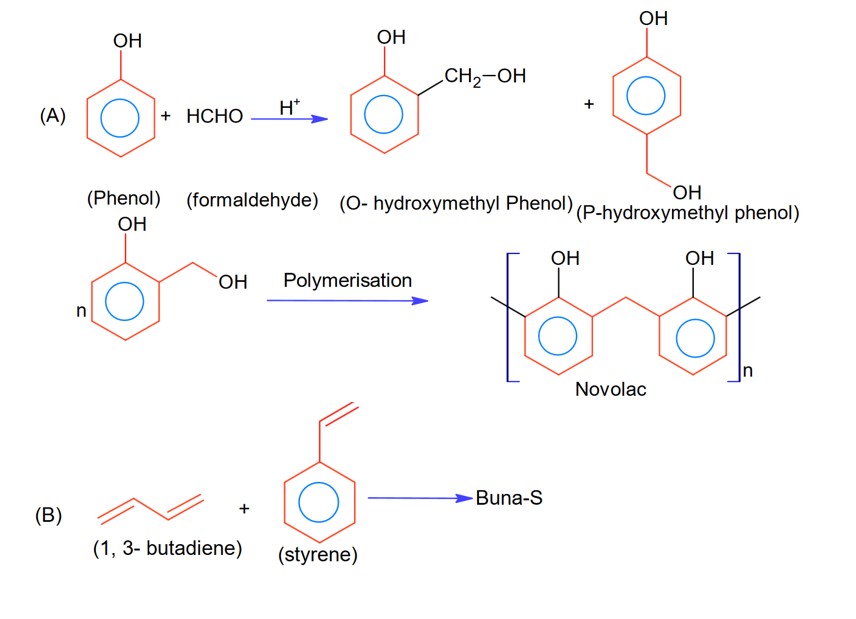
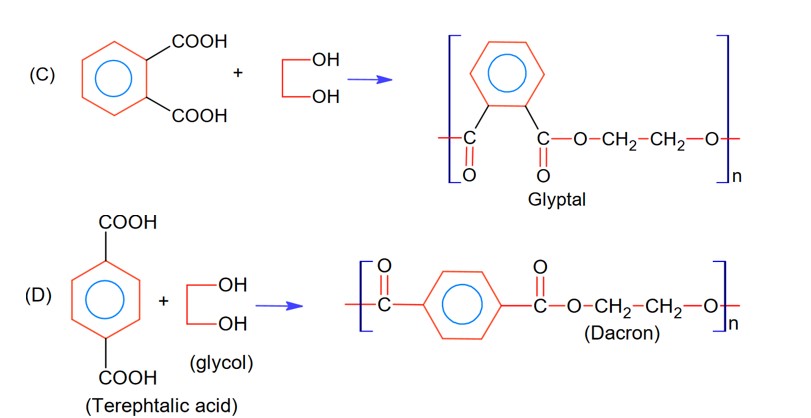
Match List I with List II
List I
Polymers
List II
Commercial names
A.
Phenol-formaldehyde resin
I.
Glyptal
B.
Copolymer of 1,3-butadiene and styrene
II.
Novolac
C.
Polyester of glycol and phtalic acid
III.
Buna-S
D.
Polyester of glycol and terephthalic acid
IV.
Dacron
Choose the correct answer from the options given below;
Match List I with List II
|
List I Polymers |
List II Commercial names |
||
|
A. |
Phenol-formaldehyde resin |
I. |
Glyptal |
|
B. |
Copolymer of 1,3-butadiene and styrene |
II. |
Novolac |
|
C. |
Polyester of glycol and phtalic acid |
III. |
Buna-S |
|
D. |
Polyester of glycol and terephthalic acid |
IV. |
Dacron |
Choose the correct answer from the options given below;

Which of the following ketone will NOT give enamine on treatment with secondary amine?
[Where t-Bu is -C(CH3)3]
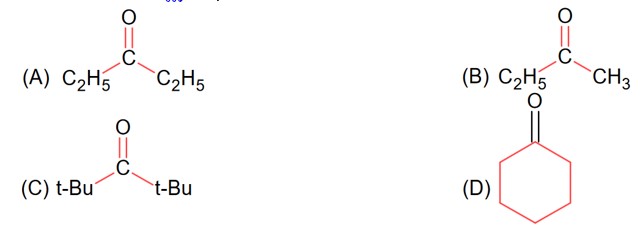
Which of the following ketone will NOT give enamine on treatment with secondary amine?
[Where t-Bu is -C(CH3)3]
Enolisable carbonyl compound gives enamine with 2° amine.
Does not form enol thus not form enamine.
 Upvote

The major product formed in the following reaction, is
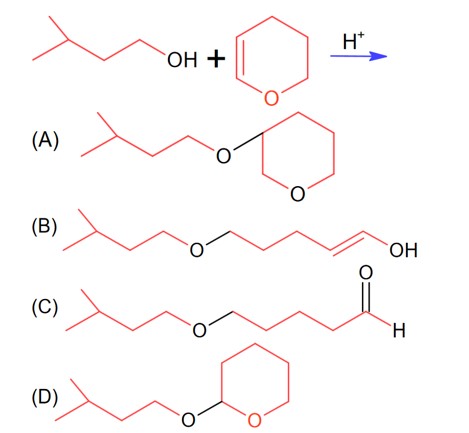
The major product formed in the following reaction, is
Kindly consider the following figure
Upvote Which of the following condition or reaction sequence will NOT given acetophenone as the major product?
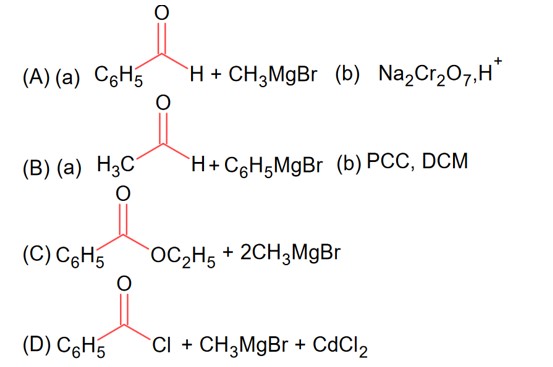
Which of the following condition or reaction sequence will NOT given acetophenone as the major product?
Kindly consider the following figure
Upvote A compound ‘A’ on reaction ‘X’ and ‘Y’ produces the same major product but different by product ‘a’ and ‘b’. Oxidation of ‘a’ gives a substance produced by ants.
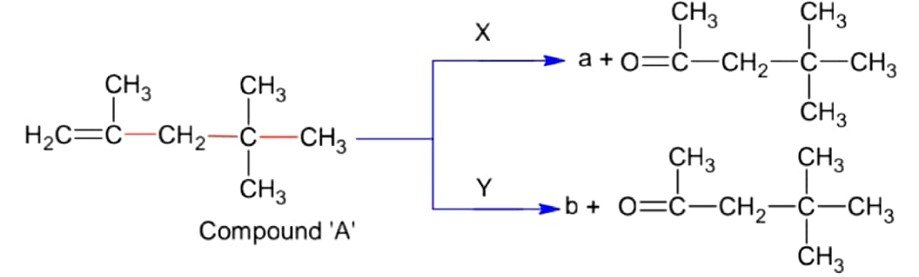
‘X’ and ‘Y’ respectively are
A compound ‘A’ on reaction ‘X’ and ‘Y’ produces the same major product but different by product ‘a’ and ‘b’. Oxidation of ‘a’ gives a substance produced by ants.
‘X’ and ‘Y’ respectively are
Oxidation of HCHO (a) will produce HCOOH, which is produced by ants.
Upvote 
Which of the following reactions will yield benzaldehyde as a product?
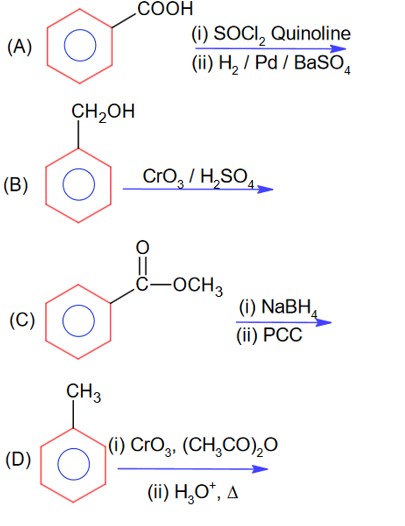
Which of the following reactions will yield benzaldehyde as a product?
Kindly consider the following figure
Upvote 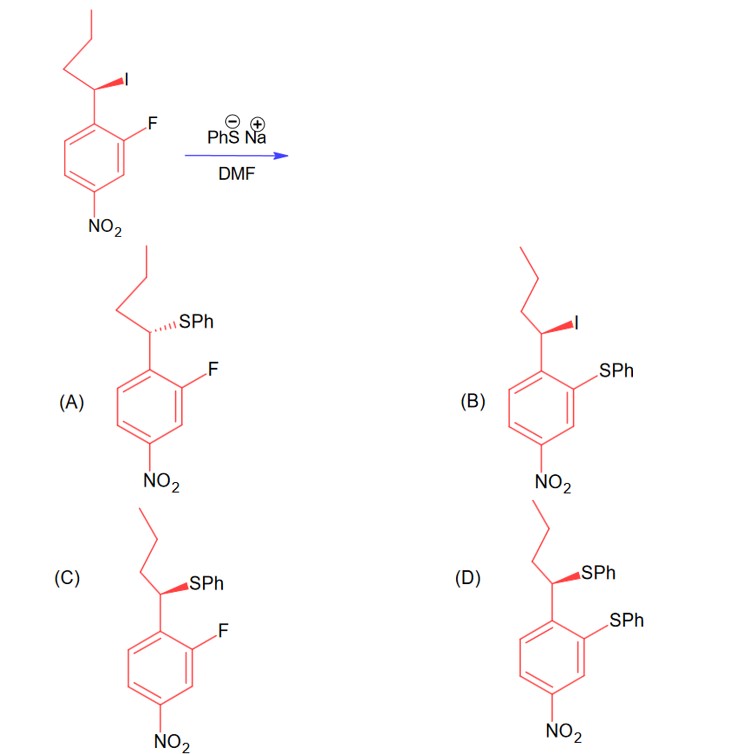
‘A’ and ‘B’ respectively are:
Ethane-1, 2- dicarbaldehyde + Glyoxal / Oxaldehyde
5- oxohexanal
‘A’ and ‘B’ respectively are:
Ethane-1, 2- dicarbaldehyde + Glyoxal / Oxaldehyde
5- oxohexanal
Kindly consider the following figure
Upvote