
Aldehydes, Ketones and Carboxylic Acids
Get insights from 184 questions on Aldehydes, Ketones and Carboxylic Acids, answered by students, alumni, and experts. You may also ask and answer any question you like about Aldehydes, Ketones and Carboxylic Acids
- 184
Questions
- 0
Discussions
- 0
Active Users
- 0
Followers
Have a question about Aldehydes, Ketones and Carboxylic Acids? Ask our experts
Keep it short & simple. Type complete word. Avoid abusive language.
Identify the major products A and B for the below given reaction sequence.
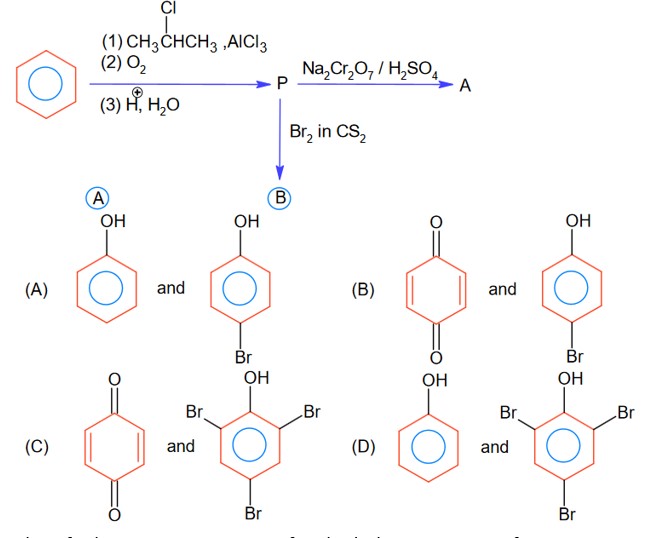
Identify the major products A and B for the below given reaction sequence.
Kindly consider the following figure
 Upvote

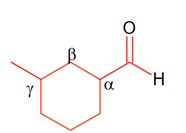
Correct structure of <!-- [if gte mso 9]><xml>
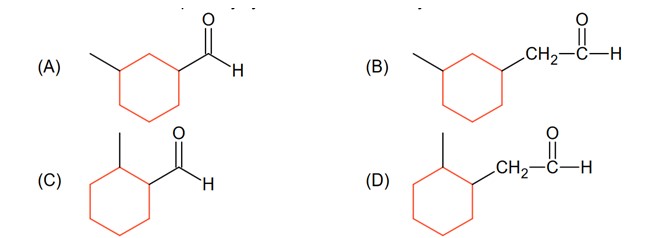
Correct structure of <!-- [if gte mso 9]><xml>
In the below reaction, 5g of toluene is converted into benzaldehyde with 92% yield. The amount of benzaldehyde produced is____________× 10-2 g. (Nearest integer)
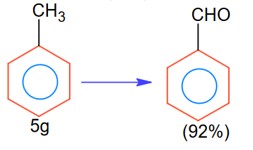
In the below reaction, 5g of toluene is converted into benzaldehyde with 92% yield. The amount of benzaldehyde produced is____________× 10-2 g. (Nearest integer)
No. of moles =
Moles of benzaldehyde =
Mass of benzaldehyde = 5 × 10-2 ×106 = 5.3 gm
= 530 × 10-2 gm
Upvote 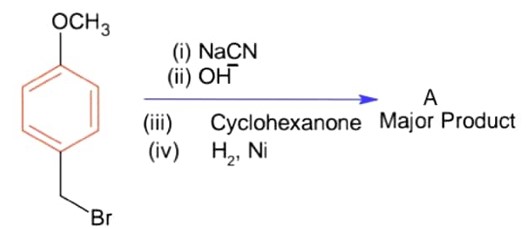
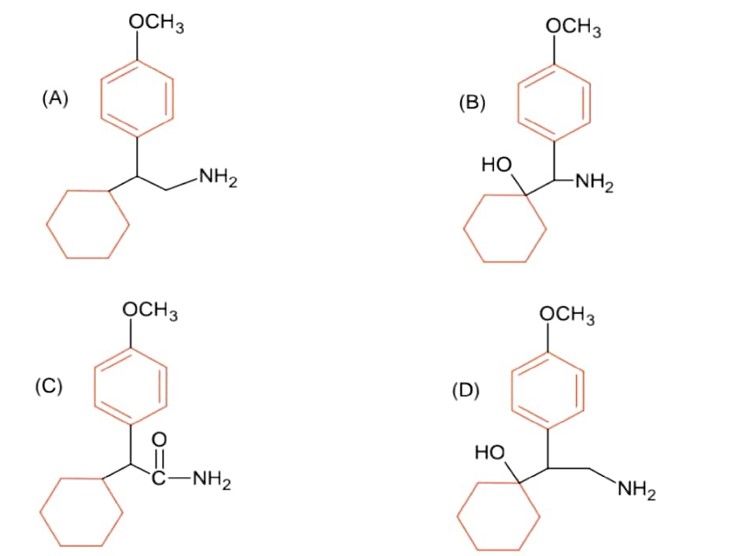
Kindly consider the following figure
Upvote Which of the following is an example of conjugated diketone?
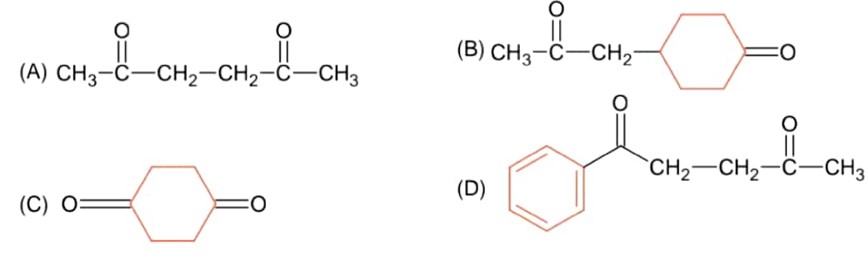
Which of the following is an example of conjugated diketone?
Kindly consider the following figure
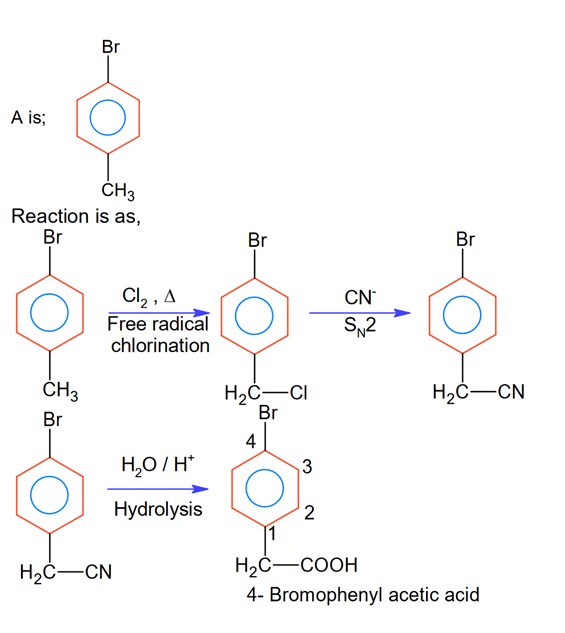
Upvote A 4-Bromophenyl acetic acid.
In the above reaction ‘A’ is
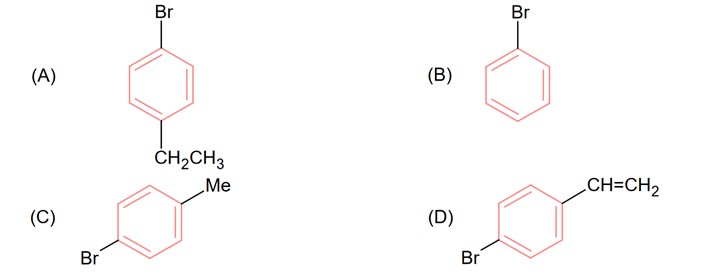
A 4-Bromophenyl acetic acid.
In the above reaction ‘A’ is
Which of the following carbocations is most stable?
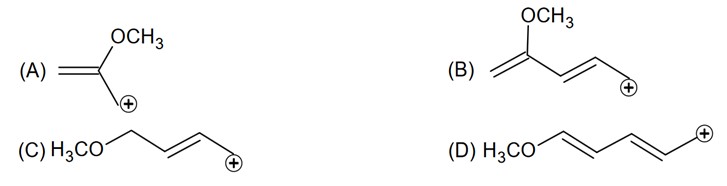
Which of the following carbocations is most stable?
In this carbocation +M effect of -OCH3 group stabilizes the carbocation.
While in option (A) and (B), +M of -OCH3 will not work but in option (C), +M of -OCH3 works so due to more delocalization in option (D), it is more stable.
Upvote Which of the following compounds will form the precipitate with aq. solution most readily?
Which of the following compounds will form the precipitate with aq. solution most readily?
Sol. . Greater the Zeff, smaller is size.
Upvote Although phenoxide ion has more number of resonating structures than carboxylate ion, carboxylic acid is a stronger acid than phenol. Why?
Although phenoxide ion has more number of resonating structures than carboxylate ion, carboxylic acid is a stronger acid than phenol. Why?
Resonating structures of phenoxide are-

In structure I and V negative charge is on E.N. Oxygen, in other cases, it is on Less E.N Carbon hence they contribute less towards stability. And the negative charge is localized.
Resonating structures of carboxylic acid-
Both the structures have –ve charge on o
Upvote An organic compound contains 69.77% carbon, 11.63% hydrogen and rest oxygen. The molecular mass of the compound is 86. It does not reduce Tollens’ reagent but forms an addition compound with sodium hydrogensulphite and give positive iodoform test. On vigorous oxidation it gives ethanoic and propanoic acid. Write the possible structure of the compound.
An organic compound contains 69.77% carbon, 11.63% hydrogen and rest oxygen. The molecular mass of the compound is 86. It does not reduce Tollens’ reagent but forms an addition compound with sodium hydrogensulphite and give positive iodoform test. On vigorous oxidation it gives ethanoic and propanoic acid. Write the possible structure of the compound.

