
Exemplar Solution
Get insights from 1.3k questions on Exemplar Solution, answered by students, alumni, and experts. You may also ask and answer any question you like about Exemplar Solution
- 1.3k
Questions
- 0
Discussions
- 0
Active Users
- 0
Followers
Have a question about Exemplar Solution? Ask our experts
Keep it short & simple. Type complete word. Avoid abusive language.
If the seventh terms from the beginning and the end in the expansion of 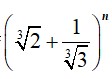
[Hint: , = nC6 (2 /3)n-6 (1/3 1/3 6) = nCn – 6 (2 1/3 6 (1/3 1/3) n - 6 solve for ]
= (2 1/3)n – 12 = 1/3 1/3 n -12 = only problem when n – 12 = 0 = n =12].
If the seventh terms from the beginning and the end in the expansion of
[Hint: , = nC6 (2 /3)n-6 (1/3 1/3 6) = nCn – 6 (2 1/3 6 (1/3 1/3) n - 6 solve for ]
= (2 1/3)n – 12 = 1/3 1/3 n -12 = only problem when n – 12 = 0 = n =12].
This is a Fill in the Blanks Type Questions as classified in NCERT Exemplar
Sol:
 Upvote

Find the -th term of an A.P. sum of whose first terms is <!-- [if gte mso 9]><xml>
[Hint: <!-- [if gte mso 9]><xml>
Find the -th term of an A.P. sum of whose first terms is <!-- [if gte mso 9]><xml>
[Hint: <!-- [if gte mso 9]><xml>
This is a Short Answer Type Questions as classified in NCERT Exemplar
Sol:
Upvote The number of different four-digit numbers that can be formed with the digits 2, 3, 4, 7 and using each digit only once is:
<!-- [if !supportLists]-->(a) 120
<!-- [if !supportLists]-->(b) 96
<!-- [if !supportLists]-->(c) 24
<!-- [if !supportLists]-->(d) 100
The number of different four-digit numbers that can be formed with the digits 2, 3, 4, 7 and using each digit only once is:
<!-- [if !supportLists]-->(a) 120
<!-- [if !supportLists]-->(b) 96
<!-- [if !supportLists]-->(c) 24
<!-- [if !supportLists]-->(d) 100
This is an Objective Type Questions as classified in NCERT Exemplar
Upvote Find the sum of the series to (i) terms (ii) 10 terms.
Find the sum of the series to (i) terms (ii) 10 terms.
This is a Short Answer Type Questions as classified in NCERT Exemplar
Sol:
Upvote In the expansion of x2 – 1/x2 16 the value of the constant term is ________________ .
In the expansion of x2 – 1/x2 16 the value of the constant term is ________________ .
This is a Fill in the Blanks Type Questions as classified in NCERT Exemplar
Sol:
Upvote The number of terms in the expansion of is _________________
[Hint: ]
The number of terms in the expansion of is _________________
[Hint: ]
This is a Fill in the Blanks Type Questions as classified in NCERT Exemplar
Sol:
Upvote The largest coefficient in the expansion of is _________________ .
The largest coefficient in the expansion of is _________________ .
This is a Fill in the Blanks Type Questions as classified in NCERT Exemplar
Sol:
Upvote If the middle term of is equal to , then the value of is:
(a)
(b)
(c)
(d)
[Hint: T6 = 10C5 1/x5 . x5 sin5 x = 63/3 = sin5 x = 1/25 sin ½= x = nπ + (-1)n π/6]
If the middle term of is equal to , then the value of is:
(a)
(b)
(c)
(d)
[Hint: T6 = 10C5 1/x5 . x5 sin5 x = 63/3 = sin5 x = 1/25 sin ½= x = nπ + (-1)n π/6]
This is a Objective Type Questions as classified in NCERT Exemplar
Sol:
Upvote The number of possible outcomes when a coin is tossed 6 times is:
(a) 36
(b) 64
(c) 12
(d) 32
The number of possible outcomes when a coin is tossed 6 times is:
(a) 36
(b) 64
(c) 12
(d) 32
This is an Objective Type Questions as classified in NCERT Exemplar
Upvote If and are coefficients of in the expansions of and , respectively, then
(a) 1
(b) 2
(c)
(d)
[Hint: 2nCn/2n – 1Cn = 2]
If and are coefficients of in the expansions of and , respectively, then
(a) 1
(b) 2
(c)
(d)
[Hint: 2nCn/2n – 1Cn = 2]
This is a Objective Type Questions as classified in NCERT Exemplar
Sol:
Upvote