Exemplar Solution

Get insights from 1.3k questions on Exemplar Solution, answered by students, alumni, and experts. You may also ask and answer any question you like about Exemplar Solution

  • 1.3k

    Questions

  • 0

    Discussions

  • 0

    Active Users

  • 0

    Followers

Have a question about Exemplar Solution? Ask our experts

Ask Your Question

Keep it short & simple. Type complete word. Avoid abusive language.

New answer posted•a year ago
S
a year ago

This is a long answer type question as classified in NCERT Exemplar

T o t a l     n u m b e r     o f     s t u d e n t s     i n     e a c h     c l a s s = 2 0 W e     h a v e     t o     s e l e c t     a t l e a s t     5     s t u d e n t s     f r o m     e a c h     c l a s s . W e     h a v e     t h e     f o l l o w i n g     c a s e s . ( i ) 5     s t u d e n t s     f r o m     X I     c l a s s     a n d     6     s t u d e n t s     f r o m     X I I     c l a s s ( i i ) 6     s t u d e n t s     f r o m     X I     c l a s s     a n d     5     s t u d e n t s     f r o m     X I I     c l a s s S o ,     n u m b e r     o f     w a y s     o f     s e l e c t i o n     o f     a     t e a m     o f     1 1     p l a y e r s                                                                                                     = C 5 2 0 × C 6 2 0 + C 6 2 0 × C 5 2 0 = 2 [ C 5 2 0 × C 6 2 0 ]             H e n c e ,     t h e     r e q u i r e d     w a y s     o f     s e l e c t i o n = 2 [ C 5 2 0 × C 6 2 0 ]

Thumbs Up IconUpvote Thumbs Down Icon
New answer posted•a year ago
S
a year ago

This is a Short Answer Type Questions as classified in NCERT Exemplar

Sol:
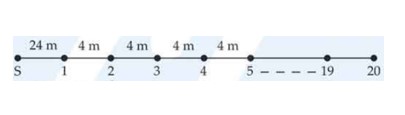
As  per  the  given  information  we  have  the  following  diagram Starting  point=S Distance  travelled  to  bring  the  first  potato=24+24=48m Distance  travelled  to  bring  the  second  potato=2(24+4)=56m Distance  travelled  to  bring  the  third  potato=2(24+4+4)=64m T h e r f o r e ,     t h e     s e r i e s     w i l l     b e = 4 8 , 5 6 , 6 4 , … w h i c h     a n ? ?     A . P     i n     w h i c h     a = 4 8 ,     d = 5 6 − 4 8 = 8 We  have  to  find  the  total  distance  to  bring  all  the  potatoes  back,  so,  n=20 ∴                       S n = n 2 [ 2 a + ( n − 1 ) d ] ⇒               S 2 0 = 2 0 2 [ 2 × 4 8 + ( 2 0 − 1 ) 8 ] = 1 0 [ 9 6 + 1 5 2 ]                                         = 1 0 × 2 4 8 = 2 4 8 0 m Hence,  the  required  distance=2480m

Thumbs Up IconUpvote Thumbs Down Icon
New answer posted•a year ago
S
a year ago

This is a Long Answer Type Questions as classified in NCERT Exemplar
Sol:
The  given  expression  is  (x2+1x)2n G e n e r a l     T e r m       T r + 1 = C r n x n − r y r                                                                                   = C r 2 n ( x 2 ) 2 n − r ( 1 x ) r = C r 2 n ( x ) 4 n − 2 r . 1 x r                                                                                   = C r 2 n ( x ) 4 n − 2 r − r = C r 2 n ( x ) 4 n − 3 r I f     x p     o c c u r s     i n     ( x 2 + 1 x ) 2 n t h e n     4 n − 3 r = p                 ⇒ 3 r = 4 n − p ⇒                                     r = 4 n − p 3 ∴     C o e f f i c i e n t     o f     x p = C r 2 n = C 4 n − p 3 2 n = ( 2 n ) ! ( 4 n − p 3 ) ! ( 2 n − 4 n − p 3 ) ! = ( 2 n ) ! ( 4 n − p 3 ) ! ( 6 n − 4 n + p 3 ) ! = ( 2 n ) ! ( 4 n − p 3 ) ! ( 2 n + p 3 ) ! H e n c e ,     c o e f f i c i e n t     o f     x p = ( 2 n ) ! ( 4 n − p 3 ) ! ( 2 n + p 3 ) !

Thumbs Up IconUpvote Thumbs Down Icon
New answer posted•a year ago
S
a year ago

This is a long answer type question as classified in NCERT Exemplar

G i v e n     t h a t     t h e     t o t a l     n u m b e r     o f     p l a y e r s = 1 6 W e     h a v e     t o     s e l e c t     1 1     p l a y e r s     o u t     o f     1 6     p l a y e r s . ( i ) I f     2     p l a y e r s     a r e     i n c l u d e d ,     t h e n     n u m b e r     o f     w a y s     o f     s e l e c t i o n = C 1 1 − 2 1 6 − 2 = C 9 1 4 ( i i ) I f     2     p l a y e r s     a r e     e x c l u d e d ,     t h e n     n u m b e r     o f     w a y s     o f     s e l e c t i o n = C 1 1 1 6 − 2 = C 1 1 1 4             H e n c e ,     t h e     r e q u i r e d     n u m b e r     o f     w a y s     o f     s e l e c t i o n     a r e               ( i ) C 9 1 4                         ( i i ) C 1 1 1 4

Thumbs Up IconUpvote Thumbs Down Icon
New answer posted•a year ago
S
a year ago

This is a Long Answer Type Questions as classified in NCERT Exemplar
Sol:

(i)The  given  expression  is  (x+a)n ( x + a ) n = C 0 n x n a 0 + C 1 n x n − 1 a + C 2 n x n − 2 a 2 + C 3 n x n − 3 a 3 + … + C n n a n S u m     o f     o d d     t e r m s , O = C 0 n x n + C 2 n x n − 2 a 2 + C 4 n x n − 4 a 4 + … a n d     t h e     s u m     o f     e v e n     t e r m s , E = C 1 n x n − 1 a + C 3 n x n − 3 a 3 + C 5 n x n − 5 a 5 + … N o w                           ( x + a ) n = O + E                                                                                             … ( i ) S i m i l a r l y ,     ( x − a ) n = O − E                                                                                             … ( i i ) M u l t i p l y i n g     e q n . ( i )     a n d     e q n . ( i i ) ,     w e     g e t ( x + a ) n ( x − a ) n = ( O + E ) ( O − E ) ( x 2 − a 2 ) n = O 2 − E 2 H e n c e ,     O 2 − E 2 = ( x 2 − a 2 ) n ( i i ) 4 O E = ( O + E ) 2 − ( O − E ) 2                                       = [ ( x + a ) n ] 2 − [ ( x − a ) n ] 2                                       = [ x + a ] 2 n − [ x − a ] 2 n H e n c e ,     4 O E = ( x + a ) 2 n − ( x − a ) 2 n

Thumbs Up IconUpvote Thumbs Down Icon
New answer posted•a year ago
S
a year ago

This is a Long Answer Type Questions as classified in NCERT Exemplar
Sol:

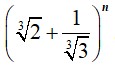
The  given  expression  is  (+1)n                                                           = ( 2 1 / 3 + 1 3 1 / 3 ) n G e n e r a l     T e r m       T r + 1 = C r n x n − r y r T 7 = T 6 + 1 = C 6 n ( 2 1 3 ) n − 6 ( 1 3 1 3 ) 6                                       = C 6 n ( 2 ) n − 6 3 . ( 1 3 2 ) = C 6 n ( 2 ) n − 6 3 . ( 3 ) − 2 7 t h     t e r m     f r o m     t h e     e n d = ( n − 7 + 2 ) t h     t e r m     f r o m     t h e     b e g i n n i n g                                                                                                   = ( n − 5 ) t h     t e r m     f r o m     t h e     b e g i n n i n g S o ,     T n − 6 + 1 = C n − 6 n ( 2 1 3 ) n − n + 6 ( 1 3 1 3 ) n − 6                                           = C n − 6 n ( 2 ) 2 . ( 1 3 n − 6 3 ) = C n − 6 n ( 2 ) 2 . ( 3 ) 6 − n 3 A c c o r d i n g     t o     t h e     q u e s t i o n ,     w e     g e t                     C 6 n ( 2 ) n − 6 3 . ( 3 ) − 2 C n − 6 n ( 2 ) 2 . ( 3 ) 6 − n 3 = 1 6 ⇒           C n − 6 n ( 2 ) n − 6 3 . ( 3 ) − 2 C n − 6 n ( 2 ) 2 . ( 3 ) 6 − n 3 = 1 6                       ⇒ ( 2 ) n − 6 3 − 2 . ( 3 ) − 2 − 6 − n 3 = 1 6 ⇒                 ( 2 ) n − 6 − 6 3 . ( 3 ) − 6 − 6 + n 3 = 1 6                       ⇒ ( 2 ) n − 1 2 3 . ( 3 ) n − 1 2 3 = ( 6 ) − 1 ⇒                                                             ( 6 ) n − 1 2 3 = ( 6 ) − 1         ⇒ n − 1 2 3 = − 1 ⇒                 n − 1 2 = − 3           ⇒ n = 1 2 − 3 = 9 H e n c e ,     t h e     r e q u i r e d     v a l u e     o f     n     i s     9 .

Thumbs Up IconUpvote Thumbs Down Icon
New answer posted•a year ago
S
a year ago

This is a long answer type question as classified in NCERT Exemplar

T o t a l     n u m b e r     o f     m a r b l e s = 6     w h i t e + 5     r e d = 1 1     m a r b l e s (i)Since,  we  have  to  draw  4  marbles  of  any  colour  from  the  11  marbles      ∴  Required  number  of  ways=C411 ( i i ) I f     2     m u s t     b e     w h i t e     a n d     2     m u s t     b e     r e d ,     t h e n     t h e     r e q u i r e d     n u m b e r     o f     w a y s = C 2 6 × C 2 5 ( i i i ) I f     a l l     t h e     4     m a r b l e s     a r e     o f     t h e     s a m e     c o l o u r ,     t h e n     t h e     r e q u i r e d     n u m b e r     o f     w a y s = C 4 6 + C 4 5                 H e n c e ,     t h e     r e q u i r e d     n u m b e r     o f     w a y s     a r e               ( i ) C 4 1 1               ( i i ) C 2 6 × C 2 5                 ( i i i ) C 4 6 + C 4 5

Thumbs Up IconUpvote Thumbs Down Icon
New answer posted•a year ago
S
a year ago

This is a Short Answer Type Questions as classified in NCERT Exemplar

Sol:


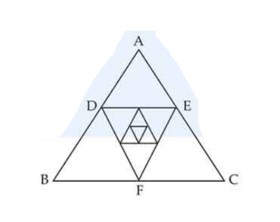
  T h e     s i d e     o f     t h e     f i r s t     e q u i l a t e r a l     Δ A B C = 2 0 c m By  joining  the  mid  points  of  the  sides  of  this  triangle,  we  get  the  second  equilateral  triangle w h i c h     e a c h     s i d e = 2 0 2 = 1 0 c m                   [ ?  The  line  joining  the  mid-points  of  two  sides  of  a  triangle i s     1 2     a n d     p a r a l l e l     t o     t h e     t h i r d     s i d e     o f     t h e     t r i a n g l e ] S i m i l a r l y ,     e a c h     s i d e     o f     t h e     t h i r d     e q u i l a t e r a l     t r i a n g l e = 1 0 2 = 5 c m ∴     P e r i m e t e r     o f     f i r s t     t r i a n g l e = 2 0 × 3 = 6 0 c m Perimeter  of  second  triangle=10×3=30cm a n d     t h e     p e r i m e t e r     o f     t h i r d     t r i a n g l e = 5 × 3 = 1 5 c m T h e r e f o r e ,     t h e     s e r i e s     w i l l     b e     6 0 , 3 0 , 1 5 , … w h i c h     i s     G . P .     i n     w h i c h     a = 6 0 ,     a n d     r = 3 0 6 0 = 1 2 N o w ,     w e     h a v e     t o     f i n d     t h e     p e r i m e t e r     o f     s i x t h     i n s c r i b e d     e q u i l a t e r a l     t r i a n g l e ∴           a 6 = a r 6 − 1                           = 6 0 × ( 1 2 ) 5 = 6 0 × 1 3 2 = 1 5 8 c m H e n c e ,     t h e     r e q u i r e d     p e r i m e t e r = 1 5 8 c m

Thumbs Up IconUpvote Thumbs Down Icon
New answer posted•a year ago
S
a year ago

This is a long answer type question as classified in NCERT Exemplar

Given  that  18  mice  were  placed  equally  in  two  experimental  groups  and o n e     c o n t r o l     g r o u p     i . e .     3     g r o u p s ∴     T h e     r e q u i r e d     n u m b e r     o f     a r r a n g e m e n t s = T o t a l     a r r a n g e m e n t s E q u a l l y     l i k e l y     a r r a n g e m e n t s                                                                                               = 1 8 ! 6 ! 6 ! 6 ! = 1 8 ! ( 6 ! ) 3 H e n c e ,     t h e     r e q u i r e d     a r r a n g e m e n t s = 1 8 ! ( 6 ! ) 3

Thumbs Up IconUpvote Thumbs Down Icon
New answer posted•a year ago
S
a year ago

This is a Short Answer Type Questions as classified in NCERT Exemplar

Sol:

Since,  the  sum  of  all  interior  angles  of  a  polygon  of  n  sides=(2n−4)×900 ∴  Sum  of  interior  angles  of  a  polygon  of  3  sides=(2×3−4)×900=1800     Sum  of  interior  angles  of  a  polygon  of  4  sides=(2×4−4)×900=3600 Similarly,  the  sum  of  interior  angles  of  a  polygon  of  sides  5,6,7,…  are  5400,7200,9000,… T h e r e f o r e ,     t h e     s e r i e s     w i l l     b e     1 8 0 0 , 3 6 0 0 , 5 4 0 0 , 7 2 0 0 , 9 0 0 0 , …     w h i c h     i s     A . P . H e r e     a = 1 8 0 0 ,     d = 1 8 0 0 We  have  to  find  the  sum  of  all  interior  angles  of  a  polygon  of  21  sides  i.e.,  19th  term             a n = a + ( n − 1 ) d           a 1 9 = 1 8 0 0 + ( 1 9 − 1 ) 1 8 0 0 = 1 8 0 0 + 1 8 × 1 8 0 0                         = 1 8 0 0 + 3 2 4 0 0 = 3 4 2 0 0 Hence,  the  required  sum  of   interior  angles=34200.

Thumbs Up IconUpvote Thumbs Down Icon