Exemplar Solution

Get insights from 1.3k questions on Exemplar Solution, answered by students, alumni, and experts. You may also ask and answer any question you like about Exemplar Solution

  • 1.3k

    Questions

  • 0

    Discussions

  • 0

    Active Users

  • 0

    Followers

Have a question about Exemplar Solution? Ask our experts

Ask Your Question

Keep it short & simple. Type complete word. Avoid abusive language.

New answer posted•a year ago
S
a year ago

This is a short answer type question as classified in NCERT Exemplar

L e t                                       A = [ a 1 1             a 1 2 a 2 1             a 2 2 a 3 1             a 3 2 ] 3 × 2 G i v e n     t h a t     a i j = e i x s i n j x                                 a 1 1 = e x s i n x                                       a 1 2 = e x s i n 2 x                                 a 2 1 = e 2 x s i n x                                   a 2 2 = e 2 x s i n 2 x                                 a 3 1 = e 3 x s i n x                                   a 3 2 = e 3 x s i n 2 x H e n c e ,     t h e     m a t r i x     A = [ e x s i n x                   e x s i n 2 x e 2 x s i n x             e 2 x s i n 2 x e 3 x s i n x             e 3 x s i n 2 x ]

Thumbs Up IconUpvote Thumbs Down Icon
New answer posted•a year ago
S
a year ago

This is a short answer type question as classified in NCERT Exemplar

L e t     A = [ a 1 1 a 1 2 a 2 1 a 2 2 ] 2 × 2 ( i )     G i v e n     t h a t                             a i j = ( i − 2 j ) 2 2 a 1 1 = ( 1 − 2 × 1 ) 2 2 = 1 2 ;     a 1 2 = ( 1 − 2 × 2 ) 2 2 = 9 2 a 2 1 = ( 2 − 2 × 1 ) 2 2 = 0 ;     a 2 2 = ( 2 − 2 × 2 ) 2 2 = 2 H e n c e ,     t h e     m a t r i x     A = [ 1 2 9 2 0 2 ] ( i i )     G i v e n     t h a t                             a i j =   | − 2 i + 3 j |                                                                                           a 1 1 = | − 2 × 1 + 3 × 1 | = 1 ;     a 1 2 = | − 2 × 1 + 3 × 2 | = 4                                                                                           a 2 1 = | − 2 × 2 + 3 × 1 | = − 1 ;     a 2 2 = | − 2 × 2 + 3 × 2 | = 2 H e n c e ,     t h e     m a t r i x     A = [ 1 4 − 1 2 ]

Thumbs Up IconUpvote Thumbs Down Icon
New answer posted•a year ago
S
a year ago

This is a short answer type question as classified in NCERT Exemplar

( i )     T h e     o r d e r     o f     t h e     g i v e n     m a t r i x     A     i s     3 × 3 ( i i )   T h e     n u m b e r     o f     e l e m e n t s     i n     a     m a t r i x     A = 3 × 3 = 9 ( i i i )   a i j = t h e     e l e m e n t s     o f     i t h     r o w     a n d     j t h     c o l u m n .                   S o ,   a 2 3 = x 2 − y ,     a 3 1 = 0 ,     a 1 2 = 1 .

Thumbs Up IconUpvote Thumbs Down Icon
New answer posted•a year ago
S
a year ago

This is a short answer type question as classified in NCERT Exemplar

T h e     p o s s i b l e     o r d e r s     t h a t     a     m a t r i x     h a v i n g     2 8     e l e m e n t s     a r e     { 2 8 × 1 ,   1 × 2 8 ,   2 × 1 4 ,   1 4 × 2 ,   4 × 7 ,   7 × 4 } . T h e     p o s s i b l e     o r d e r s     o f     a     m a t r i x     h a v i n g     1 3     e l e m e n t s     a r e { 1 × 1 3 ,   1 3 × 1 } .

Thumbs Up IconUpvote Thumbs Down Icon
New answer posted•a year ago
S
a year ago

This is a long answer type question as classified in NCERT Exemplar

We  know  that any  square  matrix  can  be  expressed  as  the  sum  of  symmetric  and  skew  symmetric  matrix  i.e. A = 1 2 [ A + A ' ] + 1 2 [ A − A ' ] S o                                           P = 1 2 [ ( 2 3 1 1 − 1 2 4 1 2 ) + ( 2 1 4 3 − 1 1 1 2 2 ) ]                                                                 = 1 2 [ 2 + 2 3 + 1 1 + 4 1 + 3 − 1 − 1 2 + 1 4 + 1 1 + 2 2 + 2 ] = 1 2 [ 4 4 5 4 − 2 3 5 3 4 ]                                                                   = [ 2 2 5 2 2 − 1 3 2 5 2 3 2 2 ]                                                       P ' = [ 2 2 5 2 2 − 1 3 2 5 2 3 2 2 ] = P A s     P ' = P                 ∴ P     i s     a     s y m m e t r i c     m a t r i x . N o w ,           Q = 1 2 [ A − A ' ]                                           = 1 2 [ ( 2 3 1 1 − 1 2 4 1 2 ) − ( 2 1 4 3 − 1 1 1 2 2 ) ]                                           = 1 2 [ 2 − 2 3 − 1 1 − 4 1 − 3 − 1 + 1 2 − 1 4 − 1 1 − 2 2 − 2 ] = 1 2 [ 0 2 − 3 − 2 0 1 3 − 1 0 ]                                                                   = [ 0 1 − 3 2 − 1 0 1 2 3 2 − 1 2 0 ] = − [ 0 − 1 3 2 1 0 − 1 2 − 3 2 1 2 0 ] = − Q A s     Q = − Q                 ∴ Q     i s     a     s k e w     s y m m e t r i c     m a t r i x . S o                                   A = P + Q                                             A = [ 2 2 5 2 2 − 1 3 2 5 2 3 2 2 ] + [ 0 1 − 3 2 − 1 0 1 2 3 2 − 1 2 0 ]                                                       = [ 2 + 0 2 + 1 5 2 − 3 2 2 − 1 − 1 + 0 3 2 + 1 2 5 2 + 3 2 3 2 &min

...Read more

Thumbs Up IconUpvote Thumbs Down Icon
New answer posted•a year ago
S
a year ago

This is an Objective Type Questions as classified in NCERT Exemplar
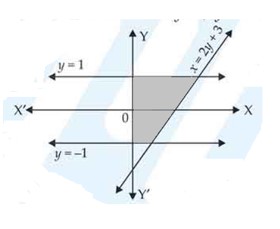
G i v e n     e q u a t i o n     o f     l i n e s     a r e     x = 2 y + 3 ,     y = 1     a n d     y = − 1 ∴Required  area=∫−11(2y+3) dy                                   = 2 . 1 2 [ y 2 ] − 1 1 + 3 [ y ] − 1 1 = ( 1 − 1 ) + 3 ( 1 + 1 ) = 6   s q .   u n i t s H e n c e ,     t h e     c o r r e c t     o p t i o n     i s     ( c ) .

Thumbs Up IconUpvote Thumbs Down Icon
New answer posted•a year ago
S
a year ago

This is an Objective Type Questions as classified in NCERT Exemplar
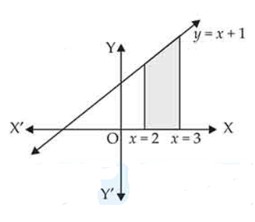
G i v e n     e q u a t i o n     o f     l i n e s     a r e     y = x + 1 ,     x = 2     a n d     x = 3 ∴Required  area=∫23(x+1) dx                                   = [ x 2 2 + x ] 2 3 = ( 9 2 + 3 ) − ( 4 2 + 2 )                                   = 1 5 2 − 4 = 7 4   s q .   u n i t s H e n c e ,     t h e     c o r r e c t     o p t i o n     i s     ( a ) .

Thumbs Up IconUpvote Thumbs Down Icon
New question posted•a year ago

<p><strong>The area of the region bounded by the curve <span class="mathml" contenteditable="false"> <math> <mrow> <mi>y</mi> <mo>=</mo> <mi>x</mi> <mo>+</mo> <mn>1</mn> </mrow> </math> </span></strong><strong>and the lines <span class="mathml" contenteditable="false"> <math> <mrow> <mi>x</mi> <mo>=</mo> <mn>2</mn> </mrow> </math> </span></strong><strong>and <span class="mathml" contenteditable="false"> <math> <mrow> <mi>x</mi> <mo>=</mo> <mn>3</mn> </mrow> </math> </span></strong><strong>is:</strong></p> <p><strong>(A) <span class="mathml" contenteditable="false"> <math> <mrow> <mfrac> <mrow> <mn>7</mn> </mrow> <mrow> <mn>2</mn> </mrow> </mfrac> </mrow> </math> </span></strong>&lt;!-- [if gte mso 9]>&lt;xml&gt;<o:OLEObject Type="Embed" ProgID="Equation.DSMT4" ShapeID="_x0000_i1028"DrawAspect="Content" ObjectID="_1812874402"></o:OLEObject> &lt;/xml&gt;&lt;![endif]--&gt;&nbsp;sq. units</p> <p><strong>(B)</strong> <span class="mathml" contenteditable="false"> <math> <mrow> <mfrac> <mrow> <mn>9</mn> </mrow> <mrow> <mn>2</mn> </mrow> </mfrac> </mrow> </math> </span>&lt;!-- [if gte mso 9]>&lt;xml&gt;<o:OLEObject Type="Embed" ProgID="Equation.DSMT4" ShapeID="_x0000_i1029"DrawAspect="Content" ObjectID="_1812874403"></o:OLEObject> &lt;/xml&gt;&lt;![endif]--&gt;&nbsp;sq. units</p> <p><strong>(C)</strong> <span class="mathml" contenteditable="false"> <math> <mrow> <mfrac> <mrow> <mn>1</mn> <mn>1</mn> </mrow> <mrow> <mn>2</mn> </mrow> </mfrac> </mrow> </math> </span>&lt;!-- [if gte mso 9]>&lt;xml&gt;<o:OLEObject Type="Embed" ProgID="Equation.DSMT4" ShapeID="_x0000_i1030"DrawAspect="Content" ObjectID="_1812874404"></o:OLEObject> &lt;/xml&gt;&lt;![endif]--&gt;&nbsp;sq. units</p> <p><strong>(D) <span class="mathml" contenteditable="false"> <math> <mrow> <mfrac> <mrow> <mn>1</mn> <mn>3</mn> </mrow> <mrow> <mn>2</mn> </mrow> </mfrac> </mrow> </math> </span>&lt;!-- [if gte mso 9]>&lt;xml&gt;<o:OLEObject Type="Embed" ProgID="Equation.DSMT4" ShapeID="_x0000_i1031"DrawAspect="Content" ObjectID="_1812874405"></o:OLEObject> &lt;/xml&gt;&lt;![endif]--&gt;&nbsp;</strong>sq. units</p>

3 Views|Posted a year ago
Asked by Payal Gupta
New answer posted•a year ago
S
a year ago

This is an Objective Type Questions as classified in NCERT Exemplar
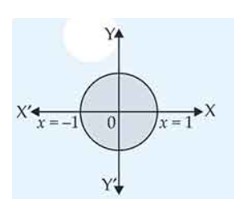
G i v e n     e q u a t i o n     o f     c i r c l e     i s     x 2 + y 2 = 1 ⇒                                   y = 1 − x 2 ∴   Since  the  circle  is  symmetrical  about  the  axes. ∴Required  area=4×∫011−x2 dx                                   = 4 [ x 2 1 − x 2 + 1 2 s i n − 1 x ] 0 1                                   = 4 [ 0 + 1 2 s i n − 1 ( 1 ) − 0 − 0 ] = 4 × 1 2 × π 2 = π   s q .   u n i t s H e n c e ,     t h e     c o r r e c t     o p t i o n     i s     ( b ) .

Thumbs Up IconUpvote Thumbs Down Icon
New answer posted•a year ago
S
a year ago

This is an Objective Type Questions as classified in NCERT Exemplar
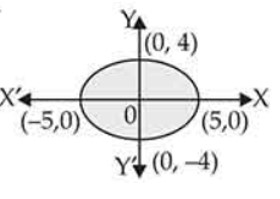
G i v e n     e q u a t i o n     o f     e l l i p s e     i s     x 2 2 5 + y 2 1 6 = 1 ⇒     y 2 1 6 = 1 − x 2 2 5             ⇒ y 2 = 1 6 2 5 ( 2 5 − x 2 ) ∴                 y = 4 5 2 5 − x 2 ∴   Since  the  ellipse  is  symmetrical  about  the  axes. ∴Required  area=4∫054525−x2 dx=4×45∫05(5)2−x2 dx                                   = 1 6 5 [ x 2 ( 5 ) 2 − x 2 + 2 5 2 s i n − 1 x 5 ] 0 5                                   = 1 6 5 [ 0 + 2 5 2 s i n − 1 ( 5 5 ) − 0 − 0 ] = 1 6 5 [ 2 5 2 . s i n − 1 ( 1 ) ]                                   = 1 6 5 [ 2 5 2 . π 2 ] = 2 0 π   s q .   u n i t s H e n c e ,     t h e     c o r r e c t     o p t i o n     i s     ( a ) .

Thumbs Up IconUpvote Thumbs Down Icon