Exemplar Solution

Get insights from 1.3k questions on Exemplar Solution, answered by students, alumni, and experts. You may also ask and answer any question you like about Exemplar Solution

  • 1.3k

    Questions

  • 0

    Discussions

  • 0

    Active Users

  • 0

    Followers

Have a question about Exemplar Solution? Ask our experts

Ask Your Question

Keep it short & simple. Type complete word. Avoid abusive language.

New answer posted•a year ago
S
a year ago

This is a long answer type question as classified in NCERT Exemplar
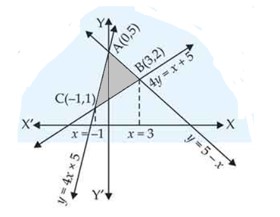
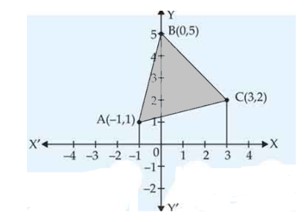
G i v e n     t h a t     y = 4 x + 5                                                                                                                 … ( i )                                                   y = 5 − x                                                                                                                   … ( i i ) a n d                             4 y = x + 5                                                                                                                   … ( i i i )           x 0 − 5 / 4 y 5 0                     x 0 5 y 5 0                     x 0 − 5 y 5 / 4 0 S o l v i n g     e q n ( i )     a n d     ( i i )     w e     g e t           4 x + 5 = 5 − x ∴                         x = 0     a n d     y = 5 C o o r d i n a t e s     o f     A = ( 0 , 5 ) S o l v i n g     e q n ( i i )     a n d     ( i i i )     w e     g e t                           y = 5 − x ∴                 4 y = x + 5                       5 y = 1 0 ∴                       y = 2     a n d     x = 3 ∴ C o o r d i n a t e s     o f     B = ( 3 , 2 )     S o l v i n g     e q n ( i )     a n d     ( i i i )     w e     g e t                           y = 4 x + 5     a n d     4 y = x + 5 ⇒ 4 ( 4 x + 5 ) = x + 5 ⇒         1 6 x + 2 0 = x + 5             ⇒ 1 5 x = − 1 5 ∴                                             x = − 1     a n d     y = 1 ∴ C o o r d i n a t e s     o f     C = ( − 1 , 1 ) ∴ A r e a     o f     r e q u i r e d     r e g i o n s           = ∫ − 1 0 y A C d x + ∫ 0 3 y A B d x − ∫ − 1 3 y C B d x           = ∫ − 1 0 ( 4 x + 5 ) d x + ∫ 0 3 ( 5 − x ) d x − ∫ − 1 3 ( x + 5 4 ) d x           = [ 4 x 2 2 + 5 x ] − 1 0 + [ 5 x − x 2 2 ] 0 3 − 1 4 [ x 2 2 + 5 x ] − 1 3           = [ ( 0 + 0 ) − ( 2 − 5 ) ] + [ ( 1 5 − 9 2 ) − ( 0 − 0 ) ] − 1 4 [ ( 9 2 + 1 5 ) − ( 1 2 − 5 ) ]           = 3 + 2 1 2 − 1 4 [ 3 9 2 + 9 2 ] = 3 + 2 1 2 − 1 4 × 2 4           = 3 + 2 1 2 − 6 = 2 1 2   s q .   u n i t s H e n c e ,     t h e     r e q u i r e d     a r e a = 2 1 2   s q .   u n i t s .

Thumbs Up IconUpvote Thumbs Down Icon
New answer posted•a year ago
S
a year ago

This is a long answer type question as classified in NCERT Exemplar

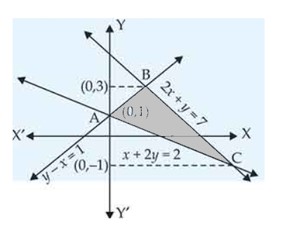
G i v e n     t h a t     x + 2 y = 2                                                                                                 … ( i )                                                         y − x = 1                                                                                                 … ( i i ) a n d                                     2 x + y = 7                                                                                             … ( i i i )           x 0 2 y 1 0                     x 0 − 1 y 1 0                     x 0 7 / 2 y 7 0 S o l v i n g     e q n ( i i )     a n d     ( i i i )     w e     g e t                                               y = 1 + x ∴         2 x + 1 + x = 7                                           3 x = 6         ⇒ x = 2 ∴                                           y = 1 + 2 = 3 C o o r d i n a t e s     o f     B = ( 2 , 3 ) S o l v i n g     e q n ( i )     a n d     ( i i i )     w e     g e t                           x + 2 y = 2 ∴                                           x = 2 − 2 y                             2 x + y = 7 2 ( 2 − 2 y ) + y = 7 ⇒       4 − 4 y + y = 7       ⇒ − 3 y = 3 ∴                                                 y = − 1     a n d     x = 4 ∴ C o o r d i n a t e s     o f     C = ( 4 , − 1 )     a n d     C o o r d i n a t e s     o f     A = ( 0 , 1 ) T a k i n g     t h e     l i m i t s     o n     y − a x i s ,     w e     g e t                             ∫ − 1 3 x B C d y − ∫ − 1 1 x A C d y − ∫ 1 3 x A B d y                         = ∫ − 1 3 7 − y 2 d y − ∫ − 1 1 ( 2 − 2 y ) d y − ∫ 1 3 ( y − 1 ) d y                         = 1 2 [ 7 y − y 2 2 ] − 1 3 − 2 [ y − y 2 2 ] − 1 1 − [ y 2 2 − y ] 1 3                         = 1 2 [ ( 2 1 − 9 2 ) − ( − 7 − 1 2 ) ] − 2 [ ( 1 − 1 2 ) − ( − 1 − 1 2 ) ] − [ ( 9 2 − 3 ) − ( 1 2 − 1 ) ]                         = 1 2 [ 3 3 2 + 1 5 2 ] − 2 [ 1 2 + 3 2 ] − [ 3 2 + 1 2 ]                         = 1 2 × 2 4 − 2 × 2 − 2 = 1 2 − 4 − 2 = 6   s q .   u n i t s H e n c e ,     t h e     r e q u i r e d     a r e a = 6   s q .   u n i t s .

Thumbs Up IconUpvote Thumbs Down Icon
New answer posted•a year ago
S
a year ago

This is a long answer type question as classified in NCERT Exemplar
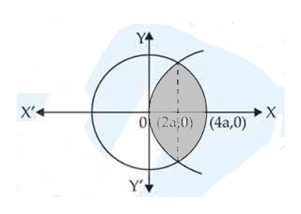
W e     a r e     g i v e n     t h a t     { ( x , y ) : y 2 ≤ 6 a x     a n d     x 2 + y 2 ≤ 1 6 a 2 } E q u a t i o n     o f     P a r a b o l a     i s                                   y 2 = 6 a x                                                                                                   … ( i ) a n d     e q u a t i o n     o f     c i r c l e     i s                 x 2 + y 2 = 1 6 a 2                                                                                           … ( i i ) S o l v i n g     e q n . ( i )     a n d     ( i i )     w e     g e t                                                                         x 2 + 6 a x = 1 6 a 2 ⇒                                   x 2 + 6 a x − 1 6 a 2 = 0 ⇒           x 2 + 8 a x − 2 a x − 1 6 a 2 = 0 ⇒       x ( x + 8 a ) − 2 a ( x + 8 a ) = 0 ⇒                                   ( x + 8 a ) ( x − 2 a ) = 0 ∴     x = 2 a     a n d     x = − 8 a . ( Rejected  as  it  out  of  region ) Area  of  the  required  shaded  region=2[∫02a6axdx+∫2a4a16a2−x2]                                                                 = 2 [ 6 a ∫ 0 2 a x d x + ∫ 2 a 4 a ( 4 a ) 2 − x 2 ]                                                                   = 2 6 a . 2 3 [ x 3 / 2 ] 0 2 a + 2 [ x 2 ( 4 a ) 2 − x 2 + 1 6 a 2 2 s i n − 1 x 4 a ] 2 a 4 a                                                                   = 4 6 3 a [ ( 2 a ) 3 / 2 − 0 ] + [ x ( 4 a ) 2 − x 2 + 1 6 a 2 s i n − 1 x 4 a ] 2 a 4 a                                                                   = 4 6 3 a . 2 2 . a 3 / 2 + [ 0 + 1 6 a 2 s i n − 1 ( 4 a 4 a ) − 2 a 1 6 a 2 − 4 a 2 − 1 6 a 2 s i n − 1 2 a 4 a ]                                                                   = 8 1 2 3 a 2 + [ 1 6 a 2 s i n − 1 ( 1 ) − 2 a 1 2 a 2 − 1 6 a 2 s i n − 1 1 2 ]                                                                   = 1 6 3 3 a 2 + [ 1 6 a 2 . π 2 − 2 a . 2 3 a − 1 6 a 2 . π 6 ]                                                                   = 1 6 3 3 a 2 + 8 π a 2 − 4 3 a 2 − 8 3 π a 2                                                                   = ( 1 6 3 3 − 4 3 ) a 2 + 1 6 3 π a 2 = 4 3 3 a 2 + 1 6 3 π a 2                                                                   = 4 3 ( 3 + 4 π ) a 2   s q .   u n i t s H e n c e ,     t h e     r e q u i r e d     a r e a = 4 3 ( 3 + 4 π ) a 2   s q .   u n i t s .

Thumbs Up IconUpvote Thumbs Down Icon
New answer posted•a year ago
S
a year ago

This is a long answer type question as classified in NCERT Exemplar
T h e     c o o r d i n a t e s     o f     t h e     v e r t i c e s     o f     Δ A B C     a r e     g i v e n     b y     A ( − 1 , 1 ) , B ( 0 , 5 )     C ( 3 , 2 ) . E q u a t i o n     o f     A B     i s     y − 1 = 5 − 1 0 + 1 ( x + 1 ) ⇒                                                                             y − 1 = 4 x + 4         ⇒ y = 4 x + 4 + 1 ⇒                                                                                             y = 4 x + 5                                                                                                                     … ( i ) E q u a t i o n     o f     B C     i s     y − 5 = 2 − 5 3 − 0 ( x − 0 ) ⇒                                                                             y − 5 = − x ⇒                                                                                           y = 5 − x                                                                                                                               … ( i i ) E q u a t i o n     o f     C A     i s     y − 1 = 2 − 1 3 + 1 ( x + 1 ) ⇒                                                                             y − 1 = 1 4 x + 1 4           ⇒ y = 1 4 x + 1 4 + 1 ⇒                                                                                           y = 1 4 x + 5 4 = 1 4 ( 5 + x )                                                                           … ( i i i ) Area  of  ΔABC=∫−10(4x+5) dx+∫03(5−x) dx−∫−1314(5+x) dx                             = 4 2 [ x 2 ] − 1 0 + 5 [ x ] − 1 0 + 5 [ x ] 0 3 − 1 2 [ x 2 ] 0 3 − 1 4 [ 5 x + x 2 2 ] − 1 3                             = 2 ( 0 − 1 ) + 5 ( 0 + 1 ) + 5 ( 3 − 0 ) − 1 2 ( 9 − 0 ) − 1 4 [ ( 1 5 + 9 2 ) − ( − 5 + 1 2 ) ]                             = − 2 + 5 + 1 5 − 9 2 − 1 4 ( 3 9 2 + 9 2 )                             = 1 8 − 9 2 − 1 4 × 4 8 2 = 1 8 − 9 2 − 6 = 1 2 − 9 2 = 1 5 2   s q .   u n i t s H e n c e ,     t h e     r e q u i r e d     a r e a = 1 5 2   s q .   u n i t s .

Thumbs Up IconUpvote Thumbs Down Icon
New answer posted•a year ago
S
a year ago

This is a long answer type question as classified in NCERT Exemplar
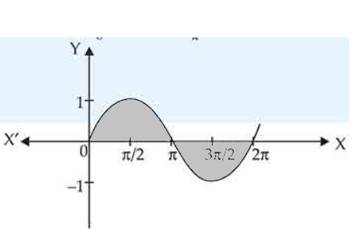
Required  area  =∫0πsinx dx+∫02π|sinx| dx                             = [ c o s x ] 0 π + | ( − c o s x ) | 0 2 π                             = − [ c o s π − c o s 0 ] + [ c o s 2 π − c o s π ]                             = − [ − 1 − 1 ] + [ 1 + 1 ] = 2 + 2 = 4   s q .   u n i t s H e n c e ,     t h e     r e q u i r e d     a r e a = 4   s q .   u n i t s .

Thumbs Up IconUpvote Thumbs Down Icon
New answer posted•a year ago
S
a year ago

This is a long answer type question as classified in NCERT Exemplar
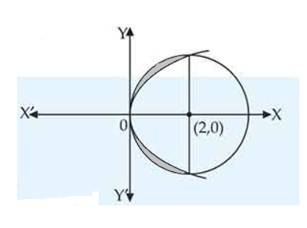
E q u a t i o n s     o f     t h e     c u r v e     a r e     g i v e n     b y                                                             x 2 + y 2 = 4 x                                                                                                     … ( i ) a n d                                                                   y 2 = 2 x                                                                                                   … ( i i ) ⇒                                 x 2 − 4 x + y 2 = 0 ⇒ x 2 − 4 x + 4 − 4 + y 2 = 0                                           ( x − 2 ) 2 + y 2 = 4 C l e a r l y     i t     i s     t h e     e q u a t i o n     o f     a     c i r c l e     h a v i n g     i t s     c e n t r e ( 2 , 0 )     a n d     r a d i u s     2 . S o l v i n g     x 2 + y 2 = 4 x     a n d     y 2 = 2 x                                     x 2 + 2 x = 4 x ⇒       x 2 + 2 x − 4 x = 0 ⇒                             x 2 − 2 x = 0 ⇒                         x ( x − 2 ) = 0 ∴                                                             x = 0 , 2 Area  of  the  required  region=2[∫024−(x−2)2dx−∫022xdx]       [ ?     P a r a b o l a     a n d     c i r c l e     b o t h     a r e     s y m m e t r i c a l     a b o u t     x − a x i s ]                                                                   = 2 [ x − 2 2 4 − ( x − 2 ) 2 + 4 2 s i n − 1 x − 2 2 ] 0 2 − 2 . 2 . 2 3 [ x 3 / 2 ] 0 2                                                                   = 2 [ ( 0 + 0 ) − ( 0 + 2 s i n − 1 ( − 1 ) ) ] −

Thumbs Up IconUpvote Thumbs Down Icon
New answer posted•a year ago
S
a year ago

This is a short answer type question as classified in NCERT Exemplar
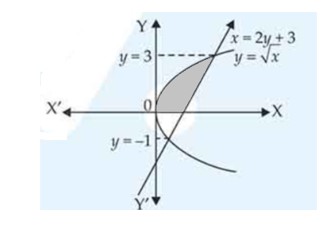
G i v e n     t h a t     y = x ,     x = 2 y + 3 ,     f i r s t     q u a d r a n t     a n d     x − a x i s . S o l v i n g     y = x     a n d     x = 2 y + 3 ,     w e     g e t                                                                                 y = 2 y + 3       ⇒ y 2 = 2 y + 3 ⇒                                 y 2 − 2 y − 3 = 0         ⇒ y 2 − 3 y + y − 3 = 0 ⇒ y ( y − 3 ) + 1 ( y − 3 ) = 0         ⇒ ( y + 1 ) ( y − 3 ) = 0 ∴                                                                                 y = − 1 , 3 A r e a     o f     t h e     s h a d e d     r e g i o n = ∫ 0 3 ( 2 y + 3 ) d y − ∫ 0 3 y 2 d y                                                 = [ 2 y 2 2 + 3 y ] 0 3 − 1 3 [ y 3 ] 0 3                                                   = [ ( 9 + 9 ) − ( 0 + 0 ) ] − 1 3 [ 2 7 − 0 ]                                                   = 1 8 − 9 = 9   s q .   u n i t s H e n c e ,     t h e     r e q u i r e d     a r e a = 9   s q .   u n i t s .

Thumbs Up IconUpvote Thumbs Down Icon
New answer posted•a year ago
S
a year ago

This is a short answer type question as classified in NCERT Exemplar
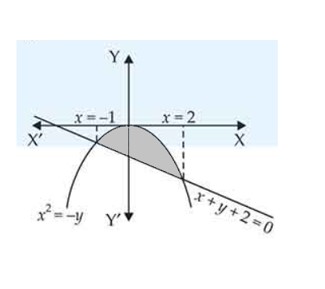
W e     a r e     g i v e n     t h a t     y = − x 2     o r     x 2 = − y a n d     t h e     l i n e     x + y + 2 = 0 S o l v i n g     t h e     t w o     e q u a t i o n s ,     w e     g e t ∴                                               x − x 2 + 2 = 0 ⇒                                           x 2 − x − 2 = 0 ⇒                       x 2 − 2 x + x − 2 = 0 ⇒       x ( x − 2 ) + 1 ( x − 2 ) = 0 ⇒                             ( x − 2 ) ( x + 1 ) = 0           ∴ x = − 1 ,   x = 2 Area  of  the  required  shaded  region=|∫−12(−x−2)dx−∫−12−x2dx|                                                                   = | − [ x 2 2 + 2 x ] − 1 2 + 1 3 [ x 3 ] − 1 2 |                                                                   = | − [ ( 4 2 + 4 ) − ( 1 2 − 2 ) ] + 1 3 [ 8 + 1 ] |                                                                   = | − ( 6 + 3 2 ) + 1 3 ( 9 ) | = | − 1 5 2 + 3 |                                                                     = | − 1 5 + 6 2 | = | − 9 2 | = 9 2   s q .   u n i t s H e n c e ,     t h e     r e q u i r e d     a r e a = 9 2   s q .   u n i t s .

Thumbs Up IconUpvote Thumbs Down Icon
New answer posted•a year ago
S
a year ago

This is a short answer type question as classified in NCERT Exemplar
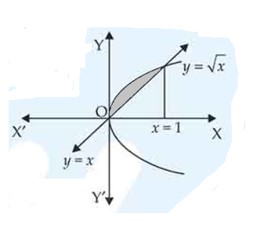
W e     a r e     g i v e n     t h e     e q u a t i o n s     o f     c u r v e     y = x     a n d     l i n e     y = x . S o l v i n g     y = x     ⇒ y 2 = x     a n d     y = x ,     w e     g e t                                                                                     x 2 = x     ⇒ x 2 − x = 0 ⇒                                                     x ( x − 1 ) = 0         ∴ x = 0 , 1 Area  of  the  required  shaded  region=∫01xdx−∫01xdx                                                 = 2 3 [ x 3 / 2 ] 0 1 − 1 2 [ x 2 ] 0 1                                                   = 2 3 [ ( 1 ) 3 / 2 − 0 ] − 1 2 [ ( 1 ) 2 − 0 ]                                                   = 2 3 − 1 2 = 4 − 3 6 = 1 6   s q .   u n i t s H e n c e ,     t h e     r e q u i r e d     a r e a = 1 6   s q .   u n i t s .

Thumbs Up IconUpvote Thumbs Down Icon
New answer posted•a year ago
S
a year ago

This is a short answer type question as classified in NCERT Exemplar
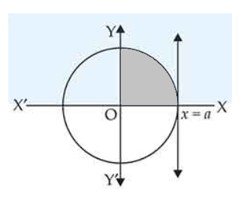
H e r e ,     w e     h a v e     y = a 2 − x 2 ⇒                                                     y 2 = a 2 − x 2 ⇒                                 x 2 + y 2 = a 2 Area  of  the  shaded  region                                                                   = 2 [ ( 1 ) 3 / 2 − 0 ] − 3 2 [ ( 1 ) 2 − 0 ]                                                                   = [ x a a 2 − x 2 + a 2 2 s i n − 1 x a ] 0 a                                                                     = [ a a a 2 − a 2 + a 2 2 s i n − 1 a a − 0 − 0 ]                                                                     = a 2 2 s i n − 1 ( 1 ) = a 2 2 . π 2 = π a 2 4   s q .   u n i t s H e n c e ,     t h e     r e q u i r e d     a r e a = π a 2 4   s q .   u n i t s .

Thumbs Up IconUpvote Thumbs Down Icon