Exemplar Solution

Get insights from 1.3k questions on Exemplar Solution, answered by students, alumni, and experts. You may also ask and answer any question you like about Exemplar Solution

  • 1.3k

    Questions

  • 0

    Discussions

  • 0

    Active Users

  • 0

    Followers

Have a question about Exemplar Solution? Ask our experts

Ask Your Question

Keep it short & simple. Type complete word. Avoid abusive language.

New answer posted•a year ago
S
a year ago

This is a short answer type question as classified in NCERT Exemplar
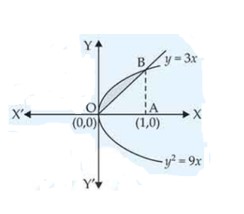
W e     h a v e ,     y 2 = 9 x ,     y = 3 x S o l v i n g     t h e     t w o     e q u a t i o n s ,     w e     h a v e                                     ( 3 x ) 2 = 9 x ⇒               9 x 2 − 9 x = 0         ⇒ 9 x ( x − 1 ) = 0 ∴                                                   x = 0 , 1 A r e a     o f     t h e     s h a d e d     r e g i o n = a r ( r e g i o n     O A B ) − a r ( Δ O A B ) = ∫ 0 1 y 1 d x = ∫ 0 1 9 x d x − ∫ 0 1 3 x d x = 3 ∫ 0 1 x d x − 3 ∫ 0 1 x d x = 3 × 2 3 [ x 3 / 2 ] 0 1 − 3 [ x 2 2 ] 0 1 = 2 [ ( 1 ) 3 / 2 − 0 ] − 3 2 [ ( 1 ) 2 − 0 ] = 2 ( 1 ) − 3 2 ( 1 ) = 2 − 3 2 = 1 2 s q .   u n i t s H e n c e ,     t h e     r e q u i r e d     a r e a = 1 2 s q .   u n i t s .

Thumbs Up IconUpvote Thumbs Down Icon
New answer posted•a year ago
S
a year ago

This is a True or False Type Questions as classified in NCERT Exemplar

T h e     g i v e n     e q u a t i o n     o f     t h e     p l a n e     i s       r → . ( 5 i ^ − 3 j ^ − 2 k ^ ) = 3 8 I f     t h e     f o o t     o f     t h e     p e r p e n d i c u l a r     t o     t h i s     p l a n e     i s                       ( 5 ,   − 3 ,   − 2 )     i . e . ,     5 i ^ − 3 j ^ − 2 k ^     t h e n ⇒                 ( 5 i ^ − 3 j ^ − 2 k ^ ) . ( 5 i ^ − 3 j ^ − 2 k ^ ) = 3 8 ⇒                                                                                                       2 5 + 9 + 4 = 3 8                                                                                 3 8 = 3 8 ( s a t i s f i e d ) H e n c e ,     t h e     g i v e n     s t a t e m e n t     i s     T r u e .

Thumbs Up IconUpvote Thumbs Down Icon
New answer posted•a year ago
S
a year ago

This is a True or False Type Questions as classified in NCERT Exemplar

H e r e ,     x 1 = 5 ,     y 1 = − 2 ,     z 1 = 4 ;     a = 2 ,     b = 1 ,     c = 3 W e     k n o w     t h a t     t h e     e q u a t i o n     o f     l i n e     i s     x − x 1 a = y − y 1 b = z − z 1 c ⇒                                       x − 5 2 = y + 2 1 = z − 4 3 H e n c e ,     t h e     g i v e n     s t a t e m e n t     i s     F a l s e .

Thumbs Up IconUpvote Thumbs Down Icon
New answer posted•a year ago
S
a year ago

This is a True or False Type Questions as classified in NCERT Exemplar

T h e     C a r t e s i a n     f o r m     o f     t h e     e q u a t i o n     i s                                 x − 5 3 = y + 4 7 = z − 6 2 = λ H e r e ,     x 1 = 5 ,     y 1 = − 4 ,     z 1 = 6 ;     a = 3 ,     b = 7 ,     c = 2 S o ,     t h e     v e c t o r     e q u a t i o n     i s     r → = ( 5 i ^ − 4 j ^ + 6 k ^ ) + λ ( 3 i ^ + 7 j ^ + 2 k ^ ) H e n c e ,     t h e     g i v e n     s t a t e m e n t     i s     T r u e .

Thumbs Up IconUpvote Thumbs Down Icon
New answer posted•a year ago
S
a year ago

This is a True or False Type Questions as classified in NCERT Exemplar

D i r e c t i o n     r a t i o s     o f     t h e     l i n e     ( i ^ − j ^ + 2 k ^ ) D i r e c t i o n     r a t i o s     o f     t h e     n o r m a l     t o     t h e     p l a n e     a r e     ( 3 i ^ + j ^ − k ^ ) S o ,     ( i ^ − j ^ + 2 k ^ ) . ( 3 i ^ + j ^ − k ^ ) = 3 − 1 − 2 = 0 T h e r e f o r e ,     t h e     l i n e     i s     p a r a l l e l     t o     t h e     p l a n e . Now  point  through  which  the  line  is  passing  →=2i^−3j^−k^ I f     t h e     l i n e     l i e s     i n     t h e     p l a n e     t h e n                       ( 2i^−3j^−k^ ) . ( 3 i ^ + j ^ − k ^ ) + 2 = 0                                                       6 − 3 + 1 + 2 ≠ 0 S o ,       t h e     l i n e     d o e s     n o t     l i e     i n     t h e     p l a n e . H e n c e ,     t h e     g i v e n     s t a t e m e n t     i s     F a l s e .

Thumbs Up IconUpvote Thumbs Down Icon
New answer posted•a year ago
S
a year ago

This is a True or False Type Questions as classified in NCERT Exemplar

T h e     g i v e n     p l a n e     a r e     r → . ( 2 i ^ − 3 j ^ + k ^ ) = 1     a n d     r → . ( i ^ − j ^ ) = 4 H e r e ,     b 1 → = 2 i ^ − 3 j ^ + k ^     a n d     n 2 → = i ^ − j ^ S o ,                   c o s θ = b 1 → n 2 → | b 1 → | | n 2 → | ⇒                 c o s θ = ( 2 i ^ − 3 j ^ + k ^ ) . ( i ^ − j ^ ) 4 + 9 + 1 1 + 1 = 2 + 3 1 4 2 = 5 2 8 ∴                 θ = c o s − 1 ( 5 2 8 )     w h i c h     i s     f a l s e . H e n c e ,     t h e     g i v e n     s t a t e m e n t     i s     F a l s e .

Thumbs Up IconUpvote Thumbs Down Icon
New answer posted•a year ago
S
a year ago

This is a True or False Type Questions as classified in NCERT Exemplar

E q u a t i o n     o f     l i n e     i s     r → = ( 5 i ^ − j ^ − 4 k ^ ) + λ ( 2 i ^ − j ^ + k ^ )     a n d     t h e e q u a t i o n     o f     p l a n e     i s     r → . ( 3 i ^ − 4 j ^ − k ^ ) + 5 = 0 H e r e ,     b 1 → = 2 i ^ − j ^ + k ^     a n d     n 2 → = 3 i ^ − 4 j ^ − k ^ ∴                     s i n θ = b 1 → n 2 → | b 1 → | | n 2 → | ⇒                 s i n θ = ( 2 i ^ − j ^ + k ^ ) . ( 3 i ^ − 4 j ^ − k ^ ) 4 + 4 + 1 9 + 1 6 + 1 = 6 + 4 − 1 6 2 6 = 9 6 2 6 ⇒                 s i n θ = 9 2 3 9     w h i c h     i s     f a l s e . H e n c e ,     t h e     g i v e n     s t a t e m e n t     i s     F a l s e .

Thumbs Up IconUpvote Thumbs Down Icon
New answer posted•a year ago
S
a year ago

This is a True or False Type Questions as classified in NCERT Exemplar

E q u a t i o n     o f     t h e     p l a n e     i s     2 x − 3 y + 5 z + 4 = 0 ⇒                                   2 x − 3 y + 5 z = − 4 ⇒       2 − 4 x − 3 − 4 y + 5 − 4 z = 1 ⇒       x − 2 − y 4 / 3 + z − 4 / 5 = 1 So,  the  required  intercepts  are  −2,  43  and  −45 H e n c e ,     t h e     g i v e n     s t a t e m e n t     i s     T r u e .

Thumbs Up IconUpvote Thumbs Down Icon
New answer posted•a year ago
S
a year ago

This is a True or False Type Questions as classified in NCERT Exemplar

G i v e n     p l a n e     i s     x + 2 y + 3 z − 6 = 0 V e c t o r     n o r m a l     t o     t h e     p l a n e     n → = i ^ + 2 j ^ + 3 k ^ ∴                     n ^ = n → | n → | = i ^ + 2 j ^ + 3 k ^ ( 1 ) 2 + ( 2 ) 2 + ( 3 ) 2 = 1 1 4 i ^ + 2 1 4 j ^ + 3 1 4 k ^ H e n c e ,     t h e     g i v e n     s t a t e m e n t     i s     T r u e .

Thumbs Up IconUpvote Thumbs Down Icon
New answer posted•a year ago
S
a year ago

This is a Fill in the blanks Type Questions as classified in NCERT Exemplar

G i v e n     e q u a t i o n     r → . ( i ^ + j ^ − k ^ ) = 2 ⇒         ( x i ^ + y j ^ + z k ^ ) . ( i ^ + j ^ − k ^ ) = 2 ⇒                                                                               x + y − z = 2 H e n c e ,     t h e     C a r t e s i a n     e q u a t i o n     o f     t h e     p l a n e     i s     x + y − z = 2

Thumbs Up IconUpvote Thumbs Down Icon