
The P Block Elements
Get insights from 57 questions on The P Block Elements, answered by students, alumni, and experts. You may also ask and answer any question you like about The P Block Elements
- 57
Questions
- 0
Discussions
- 0
Active Users
- 0
Followers
Have a question about The P Block Elements? Ask our experts
Keep it short & simple. Type complete word. Avoid abusive language.
Boric acid is an acid because its molecule
(A) Contains replaceable H+ ion
(B) Gives up a proton.
(C) Accepts OH−from water releasing proton.
(D) Combines with proton from water molecule.
Boric acid is an acid because its molecule
(A) Contains replaceable H+ ion
(B) Gives up a proton.
(C) Accepts OH−from water releasing proton.
(D) Combines with proton from water molecule.
This is a Multiple Choice Questions as classified in NCERT Exemplar
C
Boric acid is Lewis acid, having six electrons in its valence shell. It combines with water, accepts electrons
from OH−of water molecule and complete it octet to 8 and releases H+
Reaction: B (OH)3 + OH − H→ [B (OH)4]− + H+
 Upvote

The exhibition of highest coordination number depends on the availability of vacant orbitals in the central atom. Which of the following elements is not likely to act as central atom in MF63− ?
(A) B
(B) AI
(C) Ga
(D) In
The exhibition of highest coordination number depends on the availability of vacant orbitals in the central atom. Which of the following elements is not likely to act as central atom in MF63− ?
(A) B
(B) AI
(C) Ga
(D) In
This is a Multiple Choice Questions as classified in NCERT Exemplar
A
Number of items/molecules bonded to the central atom is termed as coordination number. In the given MF63−
Coordination number of metal is six and boron can have topmost coordination number of four as it consists of s and p orbital on
Upvote Which of the following oxides is acidic in nature?
(A) B2O3
(B) Al2O3
(C) Ga2O3
(D) In2O3
Which of the following oxides is acidic in nature?
(A) B2O3
(B) Al2O3
(C) Ga2O3
(D) In2O3
This is a Multiple Choice Questions as classified in NCERT Exemplar
A
The B2O3 reacts with water to form boric acid hence it is an acidic oxide. As we move down the group electronegativity decreases and the tendency to donate electrons increases therefore basic character increases or acidic character
Upvote The geometry of a complex species can be understood from the knowledge of type of hybridisation
of orbitals of central atom. The hybridisation, of orbitals of central atom in [B(OH)4]− and the geometry of the complex are respectively
(A) sp3, tetrahedral
(B) sp3, square planar
(C) sp3 d2, octahedral
(D) dsp2, square planar
The geometry of a complex species can be understood from the knowledge of type of hybridisation
of orbitals of central atom. The hybridisation, of orbitals of central atom in [B(OH)4]− and the geometry of the complex are respectively
(A) sp3, tetrahedral
(B) sp3, square planar
(C) sp3 d2, octahedral
(D) dsp2, square planar
This is a Multiple Choice Questions as classified in NCERT Exemplar
A
Central atom in [B (OH)4 ]− no lone pair. Electronic conf In ground state: 1s2 2s2 2px1 2py0 2pz0
In excited state, One Electron from 2s shifts to 2py orbital and the configuration becomes:
1s2 2s2 2p1 x2 p1 y2 pz0
Now, one
Upvote Which of the following is a Lewis acid?
(A) AlCl3
(B) MgCl2
(C) CaCl2
(D) BaCl2
Which of the following is a Lewis acid?
(A) AlCl3
(B) MgCl2
(C) CaCl2
(D) BaCl2
This is a Multiple Choice Questions as classified in NCERT Exemplar
A
Lewis acids are the species in which the state is not complete and ready to accept electrons. Because Al is surrounded by 6 electrons in AlCl3 and all three Cl atoms are surrounded by 8 electrons, AlCl3 is an electron acceptor. It i
Upvote The element which exists in liquid state for a wide range of temperature and can be used for measuring high temperature is
(A) B
(B) Al
(C) Ga
(D) In
The element which exists in liquid state for a wide range of temperature and can be used for measuring high temperature is
(A) B
(B) Al
(C) Ga
(D) In
This is a Multiple Choice Questions as classified in NCERT Exemplar
C
Gallium generally exists as solid at room temperature but melts on slight heating (melting point: 20? C ).
Whereas the boiling point of Gallium is very high around 2400? C. Gallium has large cohesive forces that hold its structure to
Upvote Complete the following chemical equations:
Z + 3LiAlH4 → X + 3 LiF 3AlF3
X + 6H2O → Y + 6H2
3X + 3O2 B2O3 + 3H2O
Complete the following chemical equations:
Z + 3LiAlH4 → X + 3 LiF 3AlF3
X + 6H2O → Y + 6H2
3X + 3O2 B2O3 + 3H2O
This is a Short Answers Type Questions as classified in NCERT Exemplar
4BF3 + 3LiAlH4? 2 B2H6 + 3LiF + 3AlF3
(Z)
Upvote Identify the compounds A, X and Z in the following reactions :
i) A + 2HCl + 5H2O → 2NaCl + X i )X  HBO2
 Z
Identify the compounds A, X and Z in the following reactions :
i) A + 2HCl + 5H2O → 2NaCl + X i )X HBO2 Z
Kindly go through the resolution
i) 
ii) 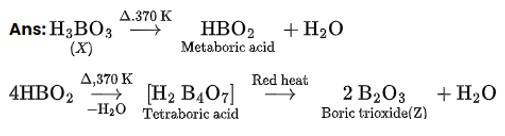
Upvote Explain the following :
(i) Gallium has higher ionisation enthalpy than aluminium (ii) Boron does not exist as B3+ ion (iii) Aluminium forms [AlF6] 3– ion but boron does not form [BF6] 3– ion (iv) PbX2 is more stable than PbX4. (v) Pb4+ acts as an oxidising agent but Sn2+ acts as a reducing agent. (vi) Electron gain enthalpy of chlorine is more negative as compared to fluorine (vii) Tl (NO3)3 acts as an oxidising agent. (viii) Carbon shows catenation property but lead does not. (ix) BF3 does not hydrolyse.
(x) Why does the element silicon, not form a graphite like structure whereas carbon does.
Explain the following :
(i) Gallium has higher ionisation enthalpy than aluminium (ii) Boron does not exist as B3+ ion (iii) Aluminium forms [AlF6] 3– ion but boron does not form [BF6] 3– ion (iv) PbX2 is more stable than PbX4. (v) Pb4+ acts as an oxidising agent but Sn2+ acts as a reducing agent. (vi) Electron gain enthalpy of chlorine is more negative as compared to fluorine (vii) Tl (NO3)3 acts as an oxidising agent. (viii) Carbon shows catenation property but lead does not. (ix) BF3 does not hydrolyse.
(x) Why does the element silicon, not form a graphite like structure whereas carbon does.
This is a Short Answers Type Questions as classified in NCERT Exemplar
(i) When moving down the periodic table within a group, ionization enthalpy generally decreases due to increased atomic radius. However, in the case of gallium (Ga) and aluminum (Al), gallium experiences a higher
Upvote