Continuity and Differentiability

Get insights from 335 questions on Continuity and Differentiability, answered by students, alumni, and experts. You may also ask and answer any question you like about Continuity and Differentiability

  • 335

    Questions

  • 0

    Discussions

  • 0

    Active Users

  • 0

    Followers

Have a question about Continuity and Differentiability? Ask our experts

Ask Your Question

Keep it short & simple. Type complete word. Avoid abusive language.

New answer posted•a year ago
A
a year ago

This is a Long Answer Type Questions as classified in NCERT Exemplar

Sol:

G i v e n     t h a t           f ( x ) = { x 2 + 3 x + p , x ≤ 1 q x + 2 , x > 1     a t     x = 1 . L . H . L .     f ' ( c ) = l i m x → 1 − f ( x ) − f ( c ) x − c                                   f ' ( 1 ) = l i m x → 1 − f ( x ) − f ( 1 ) x − 1                                                             = l i m x → 1 − ( x 2 + 3 x + p ) − ( 1 + 3 + p ) x − 1                                                             = l i m h → 0 [ ( 1 − h ) 2 + 3 ( 1 − h ) + p ] − ( 1 + 3 + p ) 1 − h − 1                                                             = l i m h → 0 [ 1 + h 2 − 2 h + 3 − 3 h + p ] − ( 4 + p ) − h                                                             = l i m h → 0 [ h 2 − 5 h + 4 + p ] − [ 4 + p ] − h                                                             = l i m h → 0 h 2 − 5 h + 4 + p − 4 − p − h                                                             = l i m h → 0 h 2 − 5 h − h = l i m h → 0 h [ h − 5 ] − h = 5 R . H . L .     f ' ( 1 ) = l i m x → 1 + f ( x ) − f ( 1 ) x − 1                                                           = l i m x → 1 + ( q x + 2 ) − ( 1 + 3 + p ) x − 1                                                           = l i m h → 0 [ q ( 1 + h ) + 2 ] − [ 4 + p ] 1 + h − 1                                                           = l i m h → 0 q + q h + 2 − 4 − p h = l i m h → 0 q + q h − 2 − p h For  existing  the  limit q − 2 − p = 0             ⇒ q − p = 0                                                       … ( 1 ) ⇒ l i m h → 0 q h − 0 h = q I f     L . H . L .     f ' ( 1 ) = R . H . L .     f ' ( 1 )     t h e n     q = 5 . N o w     p

...Read more

Thumbs Up IconUpvote Thumbs Down Icon
New answer posted•a year ago
A
a year ago

This is a Short Answer Type Questions as classified in NCERT Exemplar

Sol:
G i v e n     t h a t     f ( x ) = | s i n x + c o s x |     a t     x = π P u t                 g ( x ) = s i n x + c o s x     a n d     h ( x ) = | x | ∴                   h [ g ( x ) ] = h ( s i n x + c o s x ) = | s i n x + c o s x | Now,  g(x)=sinx+cosx  is  a  continuous  function  since  sinx  and  cosx  are  two  continuous f u n c t i o n s     a t     x = π . We  know  that  every  modulus  function  is  a  continuous  function  everywhere. H e n c e ,     f ( x ) = | s i n x + c o s x |     i s     a     c o n t i n u o u s     f u n c t i o n     a t     x = π .

Thumbs Up IconUpvote Thumbs Down Icon
New answer posted•a year ago
A
a year ago

This is a Short Answer Type Questions as classified in NCERT Exemplar

Sol:

We  have    f(x)=1t2+t−2⇒                  f(t)=1(1x−1)2+1x−1−2[Putting  t=1x−1]                                  =11+x−1−2(x−1)2(x−1)2=(x−1)2x−2x2−2+4x                                   =(x−1)2−2x2+5x−2=(x−1)2−(2x2−5x+2)                                   =(x−1)2−[2x2−4x−x+2]=(x−1)2−[2x(x−2)−1(x−2)]                                    =(x−1)2−(x−2)(2x−1)=(x−1)2(2−x)(2x−1)So,  if  f(t)  is  discontinuous,  then  2−x=0    ∴x=2and  2x−1=0    ∴x=12Hence,  the  required    of  discontinuity  are  2  and  12.

Thumbs Up IconUpvote Thumbs Down Icon
New answer posted•a year ago
A
a year ago

This is a Short Answer Type Questions as classified in NCERT Exemplar

Sol:

        f ( x ) = 1 x + 2         f [ f ( x ) ] = 1 f ( x ) + 2 = 1 1 x + 2 + 2 = 1 1 + 2 x + 4 x + 2 = x + 2 2 x + 5 ∴ f [ f ( x ) ] = x + 2 2 x + 5 T h i s     f u n c t i o n     w i l l     n o t     b e     d e f i n e d     a n d     c o n t i n u o u s     w h e r e     2 x + 5 = 0 ⇒ x = − 5 2 . Hence,  x=−52  is  the  point  of  discontinuity.

Thumbs Up IconUpvote Thumbs Down Icon
New answer posted•a year ago
A
a year ago

This is a Short Answer Type Questions as classified in NCERT Exemplar

Sol:

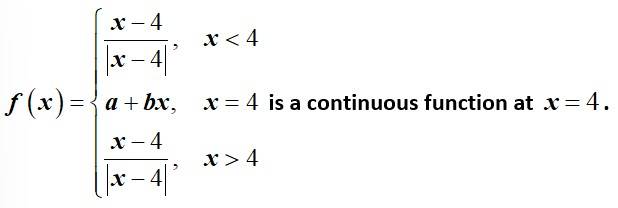
                      l i m x → 4 − f ( x ) = x − 4 | x − 4 | + a = l i m h → 0 4 − h − 4 | 4 − h − 4 | + a                                                                 = l i m h → 0 − h h + a = − 1 + a                       l i m x → 4 f ( x ) = a + b                         l i m x → 4 + f ( x ) = x − 4 | x − 4 | + b = l i m h → 0 4 + h − 4 | 4 + h − 4 | + b                                                                 = l i m h → 0 h h + b = 1 + b A s     t h e     f u n c t i o n     i s     c o n t i n u o u s     a t     x = 4 . ∴       l i m x → 4 − f ( x ) = l i m x → 4 f ( x ) = l i m x → 4 + f ( x )                     − 1 + a = a + b = 1 + b ∴                 − 1 + a = a + b         ⇒         b = − 1                               1 + b = a + b         ⇒         a = 1 H e n c e ,     t h e     v a l u e     o f     a = 1     a n d     b = − 1 .

Thumbs Up IconUpvote Thumbs Down Icon
New answer posted•a year ago
A
a year ago

This is a Short Answer Type Questions as classified in NCERT Exemplar

Sol:

                      l i m x → 0 − f ( x ) = x | x | + 2 x 2 = l i m h → 0 0 − h | 0 − h | + 2 ( 0 − h ) 2                                                                 = l i m h → 0 − h h + 2 h 2 = l i m h → 0 − h h ( 1 + 2 h )                                                                 = l i m h → 0 − 1 1 + 2 h = − 1 1 + 2 ( 0 ) = − 1                         l i m x → 0 + f ( x ) = x | x | + 2 x 2 = l i m h → 0 0 + h | 0 + h | + 2 ( 0 + h ) 2                                                                 = l i m h → 0 h h + 2 h 2 = l i m h → 0 h h ( 1 + 2 h ) = 1 1 + 0 = 1 A s       l i m x → 0 − f ( x ) ≠ l i m x → 0 + f ( x ) H e n c e ,     f ( x )     i s     d i s c o n t i n u o u s     a t     x = 0     r e g a r d l e s s     t h e     c h o i c e     o f     k .

Thumbs Up IconUpvote Thumbs Down Icon
New answer posted•a year ago
A
a year ago

This is a Short Answer Type Questions as classified in NCERT Exemplar

Sol:

                            l i m x → 0 − f ( x ) = 1 − c o s k x x s i n x = l i m h → 0 1 − c o s k ( 0 − h ) ( 0 − h ) s i n ( 0 − h )                                                                         = l i m h → 0 1 − c o s ( − k h ) ( − h ) s i n ( − h ) = l i m h → 0 1 − c o s k h h s i n h                   [ ?     s i n ( − θ ) = − s i n θ           c o s ( − θ ) = c o s θ ]                                                                         = l i m h → 0 2 s i n 2 k h 2 h s i n h = l i m h → 0 k h → 0 2 s i n k h 2 k h 2 × k h 2 × s i n k h 2 k h 2 × k h 2 . 1 h . s i n h h . h                                                                         = 2 . 1 . k h 2 . 1 . k h 2 . 1 h 2 . 1                                             [ l i m h → 0 s i n h h = 1     a n d     l i m k h → 0 s i n k h k h = 1 ]                                                                         = k 2 2                         l i m x → 0 f ( x ) = 1 2 ∴                       l i m x → 0 − f ( x ) = l i m x → 0 f ( x ) ∴                                                         k 2 2 = 1 2               ⇒           k 2 = 1         ⇒ k = ± 1 H e n c e ,     t h e     v a l u e     o f     k     i s     ± 1 .

Thumbs Up IconUpvote Thumbs Down Icon
New answer posted•a year ago
A
a year ago

This is a Short Answer Type Questions as classified in NCERT Exemplar

Sol:

Thumbs Up IconUpvote Thumbs Down Icon
New answer posted•a year ago
A
a year ago

This is a Short Answer Type Questions as classified in NCERT Exemplar

Sol:

f(x)=2x+2−164x−16=22.2x−16(2x)2−(4)2=4(2x−4)(2x−4)(2x+4)                                  =4(2x+4)              limx→2−f(x)=limh→04(22−h+4)=422+4=44+4=48=12            limx→2f(x)=kAs  the  function  is  continuous  at  x=2∴           limx→2−f(x)=limx→2f(x)∴                            k=12Hence,  the  value  of  k  is  12.

Thumbs Up IconUpvote Thumbs Down Icon
New answer posted•a year ago
A
a year ago

This is a Short Answer Type Questions as classified in NCERT Exemplar

Sol:

                        l i m x → 5 f ( x ) = 3 x − 8 = l i m h → 0 3 ( 5 − h ) − 8 = 1 5 − 8 = 7                         l i m x → 5 + f ( x ) = 2 k A s     t h e     f u n c t i o n     i s     c o n t i n u o u s     a t     x = 5 ∴                       l i m x → 1 − f ( x ) = l i m x → 5 + f ( x ) ∴                                                         7 = 2 k         ⇒         k = 7 2 A s       l i m x → 1 − f ( x ) = l i m x → 1 + f ( x ) = l i m x → 1 f ( x ) H e n c e ,     t h e     v a l u e     o f     k     i s     7 2 .

Thumbs Up IconUpvote Thumbs Down Icon