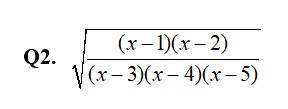
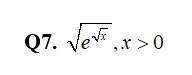
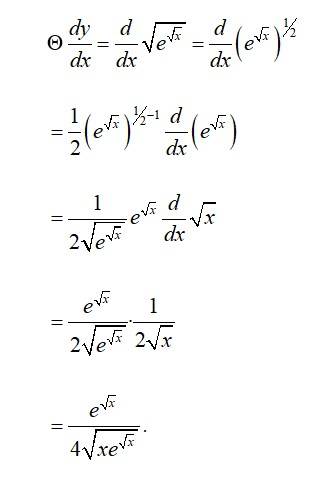
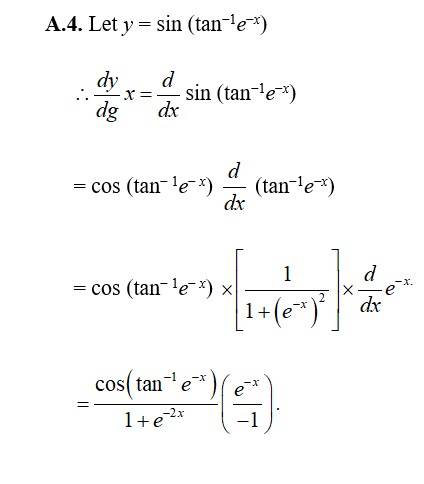
Continuity and Differentiability

Get insights from 335 questions on Continuity and Differentiability, answered by students, alumni, and experts. You may also ask and answer any question you like about Continuity and Differentiability

  • 335

    Questions

  • 0

    Discussions

  • 0

    Active Users

  • 0

    Followers

Have a question about Continuity and Differentiability? Ask our experts

Ask Your Question

Keep it short & simple. Type complete word. Avoid abusive language.

New answer posted•a year ago
A
a year ago

71. Let y = (log x) cos x

Taking loge on both sides,

Log y = cos x [log (log x)]

Differentiating w r t ‘x’ we get,

1ydydx=cosxddx log (log x) +log (log x) dcosxdx

=cosx×1logx×d (logx)dx + log (log x) (- sin x)

=cogxxlogx - sin x log (log x)

= dydx=y [cosxxlog2−sinx·log (logx)].

⇒dydx= (logx)cosx [cosxxlogx−sinx·log (logx)]

Thumbs Up IconUpvote Thumbs Down Icon
New answer posted•a year ago
A
a year ago

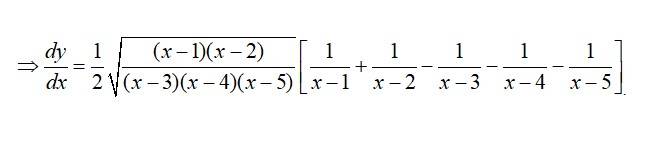
70. Kindly go through the solution

Putting value of y from the above we get,
Thumbs Up IconUpvote Thumbs Down Icon
New answer posted•a year ago
A
a year ago

69. Let y = cos x cos 2x cos 3x _____ (i)

Taking loge on bolk sides.

logy = log (cos x) + log (cos 2x + log (cos 3x)

= log (cos x) + log (cos 2x) + log (cos 3x)

Differentiating w r t ‘x’

1ydydx=1cosxddxcosx+1cos2xddxcos2x+1cos3xddxcos3x.

= (−sinx)cosx+ (−sin2x)cos2xddx (2x)+ (−sin3x)cos3xd (3x)dx

= - tan x-2 tan 2x- 3 tan 3x.

⇒dydx = y [- tan x- 2 tan 2x- 3 tan 3x]

Putting value of y from (i) we get,

=dydx= - cos x cos 2x co

...Read more

Thumbs Up IconUpvote Thumbs Down Icon
New answer posted•a year ago
A
a year ago

68. Let y = cos (log x + ex)

∴dydx=ddxcos (log x + ex)

= - sin (log x + ex) ddx (log x + ex)

= - sin (log x + ex)   [1x+ex]

=− [1x+ex] sin (log x + ex).

Thumbs Up IconUpvote Thumbs Down Icon
New answer posted•a year ago
A
a year ago

67. y=cotxlogx

∴dydx=logxddacox−cosxddxlogx [logx]2

=−sinx·logx−cosx×1x [logx]2.

=− [xsinxlogx−cosx]x (logx)2.

Thumbs Up IconUpvote Thumbs Down Icon
New answer posted•a year ago
A
a year ago

 66. Let y = log (log x)

∴dydx=1logxddx (logx)

=1logx×1x

dydx=1xlogx

Thumbs Up IconUpvote Thumbs Down Icon
New answer posted•a year ago
A
a year ago

65. Kindly go through the solution

Thumbs Up IconUpvote Thumbs Down Icon
New answer posted•a year ago
A
a year ago

64. Let y = ex + ex2 + … + ex5.

∴dydx=ddx (ex + ex2 + ex3 + ex4 + ex5).

=dexdx+dex2dx+dex3dx+ddxex4+ddxex5.

=ex+ex2dx2dx+ex3dx3dx+ex4dx4dx+ex5dx5dx.

= ex + 2x ex2 + 3x2ex3 + 4x3ex4 + 5eex4

Thumbs Up IconUpvote Thumbs Down Icon
New answer posted•a year ago
A
a year ago

63. Let y = log (cos ex).

∴dydx=ddx log (cos ex)

=1cosexddx (cos ex)

= - sinexcosexdex.dx

= -ex [tan ex]

Thumbs Up IconUpvote Thumbs Down Icon
New answer posted•a year ago
A
a year ago

62. Kindly go through the solution

Thumbs Up IconUpvote Thumbs Down Icon