
Data Interpretation
Get insights from 221 questions on Data Interpretation, answered by students, alumni, and experts. You may also ask and answer any question you like about Data Interpretation
- 221
Questions
- 0
Discussions
- 9
Active Users
- 0
Followers
Have a question about Data Interpretation? Ask our experts
Keep it short & simple. Type complete word. Avoid abusive language.
I. A resort has 6 rooms – R1, R2, R3, R4, R5 and R6.
Rooms ‘R1’ and ‘R3’ can accommodate only two persons each; the rest can accommodate only one person each.
<!-- [if !supportLists]-->II. Eight persons P1, P2, P3, P4, P5, P6, P7 and P8 are to live in these rooms. P2, P5, and P8 are females while the rest are males. Persons of different genders can’t be put together in the same room.
<!-- [if !supportLists]-->III. P5 man is willing to live in room R3 or R6.
<!-- [if !supportLists]-->IV. P1 wants to live alone but doesn’t want to live in room R2 or R4.
<!-- [if !supportLists]-->V. P4 needs a partner but is not ready to live with either P6 or P7.
<!-- [if !supportLists]-->VI. P8 does not want to share her room.
<!-- [if !supportLists]-->VII. P6 is willing to live in R6
P4 will live in which of the following rooms?
I. A resort has 6 rooms – R1, R2, R3, R4, R5 and R6.
Rooms ‘R1’ and ‘R3’ can accommodate only two persons each; the rest can accommodate only one person each.
<!-- [if !supportLists]-->II. Eight persons P1, P2, P3, P4, P5, P6, P7 and P8 are to live in these rooms. P2, P5, and P8 are females while the rest are males. Persons of different genders can’t be put together in the same room.
<!-- [if !supportLists]-->III. P5 man is willing to live in room R3 or R6.
<!-- [if !supportLists]-->IV. P1 wants to live alone but doesn’t want to live in room R2 or R4.
<!-- [if !supportLists]-->V. P4 needs a partner but is not ready to live with either P6 or P7.
<!-- [if !supportLists]-->VI. P8 does not want to share her room.
<!-- [if !supportLists]-->VII. P6 is willing to live in R6
Which of the given statements is not needed to complete the living arrangement so far?
Directions for questions: Read the information carefully and answer the questions given below.
<!-- [if !supportLists]-->I. A resort has 6 rooms – R1, R2, R3, R4, R5 and R6.
Rooms ‘R1’ and ‘R3’ can accommodate only two persons each; the rest can accommodate only one person each.
<!-- [if !supportLists]-->II. Eight persons P1, P2, P3, P4, P5, P6, P7 and P8 are to live in these rooms. P2, P5, and P8 are females while the rest are males. Persons of different genders can’t be put together in the same room.
<!-- [if !supportLists]-->III. P5 man is willing to live in room R3 or R6.
<!-- [if !supportLists]-->IV. P1 wants to live alone but doesn’t want to live in room R2 or R4.
<!-- [if !supportLists]-->V. P4 needs a partner but is not ready to live with either P6 or P7.
<!-- [if !supportLists]-->VI. P8 does not want to share her room.
<!-- [if !supportLists]-->VII. P6 is willing to live in R6
Who among the following will live in room R5?
Room | Person |
R1 | - |
R2 | - |
R3 | - |
R4 | - |
R5 | - |
R6 | - |
P2, P5 and P8 are women
From (III) and the other given facts, two women will live in room R3. From (III) and (VI), P1 will live in room R5.
From (VII) & (III) P5 will be in R3 and P6 will be R6 Hence P2 and P5 will live in room R3. Now the whole scene looks like this:
Room | Perso |
| n |
R1 | P4, P3 |
R2 | P8/P7 |
R3 | P2, P5 |
R4 | P8/P7 |
R5 | P1 |
R6 | P6 |
 Upvote

Accountant, Manager, Sweeper, CEO, Software engineer and Technician are sitting around a circle facing the centre for a forest meeting. Accountant, who is to the immediate left of CEO, is not the neighbor of Sweeper. Software engineer, the neighbour of Sweeper is not the neighbour of Manager. Technician is between CEO and Manager.
What is the position of Software engineer?
Directions for questions: Read the information carefully and answer the questions given below.
Accountant, Manager, Sweeper, CEO, Software engineer and Technician are sitting around a circle facing the centre for a forest meeting. Accountant, who is to the immediate left of CEO, is not the neighbor of Sweeper. Software engineer, the neighbour of Sweeper is not the neighbour of Manager. Technician is between CEO and Manager.
Which of the following is true?

On the occasion of Janmasthmi, four persons – A1, A2, A3 and A4 bought certain dozens of bananas for their respective houses. Their wives also went to the market and bought bananas. Further it is known that
<!-- [if !supportLists]-->I. The wives are W1, W2, W3 and W4
<!-- [if !supportLists]-->II. A1 bought as many bananas as his wife, A2 bought twice as many as his wife, A3 bought three times as many as his wife, and A4 bought four times as his wife.
<!-- [if !supportLists]-->III. W1 bought 2 dozens bananas, W2 bought 3, W3 and W4 bought 4 and 5 dozens of bananas respectively.
<!-- [if !supportLists]-->IV. The four couples bought 44 dozen of bananas between them.
Who is the wife of A4 among the four females?
On the occasion of Janmasthmi, four persons – A1, A2, A3 and A4 bought certain dozens of bananas for their respective houses. Their wives also went to the market and bought bananas. Further it is known that
<!-- [if !supportLists]-->I. The wives are W1, W2, W3 and W4
<!-- [if !supportLists]-->II. <!--[endif]-->A1 bought as many bananas as his wife, A2 bought twice as many as his wife, A3 bought three times as many as his wife, and A4 bought four times as his wife.
<!-- [if !supportLists]-->III. <!--[endif]-->W1 bought 2 dozens bananas, W2 bought 3, W3 and W4 bought 4 and 5 dozens of bananas respectively.
<!-- [if !supportLists]-->IV. The four couples bought 44 dozen of bananas between them.
Who brought the maximum number of bananas among the four men?
Directions for questions: Read the information carefully and answer the questions given below.
On the occasion of Janmasthmi, four persons – A1, A2, A3 and A4 bought certain dozens of bananas for their respective houses. Their wives also went to the market and bought bananas. Further it is known that
<!-- [if !supportLists]-->I. The wives are W1, W2, W3 and W4
<!-- [if !supportLists]-->II. <!--[endif]-->A1 bought as many bananas as his wife, A2 bought twice as many as his wife, A3 bought three times as many as his wife, and A4 bought four times as his wife.
<!-- [if !supportLists]-->III. <!--[endif]-->W1 bought 2 dozens bananas, W2 bought 3, W3 and W4 bought 4 and 5 dozens of bananas respectively.
<!-- [if !supportLists]-->IV. The four couples bought 44 dozen of bananas between them.
Which two husbands bought the same number of bananas?
Let us denote, the dozens of Bananas bought by A4's wife by a1, a2 by A3's wife, a3 by A2's wife and a4 by A1's wife. We prepare the table given below Bananas bought:
A1 = a4 A1's wife = a4
A2 = 2a3 A2
Upvote Six cities of India – Jammu, Kolkata, Lucknow, Mumbai, Nagpur and Orcha are connected by one way and two way highways as indicated in the diagram given below. The arrow head indicates the direction in which the traffic is allowed to flow. No other route is available except those given in the diagram.
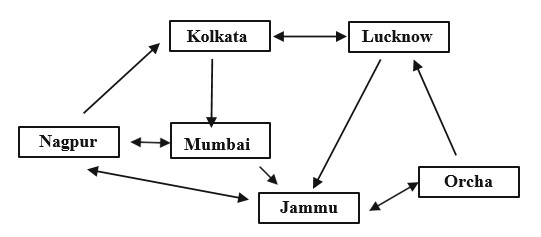
What is the least possible number of cities, a person has to pass through, while travelling from Mumbai city to Lucknow city?
Six cities of India – Jammu, Kolkata, Lucknow, Mumbai, Nagpur and Orcha are connected by one way and two way highways as indicated in the diagram given below. The arrow head indicates the direction in which the traffic is allowed to flow. No other route is available except those given in the diagram.
What is the least possible number of cities, a person has to pass through, while travelling from Mumbai city to Lucknow city?
Following are the possible ways from city Mumbai to city Lucknow.
I. Mumbai – Nagpur – Kolkata –Lucknow
II. Mumbai – Jammu – Orcha – Lucknow
III. Mumbai – Nagpur – Jammu – Orcha – Lucknow
The least possible number of cities is two.
Upvote Six cities of India – Jammu, Kolkata, Lucknow, Mumbai, Nagpur and Orcha are connected by one way and two way highways as indicated in the diagram given below. The arrow head indicates the direction in which the traffic is allowed to flow. No other route is available except those given in the diagram.
For which of the following cities it is not possible for a person to start his journey from the city and pass through all the other cities and come back to the same city, without passing through any city more than once?
Six cities of India – Jammu, Kolkata, Lucknow, Mumbai, Nagpur and Orcha are connected by one way and two way highways as indicated in the diagram given below. The arrow head indicates the direction in which the traffic is allowed to flow. No other route is available except those given in the diagram.
For which of the following cities it is not possible for a person to start his journey from the city and pass through all the other cities and come back to the same city, without passing through any city more than once?
A person can start and return the same city while passing through every city.
So, According to the given data option d is correct
Upvote