
Definite Integrals
Get insights from 36 questions on Definite Integrals, answered by students, alumni, and experts. You may also ask and answer any question you like about Definite Integrals
- 36
Questions
- 0
Discussions
- 0
Active Users
- 0
Followers
Have a question about Definite Integrals? Ask our experts
Keep it short & simple. Type complete word. Avoid abusive language.
I = ∫?⁄?⁄? [cos³x(1+cos x) + sin³x(1+sin x)] dx. Then 24I - 18π = ______.
I = ∫?⁄?⁄? [cos³x(1+cos x) + sin³x(1+sin x)] dx. Then 24I - 18π = ______.
Let J = <!-- [if gte mso 9]><xml>
Let J = <!-- [if gte mso 9]><xml>
In the integral J, substitute x + 1 = t
Now
Hence
 Upvote

If I₁ = ∫₀¹ (1 – x⁴)⁷dx and I₂ = ∫₀¹ (1 – x⁴)⁶dx then (29 I₁)/(4 I₂) is equal to:
If I₁ = ∫₀¹ (1 – x⁴)⁷dx and I₂ = ∫₀¹ (1 – x⁴)⁶dx then (29 I₁)/(4 I₂) is equal to:
I? = ∫? ¹ (1 − x? )? · 1 dx
= (1 - x? )? x|? ¹ - ∫? ¹ 7 (1 - x? )? (-4x³)xdx = -28∫? ¹ (1 − x? )? (1 − x? − 1)dx
I? = −28∫? ¹ (1 − x? )? dx + 28∫? ¹ (1 − x? )? dx
I? = -28I? + 28I?
29I? = 28I?
I? /I? = 28/29 ⇒ (29/4) * (I? /I? ) = (29/4) * (28/29) = 7
Upvote The value of Σi?08 8Ci(8Cr+1 - 8Cr) equals ____________
The value of Σi?08 8Ci(8Cr+1 - 8Cr) equals ____________
? C? +? C? =? C?
Σ (from r=0 to 3)? C? =? C? +? C? +? C? +? C?
=? C? +? C? +? C? +? C?
= ¹²C? = (12×11×10)/6 = 220
Upvote The value of ∫₀^(π/2) |xsin²x - 1/2|dx is equal to aπ/b where a, b are co-prime numbers, then a.b is ____________
The value of ∫₀^(π/2) |xsin²x - 1/2|dx is equal to aπ/b where a, b are co-prime numbers, then a.b is ____________
∫ (from 0 to π/2) (x/2)|cos (2x)|dx
∫ (from 0 to π/4) (x/2)cos (2x)dx - ∫ (from π/4 to π/2) (x/2)cos (2x)dx
= [x sin (2x)/4 - ∫sin (2x)/4 dx] (from 0 to π/4) - [x sin (2x)/4 - ∫sin (2x)/4 dx] (from π/4 to π/2)
= [x sin (2x)/4 + cos (2x)/8] (from 0 to π/4) - [x sin (2x)/4 + cos (2x)/8] (from π/4 to π/2)
Upvote <!-- [if gte mso 9]><xml>
<!-- [if gte mso 9]><xml>
If ∫₀^(π/2) (sin³x)e⁻sin²ˣdx = α - (β/e)∫₀¹ √t eᵗdt, then α + β is equal to ………
If ∫₀^(π/2) (sin³x)e⁻sin²ˣdx = α - (β/e)∫₀¹ √t eᵗdt, then α + β is equal to ………
∫? ^ (π/2) sin³x e? sin²? dx
=∫? ^ (π/2) (1−cos²x)sinx e? (¹? cos²? )dx
=2∫? ^ (π/2) (1−cos²x)sinx e? (¹? cos²? )dx
Let cos²x=t⇒sin2xdx=−dt
=−2∫? (1−t)e? (¹? ) dt/ (−2cosx)
=1/e ∫? e? dt −∫? te? dt
=1/e [e? ]? − [te? −e? ]?
=2e−3∫? ¹ √t e? dt
⇒α=2, β=3
α+β=5
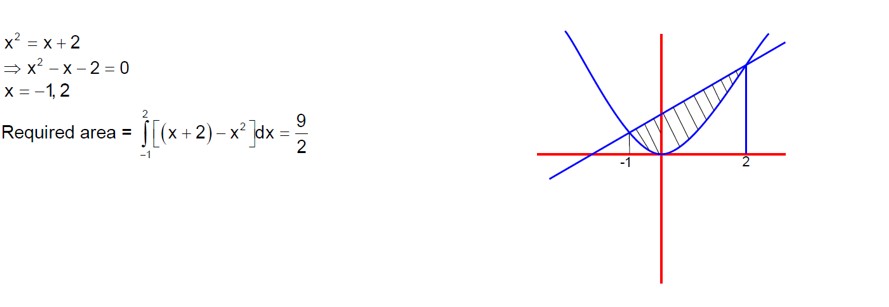
Upvote The area of the region bounded by y - x = 2 and x² = y is equal to :
The area of the region bounded by y - x = 2 and x² = y is equal to :
The value of cos(2π/7) + cos(4π/7) + cos(6π/7) is equal to:
<!-- [if !supportLineBreakNewLine]-->
<!--[endif]-->
The value of cos(2π/7) + cos(4π/7) + cos(6π/7) is equal to:
<!-- [if !supportLineBreakNewLine]-->
<!--[endif]-->
(cos (2π/7) + cos (4π/7) + cos (6π/7)/ (sin (3π/7)cos (π/7) = (2sin (π/7)cos (2π/7) + 2sin (π/7)cos (4π/7) + 2sin (π/7)cos (6π/7)/ (2sin (π/7)
= (sin (3π/7)-sin (π/7) + sin (5π/7)-sin (3π/7) + sin (π)-sin (5π/7)/ (2sin (π/7) = (-sin (π/7)/ (2sin (π/7) = -1/2
Upvote