Exemplar Solution

Get insights from 1.3k questions on Exemplar Solution, answered by students, alumni, and experts. You may also ask and answer any question you like about Exemplar Solution

  • 1.3k

    Questions

  • 0

    Discussions

  • 0

    Active Users

  • 0

    Followers

Have a question about Exemplar Solution? Ask our experts

Ask Your Question

Keep it short & simple. Type complete word. Avoid abusive language.

New answer posted•a year ago
S
a year ago

This is Other Questions as classified in NCERT Exemplar

G i v e n     t h a t         z = 2 − i ( 1 − 2 i ) 2 = 2 − i 1 + 4 i 2 − 4 i = 2 − i 1 − 4 − 4 i                                                             = 2 − i − 3 − 4 i = 2 − i − 3 − 4 i × − 3 + 4 i − 3 + 4 i                                                             = − 6 + 8 i + 3 i − 4 i 2 ( − 3 ) 2 − ( 4 i ) 2 = − 6 + 1 1 i + 4 9 − 1 6 i 2                                                             = − 2 + 1 1 i 9 + 1 6 = − 2 2 5 + 1 1 2 5 i ∴                                               z ¯ = − 2 2 5 − 1 1 2 5 i H e n c e ,                       z ¯ = − 2 2 5 − 1 1 2 5 i

Thumbs Up IconUpvote Thumbs Down Icon
New answer posted•a year ago
S
a year ago

This is a long answer type question as classified in NCERT Exemplar
G i v e n     t h a t     e a c h     e d g e     o f     t h e     c u b o i d     i s     2     u n i t s . ∴     C o o r d i n a t e s     o f     t h e     v e r t i c e s     a r e             A ( 2 , 0 , 0 ) ,     B ( 2 , 2 , 0 ) ,     C ( 0 , 2 , 0 ) ,     D ( 0 , 2 , 2 ) ,     E ( 0 , 0 , 2 ) ,     F ( 2 , 0 , 2 ) ,     G ( 2 , 2 , 2 )     a n d     O ( 0 , 0 , 0 ) .

Thumbs Up IconUpvote Thumbs Down Icon
New answer posted•a year ago
S
a year ago

This is a long answer type question as classified in NCERT Exemplar

Let  the  given  points  are  A(0,−1,−7),  B(2,1,−9),  C(6,5,−13)            AB=(2−0)2+(1+1)2+(−9+7)2=4+4+4=12=23            BC=(6−2)2+(5−1)2+(−13+9)2=16+16+16=48=43            AC=(6−0)2+(5+1)2+(−13+7)2=36+36+36=108=63             23+43=63i.e.,          AB+BC=AC∴                AB:AC=23:63=1:3Hence,  point  A  divides  B  and  C  in  1:3  externally.

Thumbs Up IconUpvote Thumbs Down Icon
New question posted•a year ago
New answer posted•a year ago
S
a year ago

This is a short answer type question as classified in NCERT Exemplar
Given   points are  A(2,3,4),  B(−1,2,−3)  and  C(−4,1,−10)        AB=(2+1)2+(3−2)2+(4+3)2=9+1+49=59        BC=(−1+4)2+(2−1)2+(−3+10)2=9+1+49=59        AC=(2+4)2+(3−1)2+(4+10)2=36+4+196=236=259∴    AB+BC=AC    59+59=259Hence,  A,B  and  C  are  collinear  and  AC:BC=259:59=2:1Hence,  C  divides  AB  is  2:1  externally.

Thumbs Up IconUpvote Thumbs Down Icon
New answer posted•a year ago
S
a year ago

This is a short answer type question as classified in NCERT Exemplar
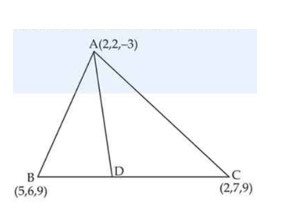
Given  that  AD  is  the   internalbisector   of  ∠A∴    ABAC=BDDC        AB=(5−2)2+(6−2)2+(9+3)2=9+16+144=169=13        AC=(2−2)2+(7−2)2+(9+3)2=0+25+144=169=13∴    ABAC=BDDC=1313        ⇒BD=DC⇒D  is  the  mid point of  BC∴  Coordinates  of  D=(5+22,6+72,9+92)=(72,132,9)Hence,  the  required  coordinates  are  (72,132,9).

Thumbs Up IconUpvote Thumbs Down Icon
New answer posted•a year ago
S
a year ago

This is a short answer type question as classified in NCERT Exemplar

C o o r d i n a t e s     o f     t h e     c e n t r o i d     G = ( 0 , 0 , 0 ) ∴                   0 = x 1 + x 2 + x 3 3                 ⇒ 0 = a − 2 + 4 3             ⇒ a = − 2                       0 = y 1 + y 2 + y 3 3                 ⇒ 0 = 1 + b + 7 3               ⇒ b = − 8 a n d       0 = z 1 + z 2 + z 3 3                   ⇒ 0 = 3 − 5 + c 3                 ⇒ c = 2 H e n c e ,     t h e     r e q u i r e d     v a l u e s     a r e     a = − 2 ,     b = − 8     a n d     c = 2 .

Thumbs Up IconUpvote Thumbs Down Icon
New answer posted•a year ago
S
a year ago

This is a short answer type question as classified in NCERT Exemplar

Let  C  and  D  be  the  points  which  divides  the  given  line  AB into   three  equal  parts.Here,  AC:CB=1:2Let  (x1,y1,z1)  be  the  coordinates  of  C∴         x1=1×5+2×21+2=3     and    y1=1×−8+2×11+2=−2            z1=1×3+2×−31+2=−1     So,  C=(3,−2,−1)Now  D  is  mid point of  CBLet  (x2,y2,z2)  be  the  coordinates  of  D∴         x2=3+52=4     and    y2=−8−22=−5            z2=3−12=1           So,  D=(4,−5,1)Hence,  the  required  coordinates  are  C(3,−2,−1)  and  D(4,−5,1).

Thumbs Up IconUpvote Thumbs Down Icon
New answer posted•a year ago
S
a year ago

This is a short answer type question as classified in NCERT Exemplar

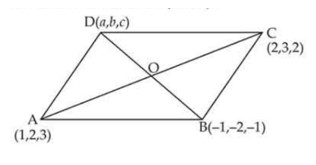
Let  the  coordinates  of  D  be  (a,b,c)We  know  that  the  diagonals  of  a   parallelogram bisect   each  other.∴  Mid  of  AC  i.e.,  O=(1+22,2+32,3+22)=(32,52,52)     Mid  of  BD  i.e.,  O=(a−12,b−22,c−12)Equating  the  corresponding  coordinate,  we  have                       a−12=32      ⇒a=4                       b−22=52      ⇒b=7and                c−12=52      ⇒c=6Hence,  the  coordinates  of  D  (4,7,6).

Thumbs Up IconUpvote Thumbs Down Icon
New answer posted•a year ago
S
a year ago

This is a short answer type question as classified in NCERT Exemplar

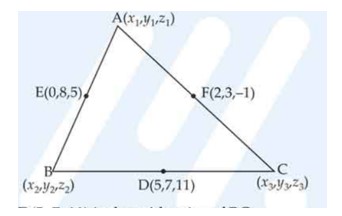
Let  the  coordinates  of  the  vertices  of  ΔABC  beA(x1,y1,z1),  B(x2,y2,z2)  and  C(x3,y3,z3)  respectively. Since D(5,7,11)  mid point of  BC∴        5=x2+x32       ⇒x2+x3=10                                   …(i)           7=y2+y32       ⇒y2+y3=14                                …(ii)         11=z2+z32       ⇒z2+z3=22                                  …(iii)E(0,8,5)  is  the  mid point of  AB∴        0=x1+x22       ⇒x1+x2=0                                    …(iv)           8=y1+y22       ⇒y1+y2=16                                  …(v)           5=z1+z22       ⇒z1+z2=10                                     …(vi)

Similarly,  F(2,3,−1)  is  the  mid point of  AC∴         2=x1+x32       ⇒x1+x3=4                                    …(vii)            3=y1+y32       ⇒y1+y3=6                                   …(viii)         −1=z1+z32       ⇒z1+z3=−2                                    …(ix)Adding  eq.(i),(iv)  and  (vii)  we  get,     2x1+2x2+2x3=10+0+4⇒        x1+x2+x3=7                                                                …(x)Subtracting  (i)  from  (x)  we  get,              x1=7−10=−3Subtracting  (iv)  from  (x)  we  get,              x3=7−0=7Subtracting  (vii)  from  (x)  we  get,              x2=7−4=3Adding  eq.(ii),(v)  and  (viii)  we  get,     2(y1+y2+y3)=14+16+6⇒       y1+y2+y3=18                                                              …(xi)Subtracting  (ii)  from  (xi)  we  get,              y1=18−14=4Subtracting  (v)  from  (xi)  we  get,              y3=18−16=2Subtracting  (viii)  from  (xi)  we  get,              y2=18−6=12Similarly,  Adding  eq.(iii),(vi)  and  (ix)  we  get,     2(z1+z2+z3)=22+10−2⇒       z1+z2+z3=15                                                              …(xii)Subtracting  (iii)  from  (xii)  we  get,              z1=15−22=−7Subtracting  (vi)  from  (xii)  we  get,              z3=15−10=5Subtractin<

...Read more

Thumbs Up IconUpvote Thumbs Down Icon